


Wydawcy
Katalog tematyczny
- Archeologia (109)
- Ekonomia, finanse, business (13704)
- Filozofia (1445)
- Historia (3040)
- Języki i językoznawstwo (2356)
- Lifestyle, hobby i rozrywka (475)
- Medycyna (9704)
- Nauki humanistyczne (4)
- Nauki o Ziemi i środowisku (2638)
- Nauki ścisłe (20412)
- Nauki społeczne (8486)
- Nauki techniczne (13450)
- Prawo (1696)
- Publikacje informacyjne i interdyscyplinarne (1288)
- Religia i wierzenia (917)
- Technika komputerowa (4067)
- Zdrowie, relacje międzyludzkie i rozwój osobisty (657)





Informacje szczegółowe o książce
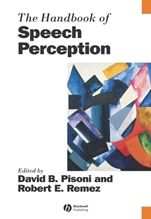
The Handbook of Speech Perception
ISBN 9781405176415
Autor: David Pisoni, Robert Remez
Wydawca: Wiley
Dostępność: 3-6 tygodni
Cena: 322,35 zł
Przed złożeniem zamówienia prosimy o kontakt mailowy celem potwierdzenia ceny.
ISBN13: |
9781405176415 |
ISBN10: |
1405176415 |
Autor: |
David Pisoni, Robert Remez |
Oprawa: |
Paperback |
Rok Wydania: |
2007-08-10 |
Ilość stron: |
722 |
Wymiary: |
243x172 |
Tematy: |
CF |
Speech perception has emerged as a major field of research over the past two decades, as enormous theoretical and technical changes have occurred. The study of speech perception has broadened in scope to encompass and appeal to a wide variety of disciplines including phonetics, auditory and speech science, cognitive science, experimental psychology, computer science, and informatics, among others. The Handbook of Speech Perception is a collection of seminal articles that offer a summary of the technical and theoretical accomplishments in this vital area of research on language processing.
The Handbook of Speech Perception provides a comprehensive examination of the field and is an essential addition to a growing understanding and appreciation of its far–reaching theoretical and clinical relevance.
List of Contributors.
Preface: Michael Studdert–Kennedy (Haskins Laboratories).
Introduction: David B. Pisoni (Indiana University) and Robert E. Remez (Barnard College).
Part I: Sensing Speech.
1. Acoustic Analysis and Synthesis of Speech: James R. Sawusch (University at Buffalo).
2. Perceptual Organization of Speech: Robert E. Remez (Barnard College).
3. Primacy of Multimodal Speech Perception: Lawrence D. Rosenblum (University of California, Riverside).
4. Phonetic Processing by the Speech Perceiving Brain: Lynne E. Bernstein (House Ear Institute).
5. Event–related Evoked Potentials (ERPs) in Speech Perception: Dennis Molfese, Alexandra P. Fonaryova Key, Mandy J. Maguire, Guy O. Dove and Victoria J. Molfese (all University of Louisville).
Part II: Perception of Linguistic Properties.
6. Features in Speech Perception and Lexical Access: Kenneth N. Stevens (Massachusetts Institute of Technology).
7. Speech Perception and Phonological Contrast: Edward Flemming (Stanford University).
8. Acoustic Cues to the Perception of Segmental Phonemes: Lawrence J. Raphael (Adelphi University).
9. Clear Speech: Rosalie M. Uchanski (CID at Washington University School of Medicine).
10. Perception of Intonation: Jacqueline Vaissiere (Laboratoire de Phonetique et de Phonologique, Paris).
11. Lexical Stress: Anne C. Cutler (Max Planck Institute for Psycholinguistics, Nijmegen, The Netherlands).
12. Slips of the Ear: Z. S. Bond (Ohio University).
Part III: Perception of Indexical Properties.
13. Perception of Dialect Variation: Cynthia Clopper and David B. Pisoni (both Indiana University).
14. Perception of Voice Quality: Jody Kreiman (UCLA), Diana Vanlancker–Sidtis (New York University) and Bruce R. Gerratt (UCLA).
15. Speaker Normalization in Speech Perception: Keith A. Johnson (Ohio State University).
16. Perceptual Integration of Linguistic and Non–Linguistic Properties of Speech: Lynne C. Nygaard (Emory University).
Part IV: Speech Perception by Special Listeners.
17. Speech Perception in Infants: Derek M. Houston (Indiana University School of Medicine).
18. Speech Perception in Childhood: Amanda C. Walley (University of Alabama, Birmingham).
19. Age–related Changes in Spoken Word Recognition: Mitchell S. Sommers (Washington University).
20. Speech Perception in Deaf Children with Cochlear Implants: David B. Pisoni (Indiana University).
21. Speech Perception following Focal Brain Injury: William Badacker (Johns Hopkins University).
22. Cross–Language Speech Perception: Nuria Sebastian–Galles (Parc Cientific de Barcelona Hospital de San Joan de Déu).
23. Speech Perception in Specific Language Impairment: Susan Ellis Weismer (University of Wisconsin, Madison).
Part V: Recognition of Spoken Words.
24. Spoken Word Recognition: The Challenge of Variation: Paul A. Luce and Conor T. McLennan (State University of New York, Buffalo).
25. Probabilistic Phonotactics in Spoken Word Recognition: Edward T. Auer, Jr. (House Ear Institute) and Paul A. Luce (State University of New York, Buffalo).
Part VI: Theoretical Perspectives.
26. The Relation of Speech Perception and Speech Production: Carol A. Fowler and Bruno Galantucci (both Haskins Laboratories).
27. A Neuroethological Perspective on the Perception of Vocal Communication Signals: Timothy Gentner (University of Chicago) and Gregory F. Ball (Johns Hopkins University).
Index
David B. Pisoni is Chancellor s Professor of Psychology and Cognitive Science and Adjunct Professor of Linguistics at Indiana University in Bloomington. He is also an Adjunct Professor of Otolaryngology, Head and Neck Surgery at the Indiana University School of Medicine. He has published numerous articles on topics such as speech synthesis, speech perception and spoken word recognition, and acoustic phonetics in a wide variety of scientific journals including Science, Journal of the Acoustical Society of America, Ear and Hearing, and Speech Communication.
Robert E. Remez is Ann Whitney Olin Professor of Psychology at Barnard College, Columbia University. His research on the perception and production of speech has focused on perceptual organization and the identification of individual talkers. His research reports have appeared in a variety of scientific journals including Journal of Experimental Psychology: Human Perception and Performance, Perception & Psychophysics, Psychological Review, Psychological Science, and Science.
"A detailed collection of forward–thinking seminal articles...enables both the student and researcher to understand the most complicated aspects of the subject... If you have to purchase just one core text on speech perception– definitely buy this! ... an exciting, stimulating and informative collection of readings available as a single volume that is excellent value for money. The editors have assembled a wonderful resource." ( Reference Reviews)
Koszyk
Książek w koszyku: 0 szt.
Wartość zakupów: 0,00 zł
Informacje


Kontakt
Gambit
Centrum Oprogramowania
i Szkoleń Sp. z o.o.
Al. Pokoju 29b/22-24
31-564 Kraków
Siedziba Księgarni
ul. Kordylewskiego 1
31-542 Kraków
+48 12 410 5991
+48 12 410 5987
+48 12 410 5989
Subskrypcje
Administratorem danych osobowych jest firma Gambit COiS Sp. z o.o. Na podany adres będzie wysyłany wyłącznie biuletyn informacyjny.
Autoryzacja płatności

Informacje na temat autoryzacji płatności poprzez PayU.

© Copyright 2012: GAMBIT COiS Sp. z o.o. Wszelkie prawa zastrzeżone.
Projekt i wykonanie: Alchemia Studio Reklamy