


Wydawcy
Katalog tematyczny
- Archeologia (109)
- Ekonomia, finanse, business (13704)
- Filozofia (1445)
- Historia (3040)
- Języki i językoznawstwo (2356)
- Lifestyle, hobby i rozrywka (475)
- Medycyna (9704)
- Nauki humanistyczne (4)
- Nauki o Ziemi i środowisku (2638)
- Nauki ścisłe (20412)
- Nauki społeczne (8486)
- Nauki techniczne (13450)
- Prawo (1696)
- Publikacje informacyjne i interdyscyplinarne (1288)
- Religia i wierzenia (917)
- Technika komputerowa (4067)
- Zdrowie, relacje międzyludzkie i rozwój osobisty (657)





Informacje szczegółowe o książce
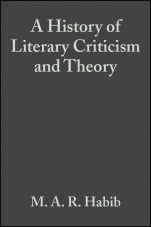
A History of Literary Criticism: From Plato to the Present
ISBN 9781405176088
Autor: M. A. R. Habib
Wydawca: Wiley
Dostępność: 3-6 tygodni
Cena: 288,75 zł
Przed złożeniem zamówienia prosimy o kontakt mailowy celem potwierdzenia ceny.
ISBN13: |
9781405176088 |
ISBN10: |
1405176083 |
Autor: |
M. A. R. Habib |
Oprawa: |
Paperback |
Rok Wydania: |
2007-08-24 |
Ilość stron: |
848 |
Wymiary: |
254x178 |
Tematy: |
CS |
This book is a guide to the history of literary criticism from antiquity to the present day. It not only provides an overview of the major movements, figures, and texts of literary criticism, but also supplies the cultural, historical, and philosophical background which enables students to see them in context. The organization of the book is broadly chronological. Starting with a comprehensive section on classical literary criticism, it shows how the central philosophical principles of Plato and Aristotle not only underlie their specific comments on literature, but also lay out the foundations and categories of much subsequent Western thought. Similarly, for each subsequent period, the book combines back ground information, whether on the philosophy of Locke, the history of the French Revolution, the political theories of Marx and Engels, or Freud′s views on civilization withy coverage of the major figures and texts of literary–critical thought.
Acknowledgements. Abbreviations of Frequently Cited Works. Introduction. Part I: Ancient Greek Criticism . 1. Plato (428–ca. 347 BC). 2. Aristotle (348–322 BC). Part II: The Traditions of Rhetoric . 3. Greek Rhetoric (Protagoras, Gorgias, Antihon, Lysias, Isocrates, Plato, Aristotle). 4. The Hellenistic Period and Roman Rhetoric. (Rhetorica, Cicero, Quintilian). Part III: Greek and Latin Criticism During the Roman Empire . 5. Horace (65–8 BC). 6. Longinus (First Century AD). 7. Neo–Platonism. (Plotinus, Macrobius, Boethius). Part IV: The Medieval Era . 8. The Early Middle Ages (St. Augustine). 9. The Later Middle Ages (Hugh of St. Victor, John of Salisbury, Dante Alighieri, Geoffrey de Hugh of St. Victor, John of Salisbury, Dante Alighieri, Geoffrey de Vinsauf, IBN Rushd (Averroe), St. Thomas Aquinas). 10. Transitions: Medieval Humanism (Giovanni Boccaccio, Christine de Pisan). Part V: The Early Modern Period to the Enlightment. 11. The Early Modern Period (Giambattista Giraldi, Lodovico Castelvetro, Giacopo Mazzoni, Torquato Tasso, Joachim Du Bellay, Pierre de Ronsard, Sir Philip Sidney, Torquato Tasso, Joachim Du Bellay, Pierre de Ronsard, Sir Philip Sidney, George Gascoigne, George Puttenham). 12. Neoclassical Literary Criticism (Pierre Corneille, Nicolas Boileau, John Dryden, Aleancer Pope, Aphra Behn, Samuel Johnson). 13. The Enlightenment (John Locke, Joseph Addison, Giambattista Vico, David Hume, Edmund Burke, Mary Wollstonecraft). Part VI: The Earlier Nineteenth Century and Romanticism . 14. The Kantian System and Kant′s Aesthetics . 15. G. W. F. Hegel (1770–1831). 16. Romanticism (I): Germany and France (Friedrich von Schiller, Friedrich Schleiermacher, Germaine de Stael). 17. Romanticism (II): England and America (William Wordsworth, Samuel Taylor Coleridge, Ralph Waldo Emerson, Edgar Allan Poe). Part VII: The Later Nineteenth Century. 18. Realism and Naturalism (George Eliot, Emile Zola, William Dean Howells, Henry James). 19. Symbolism and Aestheticism (Charles Baudelaire, Walter Pater, Oscar Wilde). 20. The Heterological Thinkers (Arthur Schopenhauer, Friedrich Nietzsche, Henri Bergson, Matthew Arnold). 21. Marxism (Karl Marx, Friedrich Engels, Gyorgy Lukacs, Terry Eaglelton). Part VIII: The Twentieth Century . 22. Psychoanalytic Criticism (Freud and Lacan). 23. Formalisms (Victor Shklovsky, Boris Eichenbaum, Mikhail Bakhtin, Roman Jakobson, John Crowe Ransom, William K. Wimsatt, Monroe C. Beardsley, T. S. Eliot). 24. Structuralism (Ferdinand de Saussure, Roland Barthes). 25. Deconstruction (Jacques Derrida). 26. Feminist Criticism (Virginai Woolf, Simone de Beauvoir, Elaine Showalter, Michele Barrett, Julia Kristeva, Helene Cixous). 27. Reader–Response and Reception Theory (Edmund Husserl, Martin Heidegger, Hans Robert Jauss, Wolfgang Iser, Stanley Fish). 28. Postcolonial Criticism (Frantz Fanon, Edward Said, Gayatri Chakravorty Spivak, Homi Bhabha, Henry Loui Gate, Jr.). 29. New Historicism (Stephen Greenblatt, Michel Foucault). Epilogue. Selective Bibliography. Index
M.A.R. Habib is Associate Professor of English at Rutgers University. He received his D.Phil. in English from Oxford University, and is the author of five books, including Modern Literary Criticism and Theory: A History (Blackwell, 2007).
Winner of a 2006 CHOICE Outstanding Academic Title Award “[A] magnificently comprehensive history of literary criticism. Authoritative, formidable, generous and compassionate … Habib′s achievements are many, but two stand out. The first is the putting of theory into historical perspective and the second is to make connections between criticism and philosophy.” Times Higher Education Supplement "This is a book to be read cover to cover, and those who undertake that happy task will be better informed. They will understand the twin pillars of Western civilization, Hellenism and the Judaic Christian ethic. They will understand the intersections of philosophy, literature, and religion. They will understand Plato, Aristotle, the Age of Enlightenment, Romanticism, and the three great thinkers who forever shifted thought at the beginning of the 20th century: Marx, Freud, and Darwin. Dividing the discussion into eight chronological sections, from ancient Greece to the 20th century, Habib (English, Rutgers Univ.) discusses each period in detail, exploring major critical figures and their works in a way that illuminates, rather than exhausts, the issues they are concerned with. His explorations entice one to read more, and that is the best kind of criticism. Summing Up: Essential. All readers; all levels." CHOICE "Philosophically sophisticated and full of fascinating connections and distinctions ...a monumental achievement." Ron Bush, University of Oxford “Rafey Habib′s History of Literary Criticism , with its substantial grounding in classical texts and its excellent coverage of contemporary criticism and theory, is certain to be as highly regarded as Wimsatt and Brooks′ Literary Criticism: A Short History . Habib′s lucidity and wit will also make his book highly teachable.” Michael Payne, Bucknell University "This huge undertaking offers a comprehensive, expository and lucid account – including close readings of selected formative texts – of the history of literary criticism and theory from the earliest western classics to influential contemporary movements, while also embedding these in their broader social, cultural and philosophical contexts. A major resource – as narrative or as compendium – for students at all levels." Peter Widdowson, University of Gloucestershire "Beginning with Plato and Aristotle, Habib traces how the study of literature evolved in the West. His strength lies in his short segments, which allow readers to absorb the major thoughts of the critics and movements without being overwhelmed. While the book runs nearly 900 pages, it is easy to maneuver. All told, Habib delivers an accessible yet scholarly survey of literary criticism." Ron Ratliff, Kansas State University “ A History of Literary Criticism: From Plato to the Present by M. A. R. Habib is a useful introduction and quick reference … The attention to each writer and their major works is significant and detailed, with major historical interpretive shifts noted.” Studies in English Literature 1500 – 1900 “Best single–volume introduction to Western literary theory … .With its admirably clear explanation of concepts and terminology, [it] admirably fulfils the promise of its title.” Literary Research Guide "Habib′s survey of literary theory and criticism is serious, ambitious, informative and intellectually challenging." Bryn Mawr Classical Review
Koszyk
Książek w koszyku: 0 szt.
Wartość zakupów: 0,00 zł
Informacje


Kontakt
Gambit
Centrum Oprogramowania
i Szkoleń Sp. z o.o.
Al. Pokoju 29b/22-24
31-564 Kraków
Siedziba Księgarni
ul. Kordylewskiego 1
31-542 Kraków
+48 12 410 5991
+48 12 410 5987
+48 12 410 5989
Subskrypcje
Administratorem danych osobowych jest firma Gambit COiS Sp. z o.o. Na podany adres będzie wysyłany wyłącznie biuletyn informacyjny.
Autoryzacja płatności

Informacje na temat autoryzacji płatności poprzez PayU.

© Copyright 2012: GAMBIT COiS Sp. z o.o. Wszelkie prawa zastrzeżone.
Projekt i wykonanie: Alchemia Studio Reklamy