


Wydawcy
Katalog tematyczny
- Archeologia (109)
- Ekonomia, finanse, business (13704)
- Filozofia (1445)
- Historia (3040)
- Języki i językoznawstwo (2356)
- Lifestyle, hobby i rozrywka (475)
- Medycyna (9704)
- Nauki humanistyczne (4)
- Nauki o Ziemi i środowisku (2638)
- Nauki ścisłe (20412)
- Nauki społeczne (8486)
- Nauki techniczne (13450)
- Prawo (1696)
- Publikacje informacyjne i interdyscyplinarne (1288)
- Bibliotekoznawstwo, informacja naukowa i muzealnictwo (433)
- Encyklopedie i leksykony (181)
- Informacja naukowa (88)
- Zagadnienia interdyscyplinarne (391)
- Religia i wierzenia (917)
- Technika komputerowa (4067)
- Zdrowie, relacje międzyludzkie i rozwój osobisty (657)





Informacje szczegółowe o książce
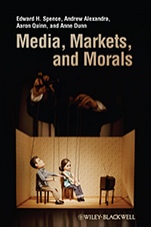
Media, Markets, and Morals
ISBN 9781405175470
Autor: Edward H. Spence, Andrew Alexandra, Aaron Quinn, Anne Dunn
Wydawca: Wiley
Dostępność: 3-6 tygodni
Cena: 374,85 zł
Przed złożeniem zamówienia prosimy o kontakt mailowy celem potwierdzenia ceny.
ISBN13: |
9781405175470 |
ISBN10: |
1405175478 |
Autor: |
Edward H. Spence, Andrew Alexandra, Aaron Quinn, Anne Dunn |
Oprawa: |
Hardback |
Rok Wydania: |
2011-04-08 |
Ilość stron: |
240 |
Wymiary: |
231x161 |
Tematy: |
GR |
The primary aim of the book is to explore and critically analyse and evaluate the ways in which the business of running large national and international media organisations in a free market economy affects, for better or worse, the integrity of the communication of information to the public. Insofar as information can be defined as instructive knowledge which must meet the traditional conditions of truth, justification and belief, the selling of information as another consumer product on the market may in some circumstances be both epistemologically and ethically problematic.
One of the main objectives of the book is to enquire into and analyse how and in what ways, if at all, the commercial and market interests of media organisations, especially as concerns news, may be undermining and in some instances corrupting both the process and the product of the communication of information to the public.
Some of the factors that will be investigated as possibly affecting the integrity of information communicated to the public by the media are convergence of the mediums of communication and the related issue of cross–media ownership, concentration of media ownership in the hands of a few powerful moguls, such as for example, Rupert Murdoch and Berlusconi, and the perceived unholy alliance between journalism on the one hand and advertising and public relations on the other.
A close conceptual analysis of the notions of information and persuasion will be conducted to determine some of the theoretical and practical inherent inconsistencies that may underlie those two concepts and how those inconsistencies are manifested in media practice. Moreover, the book will investigate how these inherent inconsistencies when allowed to covertly undermine the integrity of media communication may constitute the corruption of communication. Infomercials and advertorials, product placements within news content may count as instances of such corruption.
Another objective of the book is to enquire into how, if at all, the aims and methods of business markets generally and media markets specifically can be reconciled with the media s aims and methods of communicating information on matters of public interest. Can the fourth estate be trusted to tell people the truth all the time or even some of the time? Should the public adopt a more sceptical attitude towards the media?
Finally another objective is to examine the concept and practice of self–regulation and whether it provides effective ethical if not legal regulation over the media. If the market constrains on the media are such that the media s ability to communicate information to the public comes under question, then more regulation of the media may be required. Opposed to that suggestion, considerations of censorship come into play. Theoretically, however, insofar as the media s freedom of communication of information to the public is based on the public s right to receive such information, then the media s freedom is constrained and overridden by the public interest. And the argument can be put forward that the public interest opposes information that is tainted by commercial and other interests that are not in the public interest with regard to an informed citizenry.
The book will include relevant cases in each chapter that will illustrate and contextualise the issues examined within a practical and professional setting.
Additionally, the book will, in some of the chapters, include interviews with leading media practitioners that will elicit their views on the issues examined.
Acknowledgments.
1 Introduction.
2 Information Ethics as a Guide for the Media: Old Tricks for New Dogs.
3 The Business of the Media and the Business of the Market.
4 Professionalism in Behavior and Identity.
5 A Conflict of Media Roles: Advertising, Public Relations, and Journalism.
6 Corruption in the Media.
7 Two Dimensions of Photo Manipulation: Correction and Corruption.
8 Promoting, Codifying, and Regulating Ethics.
9 Moral Excellence and Role Models in the Media.
Index.
Dr Edward Spence, Lecturer in Moral Philosophy and Professional Ethics including Media Ethics, Advertising Ethics, Police Ethics, and the Ethics of Fraud Investigation. Spence is also the University s Course Coordinator of Ethics and Legal Studies, a full–fee paying postgraduate course at certificate, diploma and masters level. The number of students taking Spence s subjects and courses is approximately 300 to 400 students per annum, 200 of which are undertaking subjects in communication ethics.
Spence is also a Research Fellow at the Centre for Applied Philosophy and Public Ethics (CAPPE) Canberra, ACT. CAPPE is an Australian Research Council funded special commonwealth centre of excellence hosted jointly by Charles Sturt University, University of Melbourne and the Australian National University.
Andrew Alexandra holds a joint position as Senior Lecturer in the Philosophy Department, and Senior Research Fellow in the Australian Research Council Special Research Centre for Applied Philosophy and Public Ethics (CAPPE), at the University of Melbourne. He has published widely, including in such international journals as History of Philosophy Quarterly, Social Theory and Practice, Professional Ethics, The Southern Journal of Philosophy, Business and Professional Ethics Journal, Ethics and Information Technology, and Agriculture and Human Values. He is the co–author of the books Police Ethics (Allen and Unwin, 1997; 2nd ed. 2004) the standard text on the topic in Australia, and Reasons, Values and Institutions (Tertiary Press, 2002). He is editor of the Australian Journal of Professional and Applied Ethics, the journal of the Australian Association of Professional and Applied Ethics.
ANNE DUNN was appointed as a lecturer at the University of Sydney in July 2001, the second fulltime academic appointment in the new BA Media & Communication, established in 2000. Prior to this appointment Anne had taught journalism at the University of Western Sydney and media production and online media at Charles Sturt University, Bathurst.
Anne has spent more than 20 years working as a presenter, media researcher, journalist, producer and director, for commercial television, for SBS and for the ABC. Her work includes award–winning television and film documentaries. She moved into management at ABC Radio in the early 90s; her roles there included senior Policy Adviser and Radio National Business Manager. She has run her own media research and consultancy business.
Anne s PhD was on policy and audiences in ABC Radio News. Her research interests are public broadcasting, audiences, the introduction of new media, and broadcast journalism education. Anne s teaching experience has been in media and journalistic writing, radio and video journalism, production and broadcasting, online media production, and media law and ethics. She teaches at both undergraduate and postgraduate level and holds a Graduate Certificate in University Teaching and Learning.
She has recently acted as Director of the Media and Communications program for 12 months, and was responsible for setting up the first postgraduate coursework program in Media and Communications. Her postgraduate research students are completing dissertations in intergenerational digital communication, the geography of newsrooms, and relationships between presentation styles and audiences in regional youth radio, among others.
Koszyk
Książek w koszyku: 0 szt.
Wartość zakupów: 0,00 zł
Informacje


Kontakt
Gambit
Centrum Oprogramowania
i Szkoleń Sp. z o.o.
Al. Pokoju 29b/22-24
31-564 Kraków
Siedziba Księgarni
ul. Kordylewskiego 1
31-542 Kraków
+48 12 410 5991
+48 12 410 5987
+48 12 410 5989
Subskrypcje
Administratorem danych osobowych jest firma Gambit COiS Sp. z o.o. Na podany adres będzie wysyłany wyłącznie biuletyn informacyjny.
Autoryzacja płatności

Informacje na temat autoryzacji płatności poprzez PayU.

© Copyright 2012: GAMBIT COiS Sp. z o.o. Wszelkie prawa zastrzeżone.
Projekt i wykonanie: Alchemia Studio Reklamy