


Wydawcy
Katalog tematyczny
- Archeologia (109)
- Ekonomia, finanse, business (13704)
- Filozofia (1445)
- Historia (3040)
- Języki i językoznawstwo (2356)
- Lifestyle, hobby i rozrywka (475)
- Medycyna (9704)
- Nauki humanistyczne (4)
- Nauki o Ziemi i środowisku (2638)
- Nauki ścisłe (20412)
- Nauki społeczne (8486)
- Nauki techniczne (13450)
- Prawo (1696)
- Publikacje informacyjne i interdyscyplinarne (1288)
- Religia i wierzenia (917)
- Technika komputerowa (4067)
- Zdrowie, relacje międzyludzkie i rozwój osobisty (657)





Informacje szczegółowe o książce
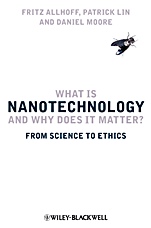
What Is Nanotechnology and Why Does It Matter?: From Science to Ethics
ISBN 9781405175449
Autor: Fritz Allhoff, Patrick Lin, Daniel Moore
Wydawca: Wiley
Dostępność: 3-6 tygodni
Cena: 213,15 zł
Przed złożeniem zamówienia prosimy o kontakt mailowy celem potwierdzenia ceny.
ISBN13: |
9781405175449 |
ISBN10: |
1405175443 |
Autor: |
Fritz Allhoff, Patrick Lin, Daniel Moore |
Oprawa: |
Paperback |
Rok Wydania: |
2010-01-28 |
Ilość stron: |
304 |
Wymiary: |
230x152 |
Tematy: |
HP |
Nanotechnology is an immensely complex area poised to impact virtually all areas of life, ushering in the next technological revolution.
What Is Nanotechnology and Why Does It Matter? provides a balanced understanding of this important emerging technology and the social and ethical issues that come from it. Divided into three sections, the book starts with a substantial introduction to the science of nanotechnology, then attends to basic issues and principles such as risk and regulations needed to evaluate nanotechnology s impact, with the final section closely examining some of the most important areas of application, such as environmental, privacy, military, medical and enhancement, as well as their ethical and social implications.
Designed for students in ethics and technology, What Is Nanotechnology and Why Does It Matter? is also an invaluable resource for policymakers, scientists, and industry executives.
Preface.
Unit I What Is Nanotechnology?
1 The Basics of Nanotechnology.
1.1 Definitions and Scales.
1.2 The Origins of Nanotechnology.
1.3 The Current State of Nanotechnology.
1.4 The Future of Nanotechnology.
1.5 Nanotechnology in Nature and Applications.
2 Tools of the Trade.
2.1 Seeing the Nanoscale.
2.2 Basic Governing Theories.
3 Nanomaterials.
3.1 Formation of Materials.
3.2 Carbon Nanomaterials.
3.3 Inorganic Nanomaterials.
4 Applied Nanotechnology.
4.1 Using Nanomaterials.
4.2 Nanotechnology Computing and Robotics.
4.3 Predicting the Future of Technology.
Unit II Risk, Regulation, and Fairness.
5 Risk and Precaution.
5.1 Risk.
5.2 Cost Benefit Analysis.
5.3 Precautionary Principles.
5.4 Evaluating the Precautionary Principle.
6 Regulating Nanotechnology.
6.1 The Stricter–Law Argument.
6.2 Learning from History.
6.3 Objections to the Stricter–Law Argument.
6.4 An Interim Solution?
6.5 Putting the Pieces Together.
7 Equity and Access.
7.1 Distributive Justice.
7.2 Nanotechnology and the Developing World.
7.3 Water Purification.
7.4 Solar Energy.
7.5 Medicine.
7.6 Nanotechnology, the Developing World, and Distributive Justice.
Unit III Ethical and Social Implications.
8 Environment.
8.1 Society, Technology, and the Environment.
8.2 Environmental Risks of Nanotechnology.
8.3 Nanotechnology Solutions to Environmental Problems.
8.4 Overall Assessments: Risk and Precaution.
9 Military.
9.1 The Military and Technology.
9.2 A Nano–Enabled Military.
9.3 A Nano–Enabled Defense System.
9.4 Ethical Concerns.
10 Privacy.
10.1 Historical and Legal Background.
10.2 Philosophical Foundations.
10.3 Radio Frequency Identity Chips.
10.4 Item–Level Tagging.
10.5 Human Implants.
10.6 RFID–Chipped Identification.
10.7 Is RFID a Threat to Privacy?
11 Medicine.
11.1 The Rise of Nanomedicine.
11.2 Diagnostics and Medical Records.
11.3 Treatment.
11.4 Moving Forward.
12 Human Enhancement.
12.1 What is Human Enhancement?
12.2 Defining Human Enhancement.
12.3 The Therapy Enhancement Distinction.
12.4 Human Enhancement Scenarios.
12.5 Untangling the Issues in Human Enhancement.
12.6 Restricting Human Enhancement Technologies?
13 Conclusion.
13.1 Chapter Summaries.
13.2 Final Thoughts and Future Investigations.
References.
Index.
Fritz Allhoff is Assistant Professor in the Department of Philosophy at Western Michigan University, where he also holds an affiliation with the Mallinson Institute for Science Education. He has held fellowships at the Center for Philosophy of Science at the University of Pittsburgh and the Centre for Applied Philosophy and Public Ethics at the Australian National University. He has edited more than 20 books, including two on the social and ethical implications of nanotechnology.
Patrick Lin is the director of Ethics + Emerging Sciences Group at California Polytechnic State University, San Luis Obispo, and holds academic appointments at Dartmouth College, US Naval Academy and Western Michigan University. He is also lead author of a recent major report funded by the Department of Navy entitled Autonomous Military Robotics: Risk, Ethics, and Design (2008), as well as other publications in technology ethics, including edited anthologies on nanoethics.
Daniel Moore is a research scientist on nanoscale semiconductor solutions for IBM. He served on the Georgia Institute of Technology s honor committee and has received numerous fellowships, including the Molecular Design Institute Fellowship, the GT Nanoscience and Technology Fellowship, the School of Materials Science and Engineering Advanced Publication Award, the NSF STEP Fellowship, and a Sam Nunn Security Fellowship. His professional experience includes nanoscale research in other leading industry laboratories.
However, for the reader looking for general background about nanotechnology and many of its social and ethical issues, the book is worth reading, as long as its arguments are carefully scrutinized and increased understanding of connections among such issues is not expected. (Bioethical Inquiry, 2011)
I highly recommend this book. It is certain that nanotechnology s advance will continue, affecting many facets of our lives. Fritz Allhof, Patrick Lin, and Daniel Moore have provided the best available overview of the many changes that one can expect to see as a result of nanotechnology s continued advances, and the many ethical implications inherent in this advance. While the authors ask many more questions than they answer, they prepare the intellectual landscape for the ethical debates that are certain to take place over the coming years regarding the often–insidious infusion of various manifestations of nanotechnology into our society. (Journal of Military Ethics, 19 April 2012)
"In their recent publication, What is Nanotechnology and Why Does it Matter: From Science to Ethics, the authors Fritz Allhoff, Patrick Lin, and Daniel Moore search for answers to these two questions–questions which, whether directly addressed or not, underlie all scholarly, political, and consumer protection writings on nanotechnology. In this 260 page, thirteen–chapter book, the authors come impressively close to providing satisfying answers to these questions." (Amber Hottes, Nanotechnology Law & Business, Volume 7, Issue 2)
"As with a number of other such books in print, "What is Nanotechnology and why does it Matter?" brings both scientific knowledge and Ethical/Legal/Societal implications (ELSI) to bear. It heralds the profound changes of nanotechnology while attempting to provide an effective way to deliberate ELSI, as nanotechnology unfolds into full development. In seeking to "tame a riot of speculation" [ix], Allhoff, Lin, and Moore reveal much of the complexity of the ongoing discourse on this matter, leaving quandary on multiple related issues. The tripartite layout of the book demarcates particular areas of expertise represented by the individual authors, in an unusual collaboration that brings distinctive breadth to a relatively well–published area of inquiry." (Rosalyn W. Berne, The Journal of Philosophy, Science & Law, Volume 11, 10 October 2011)
"The book is well–suited to be used either as a coherent text for introductory courses focused specifically on nanotechnology, or used as stand–alone chapters that can be selected to augment and supplement readings in a wide range of courses in fields such as public policy, engineering, sociology, or philosophy of science. The highly interdisciplinary perspective offered in this book should also serve as a model of how scholars can effectively collaborate across fields in ways that break down obstacles and connect findings across disciplines that are all–too–often isolated." (Evan S. Michelson, Science and Public Policy, 2011)
"Overall What is Nanotechnology and Why does it Matter? From Science to Ethics makes an important contribution to the literature as it offers an overview of the nature and implications of nanotechnology. Scientists, researchers, students, industry executives and policymakers will find this volume extremely informative and useful. As advancements in nanotechnology will take place, further dialogues and debates are needed to move nano–products responsibly into the market." (Fabrice Jotterand, International Journal of Applied Philosophy,2010)
"Undoubtedly, reading this book will stimulate a great deal of discussion, which is, perhaps, its chief merit. From this viewpoint the great breadth of coverage is a definite advantage, because it ensures that there is a great variety of food for thought in the content." (Nanotechnology Perceptions, 1 November 2010)
"This book was very carefully constructed. Painstaking internal cross–reference refer the reader to fuller discussions of topics in other chapters. Nearly every chapter, at the start and conclusion, includes a few sentences on scope." (Nanotechnology Law & Business, summer 2010)
Koszyk
Książek w koszyku: 0 szt.
Wartość zakupów: 0,00 zł
Informacje


Kontakt
Gambit
Centrum Oprogramowania
i Szkoleń Sp. z o.o.
Al. Pokoju 29b/22-24
31-564 Kraków
Siedziba Księgarni
ul. Kordylewskiego 1
31-542 Kraków
+48 12 410 5991
+48 12 410 5987
+48 12 410 5989
Subskrypcje
Administratorem danych osobowych jest firma Gambit COiS Sp. z o.o. Na podany adres będzie wysyłany wyłącznie biuletyn informacyjny.
Autoryzacja płatności

Informacje na temat autoryzacji płatności poprzez PayU.

© Copyright 2012: GAMBIT COiS Sp. z o.o. Wszelkie prawa zastrzeżone.
Projekt i wykonanie: Alchemia Studio Reklamy