


Wydawcy
Katalog tematyczny
- Archeologia (109)
- Ekonomia, finanse, business (13704)
- Filozofia (1445)
- Historia (3040)
- Języki i językoznawstwo (2356)
- Lifestyle, hobby i rozrywka (475)
- Medycyna (9704)
- Nauki humanistyczne (4)
- Nauki o Ziemi i środowisku (2638)
- Nauki ścisłe (20412)
- Nauki społeczne (8486)
- Nauki techniczne (13450)
- Prawo (1696)
- Publikacje informacyjne i interdyscyplinarne (1288)
- Religia i wierzenia (917)
- Technika komputerowa (4067)
- Zdrowie, relacje międzyludzkie i rozwój osobisty (657)





Informacje szczegółowe o książce
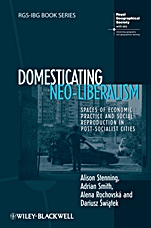
Domesticating Neo–Liberalism: Spaces of Economic Practice and Social Reproduction in Post–Socialist Cities
ISBN 9781405169912
Autor: Alison Stenning, Adrian Smith, Alena Rochovská, Dariusz Świątek
Wydawca: Wiley
Dostępność: 3-6 tygodni
Cena: 368,55 zł
Przed złożeniem zamówienia prosimy o kontakt mailowy celem potwierdzenia ceny.
ISBN13: |
9781405169912 |
ISBN10: |
1405169915 |
Autor: |
Alison Stenning, Adrian Smith, Alena Rochovská, Dariusz Świątek |
Oprawa: |
Hardback |
Rok Wydania: |
2010-07-30 |
Ilość stron: |
320 |
Wymiary: |
237x161 |
Tematy: |
RG |
Domesticating Neo–Liberalism addresses how we understand the processes of neo–liberalization in post–socialist cities. The book develops a conceptualization of these processes that is grounded in the diversity of everyday economic practices and in the ways that the economies of neo–liberalism are ′domesticated′. Based on in–depth research in Poland and Slovakia, it explores how households attempt to create the circumstances for their social reproduction at times when labour markets and job prospects are being transformed and social relationships are rapidly changing. It investigates how households not only attempt to make these wider political–economic changes more tolerable but how, in doing so, they also establish some of the conditions for the re–making of neo–liberalization.
Spis treści:
List of Plates, Figures and Tables.
Series Editor′s Preface.
Preface and Acknowledgements.
1. Domesticating Neo–Liberalism and the Spaces of Post–Socialism.
2. Neo–Liberalism and Post–Socialist Transformations.
3. Domesticating Economies: Diverse Economic Practices, Households and Social Reproduction.
4. Work: Employment, Unemployment and the Negotiation of Labour Markets.
5. Housing: Markets, Assets and Social Reproduction.
6. Land and Food: Production, Consumption and Leisure.
7. Care: Family, Social Networks and the State.
8. Conclusion.
Bibliography.
Appendix 1: Summary Information on Interviewed Households.
Appendix 2: Semi–Structured Interviews with Key Informants.
Index.
Nota biograficzna:
Adrian Smith is Professor of Human Geography and Head of Department at Queen Mary, University of London. He works on the economic and social geographies of transformation from state socialism in East–Central Europe, with a particular focus on industrial and regional change and on community an
d household economies. This research has involved a number of externally–funded research projects including ESRC, Nuffield, and US National Science Foundation.
Alison Stenning is Reader in the School of Geography, Politics and Sociology at Newcastle University. She has worked on the economic and social geographies of post–socialism for more than 15 years, focusing particularly on issues of work, class, gender and community. She has published two edited books and more than 40 book chapters and articles in this field, based on research funded by, amongst others, the ESRC and the Nuffield Foundation.
Alena Rochovská is a Lecturer at Comenius University in Bratislava. Previously she worked as a Research Fellow at Queen Mary, University of London on the ESRC–funded project on ‘Social Exclusion, Spaces of Household Economic Practice and Post–Socialism’. She has published widely on the feminisation of poverty, feminist geography, and the geographies of social inequality in Slovakia.
Dariusz Świątek is a researcher at the Institute of Geography and Spatial Organisation of the Polish Academy of Sciences in Warsaw. He previously worked as a Research Fellow at the University of Newcastle on the ESRC–funded project on ‘Social Exclusion, Spaces of Household Economic Practice and Post–Socialism’. Swiatek has published widely on unemployment problems, housing market changes and the development of suburban areas in Poland.
Okładka tylna:
Domesticating Neo–Liberalism addresses how we understand the processes of neo–liberalization in post–socialist cities. The book develops a conceptualization of these processes that is grounded in the diversity of everyday economic practices and in the ways that the economies of neo–liberalism are ′domesticated′. Based on in–depth research in Poland and Slovakia, it explores
how households attempt to create the circumstances for their social reproduction at times when labour markets and job prospects are being transformed and social relationships are rapidly changing. It investigates how households not only attempt to make these wider political–economic changes more tolerable but how, in doing so, they also establish some of the conditions for the re–making of neo–liberalization.
Koszyk
Książek w koszyku: 0 szt.
Wartość zakupów: 0,00 zł
Informacje


Kontakt
Gambit
Centrum Oprogramowania
i Szkoleń Sp. z o.o.
Al. Pokoju 29b/22-24
31-564 Kraków
Siedziba Księgarni
ul. Kordylewskiego 1
31-542 Kraków
+48 12 410 5991
+48 12 410 5987
+48 12 410 5989
Subskrypcje
Administratorem danych osobowych jest firma Gambit COiS Sp. z o.o. Na podany adres będzie wysyłany wyłącznie biuletyn informacyjny.
Autoryzacja płatności

Informacje na temat autoryzacji płatności poprzez PayU.

© Copyright 2012: GAMBIT COiS Sp. z o.o. Wszelkie prawa zastrzeżone.
Projekt i wykonanie: Alchemia Studio Reklamy