


Wydawcy
Katalog tematyczny
- Archeologia (109)
- Ekonomia, finanse, business (13704)
- Filozofia (1445)
- Historia (3040)
- Języki i językoznawstwo (2356)
- Lifestyle, hobby i rozrywka (475)
- Medycyna (9704)
- Nauki humanistyczne (4)
- Nauki o Ziemi i środowisku (2638)
- Nauki ścisłe (20412)
- Nauki społeczne (8486)
- Edukacja (229)
- Kryminologia, opieka spełeczna (284)
- Obronność (10)
- Polityka (1389)
- Psychologia (777)
- Socjologia (410)
- Społeczeństwo i kultura (187)
- Nauki techniczne (13450)
- Prawo (1696)
- Publikacje informacyjne i interdyscyplinarne (1288)
- Religia i wierzenia (917)
- Technika komputerowa (4067)
- Zdrowie, relacje międzyludzkie i rozwój osobisty (657)





Informacje szczegółowe o książce
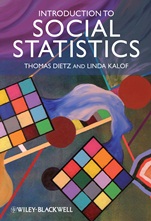
Introduction to Social Statistics: The Logic of Statistical Reasoning
ISBN 9781405169028
Autor: Thomas Dietz, Linda Kalof
Wydawca: Wiley
Dostępność: 3-6 tygodni
Cena: 241,50 zł
Przed złożeniem zamówienia prosimy o kontakt mailowy celem potwierdzenia ceny.
ISBN13: |
9781405169028 |
ISBN10: |
1405169028 |
Autor: |
Thomas Dietz, Linda Kalof |
Oprawa: |
Hardback |
Rok Wydania: |
2009-03-13 |
Ilość stron: |
608 |
Wymiary: |
252x181 |
Tematy: |
JB |
Why are some countries more likely than others to participate in environmental treaties? Why do some people feel animals have rights while others feel animals can be treated as objects? Why do some US states have high homicide rates while in others the occurrence of a homicide is very rare?
With a relaxed and conversational writing style, ongoing examples and complete exercises, this book shows how quantitative methods can help us to understand social questions and contemporary issues. Its special features include:Three strategies to help students master statistics: use of models throughout; repetition with variation to underpin pedagogy; and emphasis on the tools most commonly used in contemporary researchAccessible and consistent structure to guide students through the text, with ongoing examples running across chapters, showing how more than one statistical method can be used to approach a research questionFor enhanced learning, includes a ‘walk–through’ of statistical concepts, applications, features, and advanced topics boxes, and a ‘What Have We Learned’ section at the end of each chapterSupported by a website containing instructor materials including chapter–by–chapter PowerPoint slides, answers to exercises, and an instructor guideThis is a lively and very user–friendly book that makes students comfortable with what is usually considered a fearsome task: learning statistics.
Spis treści:
List of Tables.
List of Figures.
Preface: A Strategy for Approaching Quantitative Analysis.
An Introduction to Quantitative Analysis.
Some Basic Concepts.
Displaying Data One Variable at a Time.
Describing Data.
Plotting Relationships and Conditional Distributions.
Causation and Models of Causal Effects.
Probability.
Sampling Distributions and Inference.
Using Sampling Distributions: Confidence Intervals.
Using Sampling Distributions: Hypothe
sis Tests.
The Subtle Logic of Analysis of Variance.
Goodness of Fit and Models of Frequency Tables.
Bivariate Regression and Correlation.
Basics of Multiple Regression.
Appendix A Summary of Variables in Examples.
Appendix B Mathematics Review.
Appendix C Statistical Tables.
Glossary of Key Terms.
Notes.
Index.
Nota biograficzna:
Thomas Dietz is Professor of Sociology and Director of the Environmental Science and Policy Program at Michigan State University. He has 20 years’ experience teaching introductory social statistics and his books include Essentials of Social Research (with Linda Kalof and Amy Dan, 2008), New Tools for Environmental Protection (edited with Paul C. Stern, 2002), Environmentally Significant Consumption (edited with Paul C. Stern et al., 1997), and Handbook for Environmental Planning (edited with James McEvoy, 1977).
Linda Kalof is Professor of Sociology at Michigan State University. With 15 years of experience teaching introductory social statistics and research methods, she has won two university teaching awards and her books include Essentials of Social Research (with Amy Dan and Thomas Dietz, 2008), Looking at Animals in Human History (2007), A Cultural History of Animals (edited with Brigitte Resl, 2007), The Animals Reader (edited with Amy Fitzgerald, 2007), and The Earthscan Reader in Environmental Values (edited with Terre Satterfield, 2005).
Okładka tylna:
Why are some countries more likely than others to participate in environmental treaties? Why do some people feel animals have rights while others feel animals can be treated as objects? Why do some US states have high homicide rates while in others the occurrence of a homicide is very rare?
With a relaxed and conversational writing style, ongoing examples and complete exercises, this book sho
ws how quantitative methods can help us to understand social questions and contemporary issues. Its special features include:Three strategies to help students master statistics: use of models throughout; repetition with variation to underpin pedagogy; and emphasis on the tools most commonly used in contemporary researchAccessible and consistent structure to guide students through the text, with ongoing examples running across chapters, showing how more than one statistical method can be used to approach a research questionFor enhanced learning, includes a ‘walk–through’ of statistical concepts, applications, features, and advanced topics boxes, and a ‘What Have We Learned’ section at the end of each chapterSupported by a website containing instructor materials including chapter–by–chapter PowerPoint slides, answers to exercises, and an instructor guideThis is a lively and very user–friendly book that makes students comfortable with what is usually considered a fearsome task: learning statistics.
Koszyk
Książek w koszyku: 0 szt.
Wartość zakupów: 0,00 zł
Informacje


Kontakt
Gambit
Centrum Oprogramowania
i Szkoleń Sp. z o.o.
Al. Pokoju 29b/22-24
31-564 Kraków
Siedziba Księgarni
ul. Kordylewskiego 1
31-542 Kraków
+48 12 410 5991
+48 12 410 5987
+48 12 410 5989
Subskrypcje
Administratorem danych osobowych jest firma Gambit COiS Sp. z o.o. Na podany adres będzie wysyłany wyłącznie biuletyn informacyjny.
Autoryzacja płatności

Informacje na temat autoryzacji płatności poprzez PayU.

© Copyright 2012: GAMBIT COiS Sp. z o.o. Wszelkie prawa zastrzeżone.
Projekt i wykonanie: Alchemia Studio Reklamy