


Wydawcy
Katalog tematyczny
- Archeologia (109)
- Ekonomia, finanse, business (13704)
- Filozofia (1445)
- Historia (3040)
- Języki i językoznawstwo (2356)
- Lifestyle, hobby i rozrywka (475)
- Medycyna (9704)
- Nauki humanistyczne (4)
- Nauki o Ziemi i środowisku (2638)
- Nauki ścisłe (20412)
- Nauki społeczne (8486)
- Edukacja (229)
- Kryminologia, opieka spełeczna (284)
- Obronność (10)
- Polityka (1389)
- Psychologia (777)
- Socjologia (410)
- Społeczeństwo i kultura (187)
- Nauki techniczne (13450)
- Prawo (1696)
- Publikacje informacyjne i interdyscyplinarne (1288)
- Religia i wierzenia (917)
- Technika komputerowa (4067)
- Zdrowie, relacje międzyludzkie i rozwój osobisty (657)





Informacje szczegółowe o książce
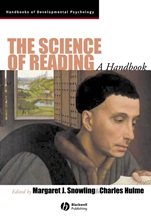
The Science of Reading: A Handbook
ISBN 9781405168113
Autor: Margaret J. Snowling, Charles Hulme
Wydawca: Wiley
Dostępność: 3-6 tygodni
Cena: 271,95 zł
Przed złożeniem zamówienia prosimy o kontakt mailowy celem potwierdzenia ceny.
ISBN13: |
9781405168113 |
ISBN10: |
1405168110 |
Autor: |
Margaret J. Snowling, Charles Hulme |
Oprawa: |
Paperback |
Rok Wydania: |
2007-12-12 |
Ilość stron: |
678 |
Wymiary: |
246x171 |
Tematy: |
JC |
The Science of Reading brings together state–of–the–art reviews of reading research from leading names in the field, to create a multidisciplinary overview of contemporary knowledge about reading and related skills.
The volume is divided into seven sections:
Word Recognition Processes in Reading
Learning to Read and Spell
Reading Comprehension provides
Reading in Different Languages
Disorders of Reading and Spelling
Biological Bases of Reading
Finally, Teaching Reading
Spis treści:
List of Contributors.
Preface.
Acknowledgments.
Part I: Word Recognition Processes in Reading:.
Editorial Part I.
1. Modelling Reading: The Dual–Route Approach: Max Coltheart (Macquarie University, Australia).
2. Connectionist Approaches to Reading: David C. Plaut (Carnegie Mellon University).
3. Visual Word Recognition: Theories and Findings: Stephen J. Lupker (University of Western Ontario).
4. The Question of Phonology and Reading: Guy C. Van Orden and Heidi Kloos (Arizona State University).
5. Eye Movements During Reading: Keith Rayner, Barbara J. Juhasz, and Alexander Pollatsek (University of Massachusetts).
Part II: Learning to Read and Spell:.
Editorial Part II.
6. Theories of Learning to Read: Brian Byrne (University of New England, Australia).
7. Writing Systems and Spelling Development: Rebecca Treiman and Brett Kessler (Washington University in St Louis).
8. Development of Sight Word Reading: Phases and Findings: Linnea C. Ehri (Graduate Center of the City University of New York).
9. Predicting Individual Differences in Learning to Read: Judith A. Bowey (University of Queensland).
10. Social Correlates of Emergent Literacy: Beth M. Phillips and Christopher J. Lonigan (Florida Center for Reading Research, Florida State University).
11. Literacy and Cognitive Change: José Morais an
d Régine Kolinsk (Université Libre de Bruxelles, Belgium).
Part III: Reading Comprehension:.
Editorial Part III.
12. Comprehension: Walter Kintsch and Katherine A. Rawson (University of Colorado).
13. The Acquisition of Reading Comprehension Skill: Charles A. Perfetti, Nicole Landi and Jane Oakhill (University of Pittsburgh).
14. Children’s Reading Comprehension Difficulties: Kate A. Nation (University of Oxford).
Part IV: Reading in Different Languages:.
Editorial Part IV.
15. Orthographic Systems and Skilled Word Recognition Processes in Reading: Ram Frost (The Hebrew University, Israel).
16. Early Reading Development in European Orthographies: Philip H. K. Seymour (University of Dundee, UK).
17. Learning to Read in Chinese: J. Richard Hanley (University of Essex, UK).
18. The Nature and Causes of Dyslexia in Different Languages: Markéta Caravolas (University of Liverpool).
Part V: Disorders of Reading and Spelling:.
Editorial Part V.
19. Developmental Dyslexia: Frank R. Vellutino and Jack M. Fletcher (State University of New York, at Albany).
20. Learning to Read with a Hearing Impairment: Jacqueline Leybaert (Université Libre de Bruxelles, Belgium).
21. Learning to Read with a Language Impairment: Margaret J. Snowling and Charles Hulme (University of York, UK).
22. Acquired Disorders of Reading: Matthew A. Lambon Ralph (University of Manchester) and Karalyn Patterson (University of Cambridge).
23. Spelling Disorders: Cristina Romani (University of Aston, UK), Andrew Olson (University of Birmingham, UK), and Anna Maria DiBetta (University of Aston).
Part VI: Biological Bases of Reading:.
Editorial Part VI.
24. Genetics of Dyslexia: Bruce F. Pennington (University of Denver) and Richard K. Olson (University of Colorado).
25. Functional Brain Imaging Studies of Skilled Reading and Developmental Dyslexia: Cathy J. Price (University College London)
and Eamon McCrory (Institute of Psychiatry, UK).
Part VII: Teaching Reading:.
Editorial Part VII.
26. Teaching Children to Read: What Do We Know About How To Do It?: Catherine E. Snow (Harvard Graduate School of Education) and Connie Juel (Stanford University).
27. Recent Discoveries from Research on Remedial Interventions for Children with Dyslexia: Joseph K. Torgesen (Florida Center for Reading Research at Florida State University).
Glossary of Terms.
References.
Author Index.
Subject Index
Nota biograficzna:
Margaret J. Snowling is Professor of Psychology at the University of York. Widely recognised as an expert in the field of children’s reading and language difficulties, she was awarded the British Psychological Society Presidents’ Award 2003 for distinguished contributions to psychological knowledge and is President–Elect of the Society for the Scientific Study of Reading. She is the author of the bestselling text, Dyslexia (Second Edition, Blackwell Publishing, 2000).
Charles Hulme is Professor of Psychology at the University of York. His research is on memory, reading and language processes and their development. He was the joint recipient of the Dina Fietelson Award of the International Reading Association for research on reading intervention, in 1998.
Okładka tylna:
The Science of Reading brings together state–of–the–art reviews of reading research from leading names in the field, to create a multidisciplinary overview of contemporary knowledge about reading and related skills.
The volume is divided into seven sections:
Word Recognition Processes in Reading
Learning to Read and Spell
Reading Comprehension provides
Reading in Different Languages
Disorders of Reading and Spelling
Biological Bases of Reading
Finally, Teaching Reading
Koszyk
Książek w koszyku: 0 szt.
Wartość zakupów: 0,00 zł
Informacje


Kontakt
Gambit
Centrum Oprogramowania
i Szkoleń Sp. z o.o.
Al. Pokoju 29b/22-24
31-564 Kraków
Siedziba Księgarni
ul. Kordylewskiego 1
31-542 Kraków
+48 12 410 5991
+48 12 410 5987
+48 12 410 5989
Subskrypcje
Administratorem danych osobowych jest firma Gambit COiS Sp. z o.o. Na podany adres będzie wysyłany wyłącznie biuletyn informacyjny.
Autoryzacja płatności

Informacje na temat autoryzacji płatności poprzez PayU.

© Copyright 2012: GAMBIT COiS Sp. z o.o. Wszelkie prawa zastrzeżone.
Projekt i wykonanie: Alchemia Studio Reklamy