


Wydawcy
Katalog tematyczny
- Archeologia (109)
- Ekonomia, finanse, business (13704)
- Filozofia (1445)
- Historia (3040)
- Języki i językoznawstwo (2356)
- Lifestyle, hobby i rozrywka (475)
- Medycyna (9704)
- Nauki humanistyczne (4)
- Nauki o Ziemi i środowisku (2638)
- Nauki ścisłe (20412)
- Nauki społeczne (8486)
- Nauki techniczne (13450)
- Prawo (1696)
- Publikacje informacyjne i interdyscyplinarne (1288)
- Religia i wierzenia (917)
- Technika komputerowa (4067)
- Zdrowie, relacje międzyludzkie i rozwój osobisty (657)





Informacje szczegółowe o książce
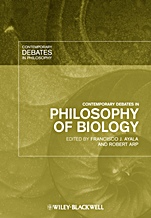
Contemporary Debates in Philosophy of Biology
ISBN 9781405159999
Autor: Francisco J. Ayala, Robert Arp
Wydawca: Wiley
Dostępność: 3-6 tygodni
Cena: 215,25 zł
Przed złożeniem zamówienia prosimy o kontakt mailowy celem potwierdzenia ceny.
ISBN13: |
9781405159999 |
ISBN10: |
1405159995 |
Autor: |
Francisco J. Ayala, Robert Arp |
Oprawa: |
Paperback |
Rok Wydania: |
2009-11-13 |
Ilość stron: |
440 |
Wymiary: |
246x171 |
Tematy: |
HP |
Contemporary Debates in Philosophy of Biology brings together original essays on some of the most hotly debated questions in this lively and fast–moving field. Are species real? Does selection operate primarily on genes? Can the biological sciences act as a ground for ethics?
Each of the ten sections introduces a specific issue within philosophy of biology and offers suggestions for further reading. Pairs of newly commissioned essays by leading scholars discuss the central questions in an engaging head–to–head debate. Together, the essays provide an accessible introduction to philosophy of biology, and a springboard to further discussion. Showcasing original arguments for well–defined positions, as well as clear and concise statements of sophisticated philosophical views, this volume is an excellent resource for professional philosophers, biologists, and students alike.
Notes on Contributors
General Introduction
References and Further Reading
Part I: Is It Possible to Reduce Biological Explanations to Explanations in Chemistry and/or Physics?
Introduction
References and Further Reading
1. It Is Possible to Reduce Biological Explanations to Explanations in Chemistry and/or Physics: Evelyn Fox Keller (MIT)
2. It Is Not Possible to Reduce Biological Explanations to Explanations in Chemistry and/or Physics: John Dupré (University of Exeter)
Part II: Have Traits Evolved to Function the Way They Do Because of a Past Advantage?
Introduction
References and Further Reading
3. Traits Have Evolved to Function the Way They Do Because of a Past Advantage: Mark Perlman (Western Oregon University)
4. Traits Have Not Evolved to Function the Way They Do Because of a Past Advantage: Robert Cummins (University of Illinois–Urbana–Champagin) and Martin Roth (Drake University)
Part III: Are Species Real?
Introduction
References and Further Reading
5. Species Are Real Biological Entities: Michael F. Claridge (Cardiff University)
6. Species Are Not Uniquely Real Biological Entities: Brent D. Mishler (University of California–Berkeley)
Part IV: Does Selection Operate Primarily on Genes?
Introduction
References and Further Reading
7. Selection Does Operate Primarily on Genes: In Defense of the Gene as the Unit of Selection: Carmen Sapienza (Temple University)
8. Selection Does Not Operate Primarily on Genes: Richard M. Burian (University of Pittsburgh)
Part V: Are Microevolution and Macroevolution Governed by the Same Processes?
Introduction
References and Further Reading
9. Microevolution and Macroevolution Are Governed by the Same Processes: Michael R. Dietrich (Dartmouth College)
10. Microevolution and Macroevolution Are Not Governed by the Same Processes: Douglas H. Erwin (Smithsonian Institution and Santa Fé Institute)
Part VI: Does Evolutionary Developmental Biology Offer a Significant Challenge to the Neo–Darwinian Paradigm?
Introduction
References and Further Reading
11. Evolutionary Developmental Biology Does Offer a Significant Challenge to the Neo–Darwinian Paradigm: Manfred D. Laubichler (Arizona State University)
12. Evolutionary Developmental Biology Does Not Offer a Significant Challenge to the Neo–Darwinian Paradigm: Alessandro Minelli (University of Padova)
Part VII: Were the Basic Components of the Human Mind Solidified During the Pleistocene Epoch?
Introduction
References and Further Reading
13. The Basic Components of the Human Mind Were Solidified During the Pleistocene Epoch: Valerie G. Starratt (Nova Southeastern University) and Todd K. Shackelford (Florida Atlantic University)
14. The Basic Components of the Human Mind Were Not Solidified During the Pleistocene Epoch: Stephen M. Downes (University of Utah)
Part VIII: Does Memetics Provide a Useful Way of Understanding Cultural Evolution?
Introduction
References and Further Reading
15. Memetics Does Provide a Useful Way of Understanding Cultural Evolution: Susan Blackmore (University of the West of England)
16. Memetics Does Not Provide a Useful Way of Understanding Cultural Evolution: A Developmental Perspective: William C. Wimsatt (University of Chicago)
Part IX: Can the Biological Sciences Act as a Ground for Ethics?
Introduction
References and Further Reading
17. The Biological Sciences Can Act as a Ground for Ethics: Michael Ruse (Florida State University)
18. What the Biological Sciences Can and Cannot Contribute to Ethics: Francisco J. Ayala (University of California–Irvine)
Part X: Is There a Place for Intelligent Design in the Philosophy of Biology?
Introduction
References and Further Reading
19. There Is a Place for Intelligent Design in the Philosophy of Biology: Intelligent Design in (Philosophy of) Biology: Some Legitimate Roles: Del Ratzsch (University of Massachusetts–Amherst)
20. There Is No Place for Intelligent Design in the Philosophy of Biology: Intelligent Design Is Not Science: Francisco J. Ayala (University of California–Irvine)
Index
Francisco J. Ayala is Donald Bren Professor of Biological Sciences at the University of California, Irvine, USA. He is a member of the U.S. National Academy of Sciences, the American Academy of Arts and Sciences, and the American Philosophical Society. In 2001, he received the National Medal of Science. Ayala has published more than 950 articles and is the author or editor of 31 books. He has been named the Renaissance Man of Evolutionary Biology by The New York Times.
Robert Arp is an analyst at The Analysis Group, LLC who has interests in philosophy of biology and ontology in the informatics sense. He is the author of Scenario Visualization: An Evolutionary Account of Creative Problem Solving (2008), and co–editor of Philosophy of Biology: An Anthology (Blackwell, 2009).
All chapters (including the very interesting contributions on the species problem by Claridge and Mishler, as well as the stimulating papers on evolutionary ethics by Ruse and Ayala) serve as an excellent introduction to the most hotly debated topics in the philosophy of biology today. ( Metascience , 2011) "A brief review like this can scarcely do justice to the richness of the ideas discussed in this text or the considerable care that went into its organization. This is, in short, a very fine contribution to the pedagogical literature on philosophy of biology. The editors are to be congratulated for the thoughtfulness that went into producing this text. May it gain the wide acceptance it deserves." (Science & Education, 2010) "Highly recommended. Lower–division undergraduates and above". (Choice, 1 November 2010) Contemporary Debates in Philosophy of Biology is an engaging anthology with many interesting contributions. The strength of the book is the format: two eminent representatives of the biophilosophical community have their say on a pivotal biophilosophical issue. ( Metapsychology, May 2010) "A very fine contribution to the pedagogical literature on philosophy of biology. The editors are to be congratulated for the thoughtfulness that went into producing this text. May it gain the wide acceptance it deserves." (Science & Education, March 2010)
Koszyk
Książek w koszyku: 0 szt.
Wartość zakupów: 0,00 zł
Informacje


Kontakt
Gambit
Centrum Oprogramowania
i Szkoleń Sp. z o.o.
Al. Pokoju 29b/22-24
31-564 Kraków
Siedziba Księgarni
ul. Kordylewskiego 1
31-542 Kraków
+48 12 410 5991
+48 12 410 5987
+48 12 410 5989
Subskrypcje
Administratorem danych osobowych jest firma Gambit COiS Sp. z o.o. Na podany adres będzie wysyłany wyłącznie biuletyn informacyjny.
Autoryzacja płatności

Informacje na temat autoryzacji płatności poprzez PayU.

© Copyright 2012: GAMBIT COiS Sp. z o.o. Wszelkie prawa zastrzeżone.
Projekt i wykonanie: Alchemia Studio Reklamy