


Wydawcy
Katalog tematyczny
- Archeologia (109)
- Ekonomia, finanse, business (13704)
- Filozofia (1445)
- Historia (3040)
- Języki i językoznawstwo (2356)
- Lifestyle, hobby i rozrywka (475)
- Medycyna (9704)
- Nauki humanistyczne (4)
- Nauki o Ziemi i środowisku (2638)
- Nauki ścisłe (20412)
- Nauki społeczne (8486)
- Nauki techniczne (13450)
- Budownictwo lądowe (1045)
- Budownictwo komunikacyjne (9)
- Hydraulika (33)
- Konstrukcje budowlane (95)
- Mechanika konstrukcji (182)
- Przemysł budowlany (7)
- Chemia przemysłowa (2258)
- Elektronika i telekomunikacja (3287)
- Energetyka (1122)
- Inne nauki stosowane (363)
- Inżynieria biochemiczna (507)
- Inżynieria transportu (232)
- Mechanika i materiały (3316)
- Nauka o środowisku (321)
- Rolnictwo (507)
- Technika, ogólnie (475)
- Prawo (1696)
- Publikacje informacyjne i interdyscyplinarne (1288)
- Religia i wierzenia (917)
- Technika komputerowa (4067)
- Zdrowie, relacje międzyludzkie i rozwój osobisty (657)





Informacje szczegółowe o książce
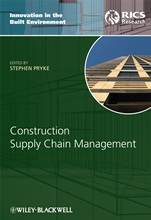
Construction Supply Chain Management: Concepts and Case Studies
ISBN 9781405158442
Autor: Stephen Pryke
Wydawca: Wiley
Dostępność: 3-6 tygodni
Cena: 605,85 zł
Przed złożeniem zamówienia prosimy o kontakt mailowy celem potwierdzenia ceny.
ISBN13: |
9781405158442 |
ISBN10: |
1405158441 |
Autor: |
Stephen Pryke |
Oprawa: |
Hardback |
Rok Wydania: |
2009-02-13 |
Ilość stron: |
244 |
Wymiary: |
250x179 |
Tematy: |
TN |
This book provides a unique appraisal of supply chain management (SCM) concepts alongside lessons from industry, observation and analysis gathered during the first decade of supply chain management strategies in the UK construction industry.
The research from leading international academics has been drawn together with the experience from some of the industry’s foremost SCM practitioners to provide both a definition of SCM and an overview of its development as a strategy for managing construction projects.
Key case studies – from Slough Estates to BAA and T5 – illustrate the benefits to the industry of adopting supply chain management strategies. Little has been written on the application of SCM to construction and this book provides an agenda for discussion for both the experienced researcher and the industry practitioner by offering a thorough grounding in its principles as well as an illustration of SCM as a methodology for industry.
Construction Supply Chain Management makes an important contribution to the debate on innovative systems and their significance in increasingly complex construction projects.
Spis treści:
Contributors.
Preface.
Acknowledgements.
Chapter 1 Introduction (Stephen Pryke).
1.1 Supply Chain Management – What Is It?
1.2 Supply Chain Management and Project Management.
1.3 Origins of SCM in Construction.
1.4 Overview of the Book.
1.5 Summary.
PART A: CONCEPTS.
Chapter 2 The Concept and Development of Supply Chain Management in the UK Construction Industry (Roy Morledge, Andrew Knight and Mohieddin Grada).
2.1 Introduction.
2.2 Characteristics of Construction Industry.
2.3 Government Initiatives in the Construction Industry.
2.4 The Historical Development of Supply Chain Management.
2.5 The Concept of Supply Chain Management.
2.6 The Application of Supply Chain Management Techniques in the Constructi
on Industry.
2.7 Supply Chain Challenges.
2.8 Conclusion.
Chapter 3 Culture in Supply Chains (Richard Fellows).
3.1 Introduction – Context.
3.2 Culture.
3.3 Dimensions of Culture.
3.4 Values and Value.
3.5 Ethics.
3.6 Organisational Citizenship Behaviour (OCB) and Corporate Social Responsibility (CSR).
3.7 Teams and Teamwork.
3.8 (Strategic) Alliances.
3.9 Supply Chain Participants and Behaviour.
3.10 Conclusion.
Chapter 4 Learning to Co–operate and Co–operating to Learn: Knowledge, Learning and Innovation in Construction Supply Chains (Mike Bresnen).
4.1 Introduction.
4.2 Supply Chain Management: Innovation, Knowledge Sharing and Organisational Learning.
4.3 SCM in the Construction Industry.
4.4 Innovation, Knowledge Sharing and Learning in Construction Supply Chains.
4.5 Situated Learning and Implications for Project–Based Supply Chains.
4.6 Conclusion.
Chapter 5 Marketing and Pricing Strategy (Martin Skitmore and Hedley Smyth).
5.1 Definitions and Difference.
5.2 Collaboration.
5.3 Added Value.
5.4 Profitability and Repeat Business.
5.5 Conclusion.
PART B: APPLICATION AND CASE STUDIES.
Chapter 6 Risk Management and the Supply Chain (Andrew Edkins).
6.1 Introduction.
6.2 Placing the UK Construction Industry in Context.
6.3 Supply Chains and Risk.
6.4 Supply Relationships.
6.5 Risk and Supply.
6.6 Managing Risks in the Supply Chain.
6.7 Supply Chain Management and PFI.
6.8 Concluding Remarks.
Chapter 7 Slough Estates in the 1990s – Client Driven SCM (Bernard Rimmer).
7.1 Introduction.
7.2 Slough Estates’ Experiences of Procurement Analysed in Terms of SCM.
7.3 Infl uences of Industry Reports.
7.4 Slough Estates SCM Initiatives and Results.
7.5 Summary and Conclusions.
Chapter 8 From Heathrow Express to Heathrow Termi
nal 5: BAA’s Development of Supply Chain Management (Keith Potts).
8.1 Introduction.
8.2 Heathrow Express High Speed Rail Link.
8.3 Continuous Improvement of the Project Process (CIPP).
8.4 SCM at BAA: ‘The Genesis Project’.
8.5 BAA Initiatives.
8.6 Best Practice – Framework Agreements.
8.7 Motivations and infl uences.
8.8 SCM on Heathrow T5.
8.9 Conclusions.
Chapter 9 Supply Chain Management: A Main Contractor’s Perspective (Andrew P. King and Marn C. Pitt).
9.1 Introduction.
9.2 Supply Chain Management.
9.3 Methodology.
9.4 Analysis.
9.5 Conclusion.
Chapter 10 Franchising the Supply Chain (Hedley Smyth).
10.1 Towards Controlling the Supply Chain.
10.2 Conceptualising Franchising.
10.3 Conclusion.
Chapter 11 Conclusion (Stephen Pryke).
11.1 Supply Chain Management in Construction.
11.2 Final Thoughts and the Future of SCM in Construction.
11.3 In Conclusion.
11.4 Next Steps.
Index.
Nota biograficzna:
Stephen Pryke is Senior Lecturer in Construction and Project Management at the Bartlett School of Graduate Studies, University College London, and Director of the Master’s course there in Project and Enterprise Management.
Okładka tylna:
This book provides a unique appraisal of supply chain management (SCM) concepts alongside lessons from industry, observation and analysis gathered during the first decade of supply chain management strategies in the UK construction industry.
The research from leading international academics has been drawn together with the experience from some of the industry’s foremost SCM practitioners to provide both a definition of SCM and an overview of its development as a strategy for managing construction projects.
Key case studies – from Slough Estates to BAA and T5 – illustrate the benefits to the industr
y of adopting supply chain management strategies. Little has been written on the application of SCM to construction and this book provides an agenda for discussion for both the experienced researcher and the industry practitioner by offering a thorough grounding in its principles as well as an illustration of SCM as a methodology for industry.
Construction Supply Chain Management makes an important contribution to the debate on innovative systems and their significance in increasingly complex construction projects.
Koszyk
Książek w koszyku: 0 szt.
Wartość zakupów: 0,00 zł
Informacje


Kontakt
Gambit
Centrum Oprogramowania
i Szkoleń Sp. z o.o.
Al. Pokoju 29b/22-24
31-564 Kraków
Siedziba Księgarni
ul. Kordylewskiego 1
31-542 Kraków
+48 12 410 5991
+48 12 410 5987
+48 12 410 5989
Subskrypcje
Administratorem danych osobowych jest firma Gambit COiS Sp. z o.o. Na podany adres będzie wysyłany wyłącznie biuletyn informacyjny.
Autoryzacja płatności

Informacje na temat autoryzacji płatności poprzez PayU.

© Copyright 2012: GAMBIT COiS Sp. z o.o. Wszelkie prawa zastrzeżone.
Projekt i wykonanie: Alchemia Studio Reklamy