


Wydawcy
Katalog tematyczny
- Archeologia (109)
- Ekonomia, finanse, business (13704)
- Filozofia (1445)
- Historia (3040)
- Języki i językoznawstwo (2356)
- Lifestyle, hobby i rozrywka (475)
- Medycyna (9704)
- Nauki humanistyczne (4)
- Nauki o Ziemi i środowisku (2638)
- Nauki ścisłe (20412)
- Nauki społeczne (8486)
- Nauki techniczne (13450)
- Prawo (1696)
- Publikacje informacyjne i interdyscyplinarne (1288)
- Religia i wierzenia (917)
- Technika komputerowa (4067)
- Zdrowie, relacje międzyludzkie i rozwój osobisty (657)





Informacje szczegółowe o książce
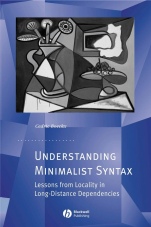
Understanding Minimalist Syntax: Lessons from Locality in Long–Distance Dependencies
ISBN 9781405157957
Autor: Cedric Boeckx
Wydawca: Wiley
Dostępność: 3-6 tygodni
Cena: 241,50 zł
Przed złożeniem zamówienia prosimy o kontakt mailowy celem potwierdzenia ceny.
ISBN13: |
9781405157957 |
ISBN10: |
140515795X |
Autor: |
Cedric Boeckx |
Oprawa: |
Paperback |
Rok Wydania: |
2007-07-04 |
Ilość stron: |
192 |
Wymiary: |
229x154 |
Tematy: |
CF |
Understanding Minimalist Syntax introduces the logic of the minimalist program by analyzing well–known descriptive generalizations about long–distance dependencies, and asks why they should be true of natural languages. This text proposes a new theory of how long–distance dependencies are formed, with implications for theories of locality, and the minimalist program as a whole.
Experts working in the field will appreciate its rich empirical coverage, and advanced undergraduate and graduate students will find it an accessible introduction to the minimalist program.
Acknowledgments xi
1 Introductory Remarks 1
1.1 The Framework 1
1.2 Outline of the Book: Goals and Structure 4
2 The Marks of Successive Cyclicity (The What–Question) 9
2.1 Subjacency and the Emergence of Successive Cyclicity 9
2.2 The Evidence 11
2.2.1 Syntax 11
2.2.2 Morphology 14
2.2.3 Phonology 22
2.2.4 Semantics 23
2.2.5 Morpho–syntactic evidence from overtly stranded pieces 26
2.3 A–movement 29
2.4 Conclusion 34
3 The Distribution of Intermediate Landing Sites (The Where–Question) 39
3.1 Punctuated vs. Uniform Paths 40
3.2 The Difficulties Faced by Punctuated Path Hypotheses 43
3.2.1 Phases: an overview 44
3.2.2 Conceptual arguments for phases 46
3.2.3 Arguments against phases 48
3.2.4 Old problems for phases 50
3.2.5 No empirical argument for phases 54
3.3 Conclusion 61
4 The Timing of Intermediate Steps of Movement (The When–Question) 64
4.1 Early vs. Late Successive Cyclicity 64
4.2 Takahashi (1994) 66
4.3 The Evidence for Early Successive Cyclic Movement 70
4.3.1 Background information on applicatives 71
4.3.2 The need for early successive cyclic movement 76
4.4 Potential Arguments for Late Successive Cyclic Movement 80
4.4.1 Sub–extraction out of a moved element 80
4.4.2 Intervening traces 82
4.4.3 Object agreement 83
4.5 Conclusion 86
5 The Motivation for Intermediate Movement Steps (The Why–Question) 90
5.1 Last Resort 90
5.2 Problematic Cases 91
5.2.1 Concord 91
5.2.2 Successive cyclicity 92
5.3 Anti–locality 101
5.4 Anti–locality and Successive Cyclicity 106
5.5 Anti–locality and Last Resort 110
5.6 The Why–Question 113
5.7 Conclusion 117
6 Alternative Views on Successive Cyclicity 119
6.1 TAG–based Accounts 119
6.2 An Agreement–based Account 125
6.3 Prolific Domains 129
6.4 Greed–based Approaches 129
6.5 Conclusion 132
7 Successive Cyclicity and Other Aspects of Locality 133
7.1 The Standard View on Islands 134
7.2 Puzzles for the Standard View 136
7.2.1 Movement, freezing, and escape hatch 136
7.2.2 Island by default? 137
7.2.3 Island–obviation 137
7.3 Ross s View 145
7.4 Agreement and Islandhood 145
7.5 Conclusion 148
8 Concluding Remarks 150
References 152
Index 167
Cedric Boeckx is Assistant Professor of Linguistics and a member of the Mind/Brain/Behavior Interfaculty Initiative at Harvard University. He is the author of Islands and Chains (2003), Linguistic Minimalism (2006), and numerous articles in journals such as Linguistic Inquiry and Natural Language and Linguistic Theory.
In the space of just 150 pages Boeckx provides an accessible and assured introduction to minimalism; a terrific critical review of the evidence for cyclic movement; a sympathetic yet powerful critique of phase theory; and a new approach to the cycle based on an intuitively natural version of Least Effort. This really is a tour de force and can be read profitably by expert and neophyte alike.
Norbert Hornstein, University of Maryland
The book investigates the venerable topic of successive cyclic movement in order to shed light on the nature of the minimalist program. It is a truly impressive achievement which draws important conclusions regarding the most fundamental issues of the minimalist program and puts back the phenomenon of successive cyclic movement in the center of syntactic theorizing. It should have a strong impact on the field.
eljko Bo kovi , University of Connecticut
This is a concise study of how locality and anti–locality effects can be handled within minimalism: it is up–to–date, thought–provoking and full of insightful and original ideas ideal for use as a specialist topic on an advanced syntax course.
Andrew Radford, University of Essex
Koszyk
Książek w koszyku: 0 szt.
Wartość zakupów: 0,00 zł
Informacje


Kontakt
Gambit
Centrum Oprogramowania
i Szkoleń Sp. z o.o.
Al. Pokoju 29b/22-24
31-564 Kraków
Siedziba Księgarni
ul. Kordylewskiego 1
31-542 Kraków
+48 12 410 5991
+48 12 410 5987
+48 12 410 5989
Subskrypcje
Administratorem danych osobowych jest firma Gambit COiS Sp. z o.o. Na podany adres będzie wysyłany wyłącznie biuletyn informacyjny.
Autoryzacja płatności

Informacje na temat autoryzacji płatności poprzez PayU.

© Copyright 2012: GAMBIT COiS Sp. z o.o. Wszelkie prawa zastrzeżone.
Projekt i wykonanie: Alchemia Studio Reklamy