


Wydawcy
Katalog tematyczny
- Archeologia (109)
- Ekonomia, finanse, business (13704)
- Filozofia (1445)
- Historia (3040)
- Języki i językoznawstwo (2356)
- Lifestyle, hobby i rozrywka (475)
- Medycyna (9704)
- Nauki humanistyczne (4)
- Nauki o Ziemi i środowisku (2638)
- Nauki ścisłe (20412)
- Nauki społeczne (8486)
- Edukacja (229)
- Kryminologia, opieka spełeczna (284)
- Obronność (10)
- Polityka (1389)
- Psychologia (777)
- Socjologia (410)
- Społeczeństwo i kultura (187)
- Nauki techniczne (13450)
- Prawo (1696)
- Publikacje informacyjne i interdyscyplinarne (1288)
- Religia i wierzenia (917)
- Technika komputerowa (4067)
- Zdrowie, relacje międzyludzkie i rozwój osobisty (657)





Informacje szczegółowe o książce
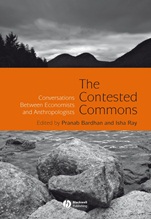
The Contested Commons: Conversations between Economists and Anthropologists
ISBN 9781405157162
Autor: Pranab Bardhan, Isha Ray
Wydawca: Wiley
Dostępność: 3-6 tygodni
Cena: 543,90 zł
Przed złożeniem zamówienia prosimy o kontakt mailowy celem potwierdzenia ceny.
ISBN13: |
9781405157162 |
ISBN10: |
140515716X |
Autor: |
Pranab Bardhan, Isha Ray |
Oprawa: |
Hardback |
Rok Wydania: |
2008-01-09 |
Ilość stron: |
304 |
Wymiary: |
256x185 |
Tematy: |
JBK |
Interdisciplinary work in the social sciences is challenging. While sometimes similar in their research themes, the large variance in the histories and methods of different disciplines tends to hinder constructive communication. The Contested Commons explores the theme of common environmental resources from the perspective of two disciplines that are often considered to be far apart: economics and anthropology.
Written by senior scholars in economics, anthropology, sociology, and political science, this volume focuses on methodological and epistemological approaches to the analysis of local common–pool resources. This is a topic that touches upon economic security, ecological sustainability, identity formation, and participatory decision–making – particularly in the developing world. The essays in this volume illustrate the wide variation in approaches to research itself, both across and within economics and anthropology.
Spis treści:
List of Contributors.
Preface.
Acknowledgments.
1. Economists, Anthropologists, and the Contested Commons: Pranab Bardhan and Isha Ray (both University of California at Berkeley).
2. Managing the Commons: The Role of Social Norms and Beliefs: Jean–Philippe Platteau (University of Namur, Belgium).
3. Sustainable Governance of Common–pool Resources: Context, Method, and Politics: Arun Agrawal (University of Michigan, Ann Arbor).
4. Cooperative Conversations: Outcomes and Processes in Economics and Anthropology: Isha Ray (University of California at Berkeley).
5. Collective Action, Common Property, and Social Capital in South India: An Anthropological Commentary: David Mosse (University of London).
6. Culture and Power in the Commons Debate: Amita Baviskar (Institute of Economic Growth, New Delhi).
7. A Simple Model of Collective Action: Rajiv Sethi and E. Somanathan (Columbia University and Indian Statistical Institute, New Delhi).
8. Revisiting
Demsetz: Contextualizing Community–Private Ownership in Western India: Pranab Mukhopadhyay (University of Goa, Panaji).
9. Scale and Mobility in Defining the Commons: Vyjayanthi Rao and Arjun Appadurai (both The New School, New York).
10. Symbolic Public Goods and the Coordination of Collective Action: A Comparison of Local Development in India and Indonesia: Vijayendra Rao (The World Bank, Washington, DC).
11. Interdisciplinarity as a Three–way Conversation: Barriers and Possibilities: Sharachchandra Lélé (Centre for International Studies in Environment and Development, Bangalore).
12. Feminism Spoken Here: Epistemologies for Interdisciplinary Development Research: Cecile Jackson (Institute of Development Studies, Brighton).
Commentaries.
Commentary 1: Social Norms and Cooperative Behavior: Notes from the Hinterland between Economics and Anthropology: Kaushik Basu (Cornell University, New York).
Commentary 2: Sociologists and Economists on “the Commons”: Erik Olin Wright (University of Wisconsin, Madison).
Commentary 3: CPR Institutions: Game–theory Constructs and Empirical Relevance: Nirmal Sengupta (Indira Gandhi Institute of Development Studies, Chennai).
Commentary 4: Disciplinary Perspectives and Policy Design for Common–pool Resources: Some Reflections: Kanchan Chopra (Institute of Economic Growth, New Delhi).
Commentary 5: Understanding Common Property Resources and Their Management: A Potential Bridge across Disciplinary Divides?: A. Vaidyanathan (Madras Institute of Development Studies, Chennai).
Commentary 6: And Never the Twain Shall Meet? An Exchange on the Strengths and Weaknesses of Anthropology and Economics in Analyzing the Commons: Ravi Kanbur and Annelise Riles (Cornell University, New York).
Index
Nota biograficzna:
Pranab Bardhan is Professor of Economics at the University of California at Berkeley, and co–chair of the MacArthur Found
ation–funded Network on the Effects of Inequality on Economic Performance. He has authored or edited a number of books, including Scarcity, Conflicts, and Cooperation (2005) and International Trade, Growth, and Development (Blackwell, 2003). He was Chief Editor of the Journal of Development Economics from 1985 to 2003.
Isha Ray is Assistant Professor in the Energy and Resources Group at the University of California at Berkeley. She is an advisor to several water– and development–related organizations, and serves on the editorial committee of the Annual Review of Environment and Resources.
Okładka tylna:
Interdisciplinary work in the social sciences is challenging. While sometimes similar in their research themes, the large variance in the histories and methods of different disciplines tends to hinder constructive communication. The Contested Commons explores the theme of common environmental resources from the perspective of two disciplines that are often considered to be far apart: economics and anthropology.
Written by senior scholars in economics, anthropology, sociology, and political science, this volume focuses on methodological and epistemological approaches to the analysis of local common–pool resources. This is a topic that touches upon economic security, ecological sustainability, identity formation, and participatory decision–making – particularly in the developing world. The essays in this volume illustrate the wide variation in approaches to research itself, both across and within economics and anthropology.
Koszyk
Książek w koszyku: 0 szt.
Wartość zakupów: 0,00 zł
Informacje


Kontakt
Gambit
Centrum Oprogramowania
i Szkoleń Sp. z o.o.
Al. Pokoju 29b/22-24
31-564 Kraków
Siedziba Księgarni
ul. Kordylewskiego 1
31-542 Kraków
+48 12 410 5991
+48 12 410 5987
+48 12 410 5989
Subskrypcje
Administratorem danych osobowych jest firma Gambit COiS Sp. z o.o. Na podany adres będzie wysyłany wyłącznie biuletyn informacyjny.
Autoryzacja płatności

Informacje na temat autoryzacji płatności poprzez PayU.

© Copyright 2012: GAMBIT COiS Sp. z o.o. Wszelkie prawa zastrzeżone.
Projekt i wykonanie: Alchemia Studio Reklamy