


Wydawcy
Katalog tematyczny
- Archeologia (109)
- Ekonomia, finanse, business (13704)
- Filozofia (1445)
- Historia (3040)
- Języki i językoznawstwo (2356)
- Lifestyle, hobby i rozrywka (475)
- Medycyna (9704)
- Nauki humanistyczne (4)
- Nauki o Ziemi i środowisku (2638)
- Nauki ścisłe (20412)
- Nauki społeczne (8486)
- Nauki techniczne (13450)
- Prawo (1696)
- Publikacje informacyjne i interdyscyplinarne (1288)
- Religia i wierzenia (917)
- Technika komputerowa (4067)
- Zdrowie, relacje międzyludzkie i rozwój osobisty (657)





Informacje szczegółowe o książce
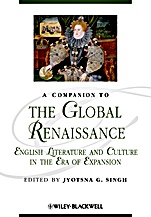
A Companion to the Global Renaissance: English Literature and Culture in the Era of Expansion
ISBN 9781405154765
Autor: Jyotsna G. Singh
Wydawca: Wiley
Dostępność: 3-6 tygodni
Cena: 249,90 zł
Przed złożeniem zamówienia prosimy o kontakt mailowy celem potwierdzenia ceny.
ISBN13: |
9781405154765 |
ISBN10: |
1405154764 |
Autor: |
Jyotsna G. Singh |
Oprawa: |
Hardback |
Rok Wydania: |
2009-04-07 |
Ilość stron: |
424 |
Wymiary: |
252x172 |
Tematy: |
CS |
The storied achievements of the Renaissance were not simply the result of a cultural rediscovery of shared European classical traditions. A Companion to the Global Renaissance presents a more complex perspective that considers England′s commercial and cross–cultural interactions with the New and Old Worlds of the Americas, Africa, and the East, as well as with Northern Europe. By illustrating how English culture and literature of the sixteenth and seventeenth centuries were shaped by emerging long–distance mercantile, proto–colonial, and cultural economies of exchange, this innovative collection presents a new history of globalization. After introducing globalization′s theoretical underpinnings, twenty one newly–commissioned essays collectively illustrate how twentieth–century globalization was the result of a lengthy and complex historical process linked to the emergence of capitalism and colonialism. These wide–ranging chapters examine such topics as England′s trading companies and the flow of labor and capital; exploration and cartography; travel and empire; domestic consumerism, money, and material culture; East–West relations and Islam; visual representations and aesthetic theories of and by cultural ‘others’; gender and race struggles within the new economies and cultures; the global dimensions of Renaissance literature; and global drama on the cosmopolitan English stage. With academic rigor and critical authority, A Companion to the Global Renaissance: English Literature and Culture in the Era of Expansion challenges popular notions of Renaissance history and presents fascinating new insights into the roots of globalization.
List of Illustrations Notes on Contributors Acknowledgments Introduction: The Global Renaissance: Jyotsna Singh (Michigan StateUniversity) Part I: Mapping the Global: 1. The New Globalism: Transcultural Commerce, Global Systems Theory, and Spenser’s Mammon: Daniel Vitkus (Florida State University) 2. “Travailing” Theory: Global Flows of Labor and the Enclosure of the Subject: Crystal Bartolovich (Syracuse University) 3. Islam and Tamburlaine ’s World–picture: John Michael Archer (New York University) 4. Traveling Nowhere: Global Utopias in the Early Modern Period: Chloë Houston (University of Reading) Part II: “Contact Zones”: 5. The Benefits of a Warm Study: The Resistance to Travel before Empire: Andrew Hadfield (University of Sussex) 6. “Apes of Imitation”: Imitation and Identity in Sir Thomas Roe’s Embassy to India: Nandini Das (University of Liverpool) 7. A Multinational Corporation: Foreign Labor in the London East India Company: Richmond Barbour (Oregon State University) 8. Where was Iceland in 1600?: Mary C. Fuller (MIT) 9. East by North–east: The English among the Russians, 1553–1603: Gerald MacLean (University of Exeter) 10. The Politics of Identity: William Adams, John Saris, and the English East India Company’s Failure in Japan : Catherine Ryu (Michigan State University) 11. The Queer Moor: Bodies, Borders, and Barbary Inns: Ian Smith (University of Reading) Part III: Networks of Exchange: Traveling Objects: 12. Guns and Gawds: Elizabethan England’s Infidel Trade: Matthew Dimmock (University of Sussex) 13. Cassio, Cash, and the “Infidel 0”: Arithmetic, Double–entry Book–keeping, and Othello’ s Unfaithful Accounts: Patricia Parker (Stanford University) 14. Seeds of Sacrifice: Amaranth, the Gardens of Tenochtitlan and Spenser’s Faerie Queene: Edward M. Test (Boise State University) 15. “So Pale, So Lame, So Lean, So Ruinous”: The Circulation of Foreign Coins in Early Modern England: Stephen Deng (Michigan State University) 16. Canary, Bristoles, Londres, Ingleses: English Traders in the Canaries in the Sixteenth and Seventeenth Centuries: Barbara Sebek (Colorado State University) 17. “The Whole Globe of the Earth”: Almanacs and Their Readers: Adam Smyth (University of Reading) 18. Cesare Vecellio, Venetian Writer and Art–book Cosmopolitan: Ann Rosalind Jones (Smith College) Part IV: The Globe Staged: 19. Bettrice’s Monkey: Staging Exotica in Early Modern London Comedy: Jean E. Howard (Columbia University) 20. The Maltese Factor: The Poetics of Place in The Jew of Malta and The Knight of Malta: Virginia Mason Vaughan (Clark University) 21. Local/Global Pericles : International Storytelling, Domestic Social Relations, Capitalism: David Morrow (College of St. Rose)
Jyotsna G. Singh is a Professor at Michigan State University, where she teaches early modern literature and culture, post–colonial theory, and gender and race studies. Her published works include Colonial Narratives/Cultural Dialogues: ′Discovery′ of India in the Language of Colonialism (1996); The Weyward Sisters: Shakespeare and Feminist Politics (co–authored, with Dympna Callaghan and Lorraine Helms, 1994); and Travel Knowledge: European ′Discoveries′ in the Early Modern Period (co–edited with Ivo Kamps, 2001). She has received several research fellowships, including at the Folger Shakespeare Library and Queen Mary, University of London.
"This volume will provoke students and scholars to think about the Renaissance in much broader, non–European contexts; it contributes valuably to new work on globalization by historicizing the concept." (The English Renaissance, 1 September 2011) "This collection is intelligently structured and impressively diverse in both its geographical and intellectual range. Most of all, it is unwaveringly enjoyable and intriguing to read. It must surely become a firm fixture on a wide and interdisciplinary range of student reading lists for the early modern period." (Renaissance Studies, November 2010)
Koszyk
Książek w koszyku: 0 szt.
Wartość zakupów: 0,00 zł
Informacje


Kontakt
Gambit
Centrum Oprogramowania
i Szkoleń Sp. z o.o.
Al. Pokoju 29b/22-24
31-564 Kraków
Siedziba Księgarni
ul. Kordylewskiego 1
31-542 Kraków
+48 12 410 5991
+48 12 410 5987
+48 12 410 5989
Subskrypcje
Administratorem danych osobowych jest firma Gambit COiS Sp. z o.o. Na podany adres będzie wysyłany wyłącznie biuletyn informacyjny.
Autoryzacja płatności

Informacje na temat autoryzacji płatności poprzez PayU.

© Copyright 2012: GAMBIT COiS Sp. z o.o. Wszelkie prawa zastrzeżone.
Projekt i wykonanie: Alchemia Studio Reklamy