


Wydawcy
Katalog tematyczny
- Archeologia (109)
- Ekonomia, finanse, business (13704)
- Filozofia (1445)
- Historia (3040)
- Języki i językoznawstwo (2356)
- Lifestyle, hobby i rozrywka (475)
- Medycyna (9704)
- Nauki humanistyczne (4)
- Nauki o Ziemi i środowisku (2638)
- Nauki ścisłe (20412)
- Nauki społeczne (8486)
- Nauki techniczne (13450)
- Prawo (1696)
- Publikacje informacyjne i interdyscyplinarne (1288)
- Religia i wierzenia (917)
- Technika komputerowa (4067)
- Zdrowie, relacje międzyludzkie i rozwój osobisty (657)





Informacje szczegółowe o książce
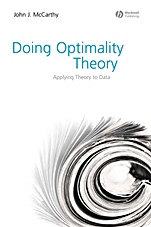
Doing Optimality Theory: Applying Theory to Data
ISBN 9781405151351
Autor: John J. McCarthy
Wydawca: Wiley
Dostępność: 3-6 tygodni
Cena: 519,75 zł
Przed złożeniem zamówienia prosimy o kontakt mailowy celem potwierdzenia ceny.
ISBN13: |
9781405151351 |
ISBN10: |
1405151358 |
Autor: |
John J. McCarthy |
Oprawa: |
Hardback |
Rok Wydania: |
2008-04-18 |
Ilość stron: |
328 |
Wymiary: |
234x153 |
Tematy: |
CF |
Optimality Theory revolutionized the field of phonology and had a huge impact on linguistics in general when it was first proposed in 1993. In Doing Optimality Theory , one of the key proponents of the theory explains how to do analysis and research using this model. Because the basic premises of OT are markedly different from other linguistic theories, new analytic techniques and new ways of thinking and theorizing are required. This unique work presents practical, in–depth advice for students in the field in an engaging and accessible way. Numerous questions, specific examples, and exercises throughout are designed to give readers an in–depth understanding of the material. McCarthy summarizes the core concepts of OT to make this an ideal guide for both advanced undergraduate and graduate students, and one that will, by example, lead the way to future developments in the field.
Acknowledgments. Read This First!. List of Abbreviations. 1. An Introduction to Optimality Theory. 1.1 How OT Began. 1.2 Why Must Constraints Be Violable?. 1.3 The Nature of Constraints in OT. 1.4 Candidate Sets: OT’s Gen Component. 1.5 Candidate Evaluation: OT’s Eval Component. 1.6 Constraint Activity. 1.7 Differences Between Languages. 1.8 The Version of OT Discussed in This Book. 1.9 Suggestions for Further Reading. 2. How to Construct an Analysis. 2.1 Where to Begin. 2.2 How to Rank Constraints. 2.3 Working through an Analysis in Phonology. 2.4 The Limits of Ranking Arguments. 2.5 Candidates in Ranking Arguments. 2.6 Harmonic Bounding. 2.7 Constraints in Ranking Arguments. 2.8 Inputs in Ranking Arguments. 2.9 Working through an Analysis in Syntax. 2.10 Finding and Fixing Problems in an Analysis. 2.11 Constraint Ranking by Algorithm and Computer. 2.12 The Logic of Constraint Ranking and Its Uses. 3. How to Write Up an Analysis. 3.1 Introduction. 3.2 How to Organize a Paper. 3.3 How to Present an OT analysis. 3.4 The Responsibilities of Good Scholarship. 3.5 How to Write Clearly. 3.6 General Advice about Research Topics. 4. Developing New Constraints. 4.1 Introduction. 4.2 When Is It Necessary to Modify Con?. 4.3 How to Discover a New Constraint. 4.4 How to Define a New Constraint. 4.5 Properties of Markedness Constraints. 4.6 Properties of Faithfulness Constraints. 4.7 Justifying Constraints. 4.8 A Classified List of Common Phonological Markedness Constraints. 5. Language Typology and Universals. 5.1 Factorial Typology. 5.2 Languages Universals and How to Explain Them in OT. 5.3 Investigating the Factorial Typology of a Constraint Set. 5.4 Using Factorial Typology to Test New Constraints. 5.5 Factorial Typology When Con Isn’t Fully Known. 5.6 How to Proceed from Typology to Constraints. 6. Some Current Research Questions. 6.1 Introduction. 6.2 How Does a Language Vary?. 6.3 How Is Language Acquired?. 6.4 Does OT Need Derivations?. 6.5 How Is Ungrammaticality Accounted For?. 6.6 Is Faithfulness Enough?. Afterword. References. Constraint Index. Language Index. Subject Index
John J. McCarthy is Professor of Linguistics at the University of Massachusetts, Amherst. His widely cited but unpublished manuscript “Prosodic Morphology I: Constraint Interaction and Satisfaction” (with Alan Prince, 1993) has been an important factor in the dissemination of Optimality Theory. He is also the author of Formal Problems in Semitic Phonology and Morphology (1985), A Thematic Guide to Optimality Theory (2002), and Hidden Generalizations: Phonological Opacity in Optimality Theory (2007), as well as the editor of Optimality Theory in Phonology: A Reader (Blackwell, 2004).
"An intensely practical book, full of concrete problemsolving advice, which should be well–thumbed by those learning and working within OT." ( Journal of Linguistics , 2009)
Koszyk
Książek w koszyku: 0 szt.
Wartość zakupów: 0,00 zł
Informacje


Kontakt
Gambit
Centrum Oprogramowania
i Szkoleń Sp. z o.o.
Al. Pokoju 29b/22-24
31-564 Kraków
Siedziba Księgarni
ul. Kordylewskiego 1
31-542 Kraków
+48 12 410 5991
+48 12 410 5987
+48 12 410 5989
Subskrypcje
Administratorem danych osobowych jest firma Gambit COiS Sp. z o.o. Na podany adres będzie wysyłany wyłącznie biuletyn informacyjny.
Autoryzacja płatności

Informacje na temat autoryzacji płatności poprzez PayU.

© Copyright 2012: GAMBIT COiS Sp. z o.o. Wszelkie prawa zastrzeżone.
Projekt i wykonanie: Alchemia Studio Reklamy