


Wydawcy
Katalog tematyczny
- Archeologia (109)
- Ekonomia, finanse, business (13704)
- Filozofia (1445)
- Historia (3040)
- Języki i językoznawstwo (2356)
- Lifestyle, hobby i rozrywka (475)
- Medycyna (9704)
- Nauki humanistyczne (4)
- Nauki o Ziemi i środowisku (2638)
- Nauki ścisłe (20412)
- Nauki społeczne (8486)
- Nauki techniczne (13450)
- Prawo (1696)
- Publikacje informacyjne i interdyscyplinarne (1288)
- Religia i wierzenia (917)
- Technika komputerowa (4067)
- Zdrowie, relacje międzyludzkie i rozwój osobisty (657)





Informacje szczegółowe o książce
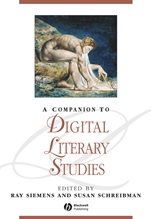
A Companion to Digital Literary Studies
ISBN 9781405148641
Autor: Ray Siemens, Susan Schreibman
Wydawca: Wiley
Dostępność: 3-6 tygodni
Cena: 915,60 zł
Przed złożeniem zamówienia prosimy o kontakt mailowy celem potwierdzenia ceny.
ISBN13: |
9781405148641 |
ISBN10: |
1405148640 |
Autor: |
Ray Siemens, Susan Schreibman |
Oprawa: |
Hardback |
Rok Wydania: |
2007-12-11 |
Ilość stron: |
640 |
Wymiary: |
252x175 |
Tematy: |
CS |
A Companion to Digital Literary Studies offers an extensive examination of how new technologies are changing the nature of literary studies. Through a series of specially commissioned articles by leading scholars, theorists, and writers creating born–digital literature, the text provides a thorough overview of the intersections between computing, literary studies, and new media. It takes a highly interdisciplinary perspective in its examination of scholarly editing and literary criticism, interactive fiction and gaming, multimedia and immersive environments, and born digital literature. This Companion is the only comprehensive collection of seminal works available to meet the needs of this growing area of inquiry. It is a must–read for anyone wishing to understand, use, or create digital literature.
Notes on Contributors. Editor’s Introduction: Ray Siemens and Susan Schreibman. 1. Imagining the new media encounter: Alan Liu (University of California, Santa Barbara). Part I: Literary Studies and the Tradition of Computing . 2. ePhilology: When the books talk to their readers: Greg Crane (Tufts University). 3. Disciplinary impact and technological obsolescence in digital medieval studies: Daniel O′Donnell (University of Lethbridge). 4. "Knowledge will be multiplied": Digital literary studies and early modern literature: Matthew Steggle (Sheffield–Hallam University). 5. Online resources for eighteenth–century literature in English and other European languages: image, text and hypertext: Peter Damian–Grint (University of Oxford). 6. Multimedia and multitasking: a survey of digital resources for nineteenth–century literary studies: John Walsh (University of Indiana). 7. Hypertext and avant–texte in twentieth century and contemporary literature: (Dirk Van Hulle, James Joyce Centre, University of Antwerp). Part II: Methods and Perspectives . 8. Reading digital literature: surface, data, interaction, and expressive processing: Noah Wardrip–Fruin (Brown University). 9. Is there a text on this screen?: Reading in an era of hypertextuality: Bertrand Gervais (Univeristy of Quebec at Montreal). 10. Reading on screen: the new media sphere: Christian Vandendorpe (University of Ottawa. 11. Electronic scholarly editions: Ken Price (University of Nebraska). 12. The Text Encoding Initiative and the study of literature: James Cummings (University of Oxford). 13. Knowing true things by what their mockeries be: modelling in the humanities: Willard McCarty (Kings College London). 14. Algorithmic criticism: Steve Ramsay (University of Georgia). 15. Writing machines: Bill Winder (University of British Columbia). 16. Cybertextuality and philology: Ian Lancashire (University of Toronto). 17. Quantative analysis and literary studies: David Hoover (New York University). Part III: Genres . 18. Handholding, remixing, and the instant replay: new narratives in a postnarrative world: Carolyn Guertin (University of Toronto). 19. Too dimensional: literary and technical images of potentiality in the history of hypertext: Belinda Barnet and Darren Tofts. 20. Riddle machines: the history and nature of interactive fiction: Nick Montfort (University of Pennsylvania). 21. Digital poetry: a look at generative, visual, and interconnected possibilities in its first four decades: Christopher Funkhouser (New Jersey Institute of Technology). 22. Digital literary studies: performance and interaction: David Saltz (University of Georgia). 23. Licensed to play: digital games, player modifications, and authorized production: Andrew Mactavish (McMaster University). 24. :Aimee Morrison (University of Waterloo). 25. Private public reading: readers in digital literature installation: Mark Leahy (Dartington College of Arts). Part IV: Representation, Practice, and Preservation . 26. The Virtual Codex from page space to e–space: Johanna Drucker (University of Virginia). 27. Digital and analogue texts: John Lavagnino (Kings College London). 28. The Virtual Library: Sayeed Choudury (Johns Hopkins University) and David Seaman (Council on Library and Information Resources). 29. Fictional worlds in the digital age: Marie–Laure Ryan (Independent Scholar). 30. Practice and preservation – format issues: Alan Burk, Marc Bragdon, Jason Nugent, and Lisa Charlong (University of New Brunswick). 31. Character encoding: Christian Wittern (Kyoto University). 32. Annotated bibliography: exemplary projects: Tanya Clement (University of Maryland) and Gretchen Gueguen (University of Maryland). Index
Ray Siemens is Canada Research Chair in Humanities Computing and Professor of English at the University of Victoria; President of the Society for Digital Humanities; and Visiting Senior Research Fellow at the Centre for Computing in the Humanities at King′s College London, and Visiting Research Professor at Sheffield Hallam University. Director of the Digital Humanities Summer Institute and founding editor of the electronic scholarly journal Early Modern Literary Studies , Siemens has authored numerous articles on the interconnection between literary studies and computational methods. Susan Schreibman is Assistant Dean and Head of Digital Collections and Research, University of Maryland Libraries, University of Maryland College Park, and Affiliate Faculty in the Department of English. She is the founding editor of The Thomas MacGreevy Archive and Irish Resources in the Humanities ; has served on the Council of the TEI Consortium; and is currently on the Executive of the Association for Computers in the Humanities. In 1991, Schreibman authored the Collected Poems of Thomas MacGreevy: An Annotated Edition and has published in the areas of Irish poetic modernism, digital editing and textual studies. She co–edited Blackwell’s A Companion to Digital Humanities with Ray Siemens and John Unsworth in 2004.
"Once again Ray Siemens and Susan Schreibman have produced a remarkable collection of writing about scholarship and resource creation in the area of digital humanities .... The companion provides a very thorough survey of research and resource development in numerous area of digital literary studies, written by an impressive collection of leading scholars." ( The Review of English Studies )
Koszyk
Książek w koszyku: 0 szt.
Wartość zakupów: 0,00 zł
Informacje


Kontakt
Gambit
Centrum Oprogramowania
i Szkoleń Sp. z o.o.
Al. Pokoju 29b/22-24
31-564 Kraków
Siedziba Księgarni
ul. Kordylewskiego 1
31-542 Kraków
+48 12 410 5991
+48 12 410 5987
+48 12 410 5989
Subskrypcje
Administratorem danych osobowych jest firma Gambit COiS Sp. z o.o. Na podany adres będzie wysyłany wyłącznie biuletyn informacyjny.
Autoryzacja płatności

Informacje na temat autoryzacji płatności poprzez PayU.

© Copyright 2012: GAMBIT COiS Sp. z o.o. Wszelkie prawa zastrzeżone.
Projekt i wykonanie: Alchemia Studio Reklamy