


Wydawcy
Katalog tematyczny
- Archeologia (109)
- Ekonomia, finanse, business (13704)
- Filozofia (1445)
- Historia (3040)
- Języki i językoznawstwo (2356)
- Lifestyle, hobby i rozrywka (475)
- Medycyna (9704)
- Nauki humanistyczne (4)
- Nauki o Ziemi i środowisku (2638)
- Nauki ścisłe (20412)
- Nauki społeczne (8486)
- Nauki techniczne (13450)
- Prawo (1696)
- Publikacje informacyjne i interdyscyplinarne (1288)
- Religia i wierzenia (917)
- Technika komputerowa (4067)
- Zdrowie, relacje międzyludzkie i rozwój osobisty (657)





Informacje szczegółowe o książce
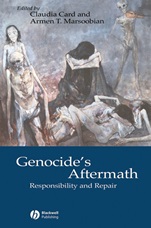
Genocides Aftermath: Responsibility and Repair
ISBN 9781405148481
Autor: Claudia Card, Armen T. Marsoobian
Wydawca: Wiley
Dostępność: 3-6 tygodni
Cena: 152,25 zł
Przed złożeniem zamówienia prosimy o kontakt mailowy celem potwierdzenia ceny.
ISBN13: |
9781405148481 |
ISBN10: |
1405148489 |
Autor: |
Claudia Card, Armen T. Marsoobian |
Oprawa: |
Paperback |
Rok Wydania: |
2007-02-06 |
Ilość stron: |
288 |
Wymiary: |
219x166 |
Tematy: |
HP |
The twentieth century has been indelibly marked as the century of genocide, while the twenty–first continues to perpetuate this dark legacy. The term itself, "genocide," was coined by Raphael Lemkin in 1944 to capture the peculiarly heinous mass killings of both the Jews in Europe from 1942 to 1945 and the Ottoman Armenians from 1915 to 1923. The atrocities committed by the Hutus of Rwanda against the Tutsis and the events currently unfolding in the Darfur region of Sudan perpetuate this legacy of genocide.
Genocide′s Aftermath takes up the hard moral dilemmas that have arisen in the wake of genocide and crimes against humanity. As we now attempt to rethink U.S. history through the lens of genocide, many historical occurrences, such as the national policy of slavery and the forcible removal of Native Americans from their lands, must be re–examined in the light of what we now identify as genocide. From the questions of guilt to the consideration of reconciliation and reparations, this volume of original essays represents the latest research in the moral issues that have developed in the aftermath of a century of genocide.
Notes on Contributors.
1. Introduction: Genocide s Aftermath: Claudia Card and Armen T. Marsoobian.
2. Genocide and Social Death: Claudia Card.
3. Clarifying the Concept of Genocide: Mohammed Abed.
4. Genocide and the Moral Agency of Ethnic Groups: Karen Kovach.
5. Moral Taint: Marina A. L. Oshana.
6. Collective Action and the Peculiar Evil of Genocide: Bill Wringe.
7. On the Possibilities of Group Injury: Stephen Winter.
8. The Counterfactual Conception of Compensation: Rodney C. Roberts.
9. Compensation and Reparation as Forms of Compensatory Justice: Haig Khatchadourian.
10. A Normative Theory of Reparations in Transitional Democracies: Ernesto Verdeja.
11. Prosecuting Military Leaders for War Crimes: Larry May.
12. Rethinking the Legitimacy of Truth Commissions: I Am the Enemy You Killed, My Friend : Nir Eisikovits.
13. Acknowledging and Rectifying the Genocide of American Indians: Why Is It That They Carry Their Lives on Their Fingernails? : William C. Bradford.
14. Epilogue: Reconciliation in the Aftermath of Genocide: Armen T. Marsoobian.
Index.
Claudia Card is the Emma Goldman Professor of Philosophy at the University of Wisconsin. She is the author of The Atrocity Paradigm: A Theory of Evil (2002), The Unnatural Lottery: Character and Moral Luck (1996), and Lesbian Choices (1995) and the editor of many books, most recently The Cambridge Companion to Simone de Beauvoir. She is currently a senior fellow at the Institute for Research in the Humanities (Madison, Wisconsin), where she is writing another book on evil and an introduction to feminist philosophy.
Armen T. Marsoobian is professor and chair of philosophy at Southern Connecticut State University. He is editor in chief of the Blackwell journal Metaphilosophy and has co–edited four books: Justus Buchler s Metaphysics of Natural Complexes (1990), Nature s Perspectives: Prospects for Ordinal Metaphysics (1991), The Philosophical Challenge of September 11 (2004), and The Blackwell Guide to American Philosophy (2004). He has published articles in aesthetics and American philosophy, and his current work deals with philosophical issues arising from genocide.
"This volume is a welcome addition to the wealth of scholarship on the topic of genocide, important for the heretofore penury of philosophical attention to this phenomenon ... This volume will be found valuable reading, if troubling and controversial in parts, by any educated adult and would also be useful as a provocative text in university studies of genocide." Wendy C. Hamblet, North Carolina A&T State University
Where genocide is concerned, philosophy and philosophers need approaches that are more heads–up and hands–on. Fortunately, Genocide′s Aftermath provides some significant examples of such philosophical work. The best work in this book favors historical specificity over theoretical abstraction. Notre Dame<!––end––>
Koszyk
Książek w koszyku: 0 szt.
Wartość zakupów: 0,00 zł
Informacje


Kontakt
Gambit
Centrum Oprogramowania
i Szkoleń Sp. z o.o.
Al. Pokoju 29b/22-24
31-564 Kraków
Siedziba Księgarni
ul. Kordylewskiego 1
31-542 Kraków
+48 12 410 5991
+48 12 410 5987
+48 12 410 5989
Subskrypcje
Administratorem danych osobowych jest firma Gambit COiS Sp. z o.o. Na podany adres będzie wysyłany wyłącznie biuletyn informacyjny.
Autoryzacja płatności

Informacje na temat autoryzacji płatności poprzez PayU.

© Copyright 2012: GAMBIT COiS Sp. z o.o. Wszelkie prawa zastrzeżone.
Projekt i wykonanie: Alchemia Studio Reklamy