


Wydawcy
Katalog tematyczny
- Archeologia (109)
- Ekonomia, finanse, business (13704)
- Filozofia (1445)
- Historia (3040)
- Języki i językoznawstwo (2356)
- Lifestyle, hobby i rozrywka (475)
- Medycyna (9704)
- Nauki humanistyczne (4)
- Nauki o Ziemi i środowisku (2638)
- Nauki ścisłe (20412)
- Nauki społeczne (8486)
- Edukacja (229)
- Kryminologia, opieka spełeczna (284)
- Obronność (10)
- Polityka (1389)
- Psychologia (777)
- Socjologia (410)
- Społeczeństwo i kultura (187)
- Nauki techniczne (13450)
- Prawo (1696)
- Publikacje informacyjne i interdyscyplinarne (1288)
- Religia i wierzenia (917)
- Technika komputerowa (4067)
- Zdrowie, relacje międzyludzkie i rozwój osobisty (657)





Informacje szczegółowe o książce
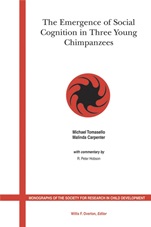
The Emergence of Social Cognition in Three Young Chimpanzees
ISBN 9781405147262
Autor: Michael Tomasello, Malinda Carpenter, R. Peter Hobson, Willis F. Overton
Wydawca: Wiley
Dostępność: 3-6 tygodni
Cena: 239,40 zł
Przed złożeniem zamówienia prosimy o kontakt mailowy celem potwierdzenia ceny.
ISBN13: |
9781405147262 |
ISBN10: |
1405147261 |
Autor: |
Michael Tomasello, Malinda Carpenter, R. Peter Hobson, Willis F. Overton |
Oprawa: |
Paperback |
Rok Wydania: |
2007-01-03 |
Ilość stron: |
168 |
Wymiary: |
228x152 |
Tematy: |
JC |
This Monograph examines a series of ten studies conducted on the social–cognitive abilities of three young chimpanzees, ages one to four years. In the studies, all previously conducted with human infants, showed the chimpanzees’ abilities to understand and imitate the goal–directed actions of others, but not their "rational" choices. Each exhibited the ability to understand the visual perception of others, but not the precise focus of their attention. There was no evidence of any ability to reverse roles with a partner in a collaborative interaction, to comprehend the communicative comprehensions behind a pointing gesture, or to engage in genuine joint attention with others. These results suggest that the ontogeny of human social cognition comprises two relatively distinct trajectories: one for understanding intentional action and perception, common to all apes, and another for sharing psychological states with others in collaborative acts involving joint intentions and attentions, unique to the human species.
Spis treści:
Abstract vii.
I. Introduction 1.
II. The Emergence of Social Cognition: A Longitudinal Study 29.
III. Understanding Intentional Action 46.
IV. Understanding Perception and Attention 73.
V. Joint Intentions and Attention 92.
VI. General Discussion 107.
References 123.
Acknowledgements 132.
Commentary– Social Engagement and Understanding in Chimpanzees and Humans.
R. Peter Hobson 133.
Contributors 153.
Statement of Editorial Policy 154
Nota biograficzna:
Michael Tomasello (Ph.D., 1980, Psychology, University of Georgia) taught
at Emory University and worked at Yerkes Primate Center from 1980 to
1998. Since 1998, he is Co–Director at the Max Planck Institute for Evolutionary
Anthropology, Leipzig, Germany. Research interests focus on
processes of social cognition, social learning, and communication and language
i
n human children and great apes. Books include Primate Cognition
(w/J. Call, Oxford University Press, 1997), The Cultural Origins of Human
Cognition (Harvard University Press, 1999), and Constructing a Language: A
Usage–Based Theory of Language Acquisition (Harvard University Press, 2003).
Malinda Carpenter (Ph.D., 1995, Psychology, Emory University) currently
is a member of the scientific staff of the Department of Developmental and
Comparative Psychology at the Max Planck Institute for Evolutionary Anthropology.
Her research interests include imitation and other types of
social learning, infants’ understanding of intentions and other mental states,
and joint attention and other early social–cognitive skills. She has worked
with typically developing infants and young children, young children with
autism, and apes.
R. Peter Hobson (Ph.D., 1989, FRCPsych, CPsychol) is Tavistock Professor
of Developmental Psychopathology in the University of London. He is an
experimental psychologist and psychiatrist (and psychoanalyst), trained at
Cambridge University and the Maudsley Hospital, London, and now at the
Tavistock Clinic, London and the Institute of Child Health, University College,
London. His primary research interest is the contribution of social
relations to early cognitive as well as social development. His principal fields
of study are early childhood autism, congenital blindness, mother–infant
relations, and adult borderline personality disorder. His first book was
entitled Autism and the development of mind (Erlbaum, 1993), and his second
more accessible and wide–ranging book is called The Cradle of Thought
(Oxford University Press, 2004).
Okładka tylna:
This Monograph examines a series of ten studies conducted on the social–cognitive abilities of three young chimpanzees, ages one to four years.
In the studies, all previously conducted with human infants, showed the chimpanzees’ abilities to understand and imitate the goal–directed actions of others, but not their "rational" choices. Each exhibited the ability to understand the visual perception of others, but not the precise focus of their attention. There was no evidence of any ability to reverse roles with a partner in a collaborative interaction, to comprehend the communicative comprehensions behind a pointing gesture, or to engage in genuine joint attention with others. These results suggest that the ontogeny of human social cognition comprises two relatively distinct trajectories: one for understanding intentional action and perception, common to all apes, and another for sharing psychological states with others in collaborative acts involving joint intentions and attentions, unique to the human species.
Koszyk
Książek w koszyku: 0 szt.
Wartość zakupów: 0,00 zł
Informacje


Kontakt
Gambit
Centrum Oprogramowania
i Szkoleń Sp. z o.o.
Al. Pokoju 29b/22-24
31-564 Kraków
Siedziba Księgarni
ul. Kordylewskiego 1
31-542 Kraków
+48 12 410 5991
+48 12 410 5987
+48 12 410 5989
Subskrypcje
Administratorem danych osobowych jest firma Gambit COiS Sp. z o.o. Na podany adres będzie wysyłany wyłącznie biuletyn informacyjny.
Autoryzacja płatności

Informacje na temat autoryzacji płatności poprzez PayU.

© Copyright 2012: GAMBIT COiS Sp. z o.o. Wszelkie prawa zastrzeżone.
Projekt i wykonanie: Alchemia Studio Reklamy