


Wydawcy
Katalog tematyczny
- Archeologia (109)
- Ekonomia, finanse, business (13704)
- Filozofia (1445)
- Historia (3040)
- Języki i językoznawstwo (2356)
- Lifestyle, hobby i rozrywka (475)
- Medycyna (9704)
- Nauki humanistyczne (4)
- Nauki o Ziemi i środowisku (2638)
- Nauki ścisłe (20412)
- Nauki społeczne (8486)
- Nauki techniczne (13450)
- Budownictwo lądowe (1045)
- Chemia przemysłowa (2258)
- Elektronika i telekomunikacja (3287)
- Energetyka (1122)
- Inne nauki stosowane (363)
- Inżynieria biochemiczna (507)
- Inżynieria transportu (232)
- Mechanika i materiały (3316)
- Nauka o środowisku (321)
- Rolnictwo (507)
- Technika, ogólnie (475)
- Prawo (1696)
- Publikacje informacyjne i interdyscyplinarne (1288)
- Religia i wierzenia (917)
- Technika komputerowa (4067)
- Zdrowie, relacje międzyludzkie i rozwój osobisty (657)





Informacje szczegółowe o książce
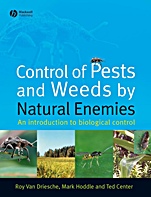
Control of Pests and Weeds by Natural Enemies: An Introduction to Biological Control
ISBN 9781405145718
Autor: Roy van Driesche, Mark Hoddle, Ted Center
Wydawca: Wiley
Dostępność: 3-6 tygodni
Cena: 408,45 zł
Przed złożeniem zamówienia prosimy o kontakt mailowy celem potwierdzenia ceny.
ISBN13: |
9781405145718 |
ISBN10: |
1405145714 |
Autor: |
Roy van Driesche, Mark Hoddle, Ted Center |
Oprawa: |
Paperback |
Rok Wydania: |
2008-04-15 |
Ilość stron: |
484 |
Wymiary: |
243x189 |
Tematy: |
TV |
Biological control – utilizing a population of natural enemies to seasonally or permanently suppress pests – is not a new concept. The cottony cushion scale, which nearly destroyed the citrus industry of California, was controlled by an introduced predatory insect in the 1880s. Accelerated invasions by insects and spread of weedy non–native plants in the last century have increased the need for the use of biological control. Use of carefully chosen natural enemies has become a major tool for the protection of natural ecosystems, biodiversity and agricultural and urban environments.
This book offers a multifaceted yet integrated discussion on two major applications of biological control: permanent control of invasive insects and plants at the landscape level and temporary suppression of both native and exotic pests in farms, tree plantations, and greenhouses. Written by leading international experts in the field, the text discusses control of invasive species and the role of natural enemies in pest management.
This book is essential reading for courses on Invasive Species, Pest Management, and Crop Protection. It is an invaluable reference book for biocontrol professionals, restorationists, agriculturalists, and wildlife biologists.
Further information and resources can be found on the Editor’s own website at: www.invasiveforestinsectandweedbiocontrol.info/index.htm
Spis treści:
Preface.
Part I: Scope of biological control.
1. Introduction.
2. Types of biological control, targets, and agents.
What is biological control?.
Permanent control over large areas.
Temporary pest suppression in production areas.
Kinds of targets and kinds of agents.
Part II: Kinds of natural enemies.
3. Parasitoid diversity and ecology.
What is a parasitoid?.
Terms and processes.
Some references to parasitoid families.
Groups of parasitoids.
Finding hosts.
Ho
st recognition and assessment.
Defeating host defenses.
Regulating host physiology.
Patch–time allocation.
4. Predator diversity and ecology.
Non–insect predators.
Major groups of predatory insects.
Overview of predator biology.
Predator foraging behavior.
Predators and pest control.
Effects of alternative foods on predator impact.
Interference of generalist predators with classical biological control agents.
Predator and prey defense strategies.
5. Weed biocontrol agent diversity and ecology.
The goal of weed biological control.
Terms and processes.
Herbivory and host finding.
Herbivore guilds.
Groups of herbivores and plant pathogens.
6. Arthropod pathogen diversity and ecology.
Bacterial pathogens of arthropods.
Viral pathogens of arthropods.
Fungal pathogens of arthropods.
Nematodes attacking arthropods.
Generalized arthropod pathogen life cycle.
Epidemiology: what leads to disease outbreaks?.
Part III: Invasions: why biological control is needed:.
7. The invasion crisis.
Urgency of the invasion crisis.
Case histories of four high–impact invaders.
The extent of harmful impact by invaders.
How do invasive species get to new places?.
Why do some invasions succeed but others fail?.
Invader ecology and impact.
8. Ways to suppress invasive species.
Prevention: heading off new invasions through sound policy.
Eradication based on early detection.
Invaders that do no harm.
Control of invasive pests in natural areas.
Factors affecting control in natural areas.
Control of invasive species in crops.
Part IV: Natural enemy introductions: theory and practice.
9. Interaction webs as the conceptual framework for classical biological control.
Terminology.
Forces setting plant population density.
Forces setting insect population density.
Predictions about pests based on food w
ebs.
10. The role of population ecology and population models in biological control: Joseph Elkinton (University of Massachusetts).
Basic concepts.
Population models.
11. Classical biological control.
Introduction.
Classical biological control.
New–association biological control.
Summary.
12. Weed biological control.
Differences and similarities between weed and arthropod programs.
Why plants become invasive.
Selecting suitable targets for weed biological control.
Conflicts of interest in weed biological control.
Faunal inventories: finding potential weed biological control agents.
Safety: “will those bugs eat my roses?”
Pre–release determination of efficacy.
How many agents are necessary for weed control?
Release, establishment, and dispersal.
Evaluation of impacts.
Non–target impacts.
When is a project successful?
Conclusions.
Part V: Tools for classical biological control.
13. Foreign exploration.
Planning and conducting foreign exploration.
Shipping natural enemies.
Operating a quarantine laboratory.
Managing insect colonies in quarantine.
Developing petitions for release into the environment.
14. Climate matching.
Climate matching.
Inductive modeling: predicting spread and incursion success.
Deductive modeling: predicting spread and incursion success.
Conclusions.
15. Molecular tools: Richard Stouthamer (University of California Riverside).
Types of molecular data.
Important biological control issues that molecular techniques can address.
Conclusions.
Part VI: Safety.
16. Non–target impacts of biological control agents.
Biological control as an evolving technology.
The amateur to early scientific period (1800–1920).
A developing science makes some mistakes (1920–70).
Broadening perspectives (1970–90).
Current pra
ctice and concerns.
“Re–greening” biological control.
17. Predicting natural enemy host ranges.
Literature records.
Surveys in the native range.
Laboratory testing to estimate host ranges.
Interpretation of tests.
Examples of host–range estimation.
Risk assessment.
18. Avoiding indirect non–target impacts.
Kinds of potential indirect effects.
Can risk of indirect impacts be reduced by predicting natural enemy efficacy?
Part VII: Measuring natural enemy impacts on pests.
19. Field colonization of natural enemies.
Limitations from the agent or recipient community.
Managing release sites.
Quality of the release.
Caging or other release methods.
Persistence and confirmation.
20. Natural enemy evaluation.
Natural enemy surveys in crops.
Pre–release surveys for classical biological control.
Post–release surveys to detect establishment and spread of new agents.
Post–release monitoring for non–target impacts.
Measurement of impacts on the pest.
Separating effects of a complex of natural enemies.
Economic assessment of biological control.
Part VIII: Conserving biological control agents in crops.
21. Protecting natural enemies from pesticides.
Problems with pesticides.
Super pests and missing natural enemies.
Dead wildlife and pesticide residues in food.
Cases when pesticides are the best tool.
How pesticides affect natural enemies.
Seeking solutions: physiological selectivity.
Pesticide–resistant natural enemies.
Ecological selectivity: using non–selective pesticides with skill.
Transgenic Bt crops: the ulimate ecologically selective pesticide.
22. Enhancing crops as natural enemy environments.
Problem 1: unfavorable crop varieties.
Solution 1: breeding natural enemy–friendly crops.
Problem 2: crop fields physically damaging to
Koszyk
Książek w koszyku: 0 szt.
Wartość zakupów: 0,00 zł
Informacje


Kontakt
Gambit
Centrum Oprogramowania
i Szkoleń Sp. z o.o.
Al. Pokoju 29b/22-24
31-564 Kraków
Siedziba Księgarni
ul. Kordylewskiego 1
31-542 Kraków
+48 12 410 5991
+48 12 410 5987
+48 12 410 5989
Subskrypcje
Administratorem danych osobowych jest firma Gambit COiS Sp. z o.o. Na podany adres będzie wysyłany wyłącznie biuletyn informacyjny.
Autoryzacja płatności

Informacje na temat autoryzacji płatności poprzez PayU.

© Copyright 2012: GAMBIT COiS Sp. z o.o. Wszelkie prawa zastrzeżone.
Projekt i wykonanie: Alchemia Studio Reklamy