


Wydawcy
Katalog tematyczny
- Archeologia (109)
- Ekonomia, finanse, business (13704)
- Filozofia (1445)
- Historia (3040)
- Języki i językoznawstwo (2356)
- Lifestyle, hobby i rozrywka (475)
- Medycyna (9704)
- Nauki humanistyczne (4)
- Nauki o Ziemi i środowisku (2638)
- Nauki ścisłe (20412)
- Nauki społeczne (8486)
- Nauki techniczne (13450)
- Prawo (1696)
- Publikacje informacyjne i interdyscyplinarne (1288)
- Religia i wierzenia (917)
- Technika komputerowa (4067)
- Zdrowie, relacje międzyludzkie i rozwój osobisty (657)





Informacje szczegółowe o książce
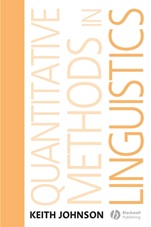
Quantitative Methods In Linguistics
ISBN 9781405144254
Autor: Keith Johnson
Wydawca: Wiley
Dostępność: 3-6 tygodni
Cena: 228,90 zł
Przed złożeniem zamówienia prosimy o kontakt mailowy celem potwierdzenia ceny.
ISBN13: |
9781405144254 |
ISBN10: |
1405144254 |
Autor: |
Keith Johnson |
Oprawa: |
Paperback |
Rok Wydania: |
2008-02-29 |
Ilość stron: |
296 |
Wymiary: |
241x144 |
Tematy: |
CF |
Quantitative Methods in Linguistics introduces the general strategies and methods of quantitative analysis. The book dedicates individual chapters to phonetics, psycholinguistics, sociolinguistics, historical linguistics, and syntax, as well as two introductory chapters on probability distribution and quantitative methods. Each chapter uses actual data sets which have been contributed by researchers working in the field to illustrate key principles. The book also provides detailed instruction in practical aspects of handling quantitative linguistic data by using statistical software package (R) to discover patterns in quantitative data and to test linguistic hypotheses. End–of–chapter assignments and a balanced presentation make this an ideal text for students. Further information and resources are available from the accompanying website at www.blackwellpublishing.com/quantmethods.
Acknowledgments. Design of the Book. 1. Fundamentals of Quantitative Analysis . 1.1 What We Accomplish in Quantitative Analysis. 1.2 How to Describe an Observation. 1.3 Frequency Distributions: A Fundamental Building Block of Quantitative Analysis. 1.4 Types of Distributions. 1.5 Is Normal Data, Well, Normal?. 1.6 Measures of Central Tendency. 1.7 Measures of Dispersion. 1.8 Standard Deviation of the Normal Distribution. Exercises. 2. Patterns and Tests . 2.1 Sampling. 2.2 Data. 2.3 Hypothesis Testing. 2.3.1 The Central Limit Theorem. 2.3.2 Score Keeping. 2.3.3 H0: µ = 100. 2.3.4 Type I and Type II Error. 2.4 Correlation. 2.4.1 Covariance and Correlation. 2.4.2 The Regression Line. 2.4.3 Amount of Variance Accounted For. Exercises. 3. Phonetics . 3.1 Comparing Mean Values. 3.1.1 Cherokee Voice Onset Time: µ1971=µ2001. 3.1.2 Samples Have Equal Variance. 3.1.3 If the Samples Do Not Have Equal Variance. 3.1.4 Paired t Test: Are Men Different from Women?. 3.1.5 The Sign Test. 3.2 Predicting the Back of the Tongue from the Front: Multiple Regression. 3.2.1 The Covariance Matrix. 3.2.2 More than One slope: The bi. 3.2.3 Selecting a Model. 3.3 Tongue Shape Factors: Principal Components Analysis. Exercises. 4. Psycholinguistics . 4.1 Analysis of Variance: One Factor, More than Two Levels. 4.2 Two Factors: Interaction. 4.3 Repeated Measures. 4.3.1 An Example of Repeated Measures ANOVA. 4.3.2 Repeated Measures ANOVA with a Between–Subjects Factor. 4.4 The “Language as Fixed Effect” Fallacy. 4.5 Exercises. 5. Sociolinguistics. 5.1 When the Data are Counts – Contingency Tables. 5.1.1 Frequency in a Contingency Table. 5.2 Working with Probabilities: The Binomial Distribution. 5.2.1 Bush or Kerry?. 5.3 An Aside about Maximum Likelihood Estimation. 5.4 Logistic Regression. 5.5 An Example from the [∫]treets of Columbus. 5.5.1 On the Relationship between x2 and G2. 5.5.2 More than One Predictor. 5.6 Logistic Regression as Regression: An Ordinal Effect – Age. 5.7 Varbrul/R Comparison. Exercises. 6. Historical Linguistics . 6.1 Cladistics: Where Linguistics and Evolutionary Biology Meet. 6.2 Clustering on the Basis of Shared Vocabulary. 6.3 Cladistic Analysis: Combining Character–Based Subtrees. 6.4 Clustering on the Basis of Spelling Similarity. 6.5 Multidimensional Scaling: A Language Similarity Space. Exercises. 7. Syntax . 7.1 Measuring Sentence Acceptability. 7.2 A Psychogrammatical Law?. 7.3 Linear Mixed Effects in the Syntactic Expression of Agents in English. 7.3.1 Linear Regression: Overall, and Separately by Verbs. 7.3.2 Fitting a Linear Mixed–Effects Model: Fixed and Random Effects. 7.3.3 Fitting Five More Mixed–Effects Models: Finding the Best Model. 7.4 Predicting the Dative Alternation: Logistic Modeling of Syntactic Corpora Data. 7.4.1 Logistic Model of Dative Alternation. 7.4.2 Evaluating the Fit of the Model. 7.4.3 Adding a Random Factor: Mixed Effects Logistic Regression. Exercises. Appendix 7A. References. Index
Keith Johnson is Professor of Linguistics at the University of California at Berkeley. He is the author of Acoustic and Auditory Phonetics, Second Edition (Blackwell, 2002), as well as numerous articles on phonetics and speech perception.
"As research in the language sciences becomes more interdisciplinary, students must become proficient in a wider range of data analysis methods. Johnson’s text is a comprehensive and detailed introduction to some of the most widely used statistical methods in language research. The book teaches by example, walking the reader through the analysis of data sets using the software package R, which provides concrete understanding of how to apply the methods, not just understand them conceptually. This is a good practical text, one that can serve as a handbook, and is appropriate for graduate students and advanced undergraduates who are doing research in the broad field of language." Mark A Pitt, Ohio State University "Johnson′s book is a catalyst for change in linguistics. Increasingly, the subjective, impressionistic data collection method is being replaced by objective, quantitative measurements. This book serves an important function in this process leading students step–by–step toward using statistical methods to analyze complex data." Chilin Shih, University of Illinois at Urbana–Champaign "This rich and rewarding textbook is a must–read for all students and researchers who wish to follow the new wave of sophisticated empirical models and methods now sweeping the field of linguistics from phonetics to syntax and semantics." Joan Bresnan, Stanford University
Koszyk
Książek w koszyku: 0 szt.
Wartość zakupów: 0,00 zł
Informacje


Kontakt
Gambit
Centrum Oprogramowania
i Szkoleń Sp. z o.o.
Al. Pokoju 29b/22-24
31-564 Kraków
Siedziba Księgarni
ul. Kordylewskiego 1
31-542 Kraków
+48 12 410 5991
+48 12 410 5987
+48 12 410 5989
Subskrypcje
Administratorem danych osobowych jest firma Gambit COiS Sp. z o.o. Na podany adres będzie wysyłany wyłącznie biuletyn informacyjny.
Autoryzacja płatności

Informacje na temat autoryzacji płatności poprzez PayU.

© Copyright 2012: GAMBIT COiS Sp. z o.o. Wszelkie prawa zastrzeżone.
Projekt i wykonanie: Alchemia Studio Reklamy