


Wydawcy
Katalog tematyczny
- Archeologia (109)
- Ekonomia, finanse, business (13704)
- Filozofia (1445)
- Historia (3040)
- Języki i językoznawstwo (2356)
- Lifestyle, hobby i rozrywka (475)
- Medycyna (9704)
- Nauki humanistyczne (4)
- Nauki o Ziemi i środowisku (2638)
- Nauki ścisłe (20412)
- Nauki społeczne (8486)
- Nauki techniczne (13450)
- Prawo (1696)
- Publikacje informacyjne i interdyscyplinarne (1288)
- Religia i wierzenia (917)
- Technika komputerowa (4067)
- Zdrowie, relacje międzyludzkie i rozwój osobisty (657)





Informacje szczegółowe o książce
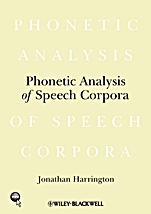
Phonetic Analysis of Speech Corpora
ISBN 9781405141697
Autor: Jonathan Harrington
Wydawca: Wiley
Dostępność: 3-6 tygodni
Cena: 609,00 zł
Przed złożeniem zamówienia prosimy o kontakt mailowy celem potwierdzenia ceny.
ISBN13: |
9781405141697 |
ISBN10: |
1405141697 |
Autor: |
Jonathan Harrington |
Oprawa: |
Hardback |
Rok Wydania: |
2010-03-12 |
Ilość stron: |
424 |
Wymiary: |
245x183 |
Tematy: |
CF |
The Phonetic Analysis of Speech Corpora introduces methods of analyzing phonetically–labelled speech corpora, with the goal of testing hypotheses that often arise in experimental phonetics and laboratory phonology. The book begins by discussing some of the techniques in digital speech processing and in structuring and querying annotations from speech corpora. The second half of the book focuses on analysis, including measuring gestural synchronization using electromagnetic articulometry (EMA), the acoustics of vowels, consonant overlap using electropalatography (EPG), spectral analysis of fricatives and obstruents, and the probabilistic classification of acoustic speech data.
Each chapter has an extensive set of exercises, with answers to reinforce the techniques introduced. An overview of the necessary software tools, including the R programming language, enables the reader to duplicate the stages of analysis computationally. Clearly laid out, with easy–to–follow computer commands, spectrograms of speech corpora, and a companion website with more illustrations and downloadable speech corpora for testing purposes, this book is a complete resource for the research increasingly conducted in phonetics.
Relationship between Machine Readable (MRPA) and International Phonetic Alphabet (IPA) for Australian English. Relationship between Machine Readable (MRPA) and International Phonetic Alphabet (IPA) for German. Downloadable Speech Databases Used in this Book. Preface. Notes on Downloading Software. 1. Using Speech Corpora in Phonetics Research. 1.1 The Place of Corpora in the Phonetic Analysis of Speech. 1.2 Existing Speech Corpora for Phonetic Analysis. 1.3 Designing Your Own Corpus. 1.4 Summary and Structure of the Book. 2. Some Tools for Building and Querying Annotated Speech Databases. 2.1 Overview. 2.2 Getting Started with Existing Speech Databases. 2.3 Interface between Praat and Emu. 2.4 Interface to R. 2.5 Creating a New Speech Database: From Praat to Emu to R. 2.6 A First Look at the Template File. 2.7 Summary. 2.8 Questions. 3. Applying Routines for Speech Signal Processing. 3.1 Introduction. 3.2 Calculating, Displaying, and Correcting Formants. 3.3 Reading the Formants into R. 3.4 Summary. 3.5 Questions. 3.6 Answers. 4. Querying Annotation Structures. 4.1 The Emu Query Tool, Segment Tiers, and Event Tiers. 4.2 Extending the Range of Queries: Annotations from the Same Tier. 4.3 Inter–tier Links and Queries. 4.4 Entering Structured Annotations with Emu. 4.5 Conversion of a Structured Annotation to a Praat TextGrid. 4.6 Graphical User Interface to the Emu Query Language. 4.7 Re–querying Segment Lists. 4.8 Building Annotation Structures Semi–automatically with Emu–Tcl. 4.9 Branching Paths. 4.10 Summary. 4.11 Questions. 4.12 Answers. 5. An Introduction to Speech Data Analysis in R: A Study of an EMA Database. 5.1 EMA Recordings and the ema5 Database. 5.2 Handling Segment Lists and Vectors in Emu–R. 5.3 An Analysis of Voice–Onset Time. 5.4 Intergestural Coordination and Ensemble Plots. 5.5 Intragestural Analysis. 5.6 Summary. 5.7 Questions. 5.8 Answers. 6. Analysis of Formants and Formant Transitions. 6.1 Vowel Ellipses in the F2ÍF1 Plane. 6.2 Outliers. 6.3 Vowel Targets. 6.4 Vowel Normalization. 6.5 Euclidean Distances. 6.6 Vowel Undershoot and Formant Smoothing. 6.7 F2 Locus, Place of Articulation, and Variability. 6.8 Questions. 6.9 Answers. 7. Electropalatography. 7.1 Palatography and Electropalatography. 7.2 An Overview of Electropalatography in Emu–R. 7.3 EPG Data–Reduced Objects. 7.4 Analysis of EPG Data. 7.5 Summary. 7.6 Questions. 7.7 Answers. 8. Spectral Analysis. 8.1 Background to Spectral Analysis. 8.2 Spectral Average, Sum, Ratio, Difference, Slope. 8.3 Spectral Moments. 8.4 The Discrete Cosine Transformation. 8.5 Questions. 8.6 Answers. 9. Classification. 9.1 Probability and Bayes Theorem. 9.2 Classification: Continuous Data. 9.3 Calculating Conditional Probabilities. 9.4 Calculating Posterior Probabilities. 9.5 Two Parameters: The Bivariate Normal Distribution and Ellipses. 9.6 Classification in Two Dimensions. 9.7 Classifications in Higher Dimensional Spaces. 9.8 Classifications in Time. 9.9 Support Vector Machines. 9.10 Summary. 9.11 Questions. 9.12 Answers. References. Index.
Jonathan Harrington is Professor of the Institute of Phonetics and Speech Processing (IPS), University of Munich, Germany. His recent research has primarily focused on modelling the acoustic and perceptual mechanisms of sound change. He is co–editor of Speech Production: Models, Phonetic Processes, and Techniques (with Marija Tabain, 2006) and Techniques in Speech Acoustics (with Steve Cassidy, 1999).
"The book undoubtedly succeeds entirely in its goal to provide an accessible and effective practical introduction to using Emu speech database system and Emu–R functions to analyze phonetic data. It is written in a clear and accessible language and the topics are introduced in a coherent and easy to follow manner with the complexity of the material gradually increasing from the beginning towards the end of the book. Even rather complicated concepts are made easy to understand with an exceptional use of analogy and a commendable restraint from going into too many mathematical and technical details...this is a well–written, well–structured, easy–to–follow workbook which boasts an excellent set of practical exercises and demonstrations and covers a wide range of techniques. Overall, those readers who have a basic background in phonetics and statistics and are prepared to work their way carefully through this book will be greatly rewarded with its informativeness and effectiveness." ( LINGUIST List, January 2011)
Koszyk
Książek w koszyku: 0 szt.
Wartość zakupów: 0,00 zł
Informacje


Kontakt
Gambit
Centrum Oprogramowania
i Szkoleń Sp. z o.o.
Al. Pokoju 29b/22-24
31-564 Kraków
Siedziba Księgarni
ul. Kordylewskiego 1
31-542 Kraków
+48 12 410 5991
+48 12 410 5987
+48 12 410 5989
Subskrypcje
Administratorem danych osobowych jest firma Gambit COiS Sp. z o.o. Na podany adres będzie wysyłany wyłącznie biuletyn informacyjny.
Autoryzacja płatności

Informacje na temat autoryzacji płatności poprzez PayU.

© Copyright 2012: GAMBIT COiS Sp. z o.o. Wszelkie prawa zastrzeżone.
Projekt i wykonanie: Alchemia Studio Reklamy