


Wydawcy
Katalog tematyczny
- Archeologia (109)
- Ekonomia, finanse, business (13704)
- Filozofia (1445)
- Historia (3040)
- Języki i językoznawstwo (2356)
- Lifestyle, hobby i rozrywka (475)
- Medycyna (9704)
- Nauki humanistyczne (4)
- Nauki o Ziemi i środowisku (2638)
- Nauki ścisłe (20412)
- Nauki społeczne (8486)
- Edukacja (229)
- Kryminologia, opieka spełeczna (284)
- Obronność (10)
- Polityka (1389)
- Psychologia (777)
- Socjologia (410)
- Społeczeństwo i kultura (187)
- Nauki techniczne (13450)
- Prawo (1696)
- Publikacje informacyjne i interdyscyplinarne (1288)
- Religia i wierzenia (917)
- Technika komputerowa (4067)
- Zdrowie, relacje międzyludzkie i rozwój osobisty (657)





Informacje szczegółowe o książce
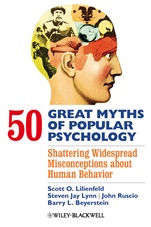
50 Great Myths of Popular Psychology: Shattering Widespread Misconceptions about Human Behavior
ISBN 9781405131124
Autor: Scott O. Lilienfeld, Steven Jay Lynn, John Ruscio, Barry L. Beyerstein
Wydawca: Wiley
Dostępność: 3-6 tygodni
Cena: 154,35 zł
Przed złożeniem zamówienia prosimy o kontakt mailowy celem potwierdzenia ceny.
ISBN13: |
9781405131124 |
ISBN10: |
1405131128 |
Autor: |
Scott O. Lilienfeld, Steven Jay Lynn, John Ruscio, Barry L. Beyerstein |
Oprawa: |
Paperback |
Rok Wydania: |
2009-09-04 |
Ilość stron: |
352 |
Wymiary: |
236x154 |
Tematy: |
JC |
In a society in which psychological knowledge is shaped as much, if not more, by supermarket tabloids, talk shows, and self–proclaimed "self–help gurus" as it is by the latest scientific advances, there is a pressing need for a book that helps students and the public distinguish fact from fiction in the world of psychology. 50 Great Myths of Popular Psychology answers this need by using popular myths as a vehicle for distinguishing science from pseudoscience. Organized around key topic areas of modern psychology such as brain functioning, perception, development, memory, emotion, intelligence, learning, personality, mental illness, and psychotherapy, this book will help students and laypersons to critically evaluate the information and misinformation that is generated by popular psychology.
Spis treści:
Preface.
Acknowledgments.
Introduction.
The Wide World of Psychomythology.
1 Brain Power.
Myths about the Brain and Perception.
#1 Most People Use Only 10% of Their Brain Power.
#2 Some People Are Left–Brained, Others Are Right–Brained.
#3 Extrasensory Perception Is a Well–Established Scientific Phenomenon.
#4 Visual Perceptions Are Accompanied by Tiny Emissions from the Eyes.
#5 Subliminal Messages Can Persuade People to Purchase Products.
2 From Womb to Tomb.
Myths about Development and Aging.
#6 Playing Mozart′s Music to Infants Boosts Their Intelligence.
#7 Adolescence Is Inevitably a Time of Psychological Turmoil.
#8 Most People Experience a Midlife Crisis in Their 40s or Early 50s.
#9 Old Age Is Typically Associated with Increased Dissatisfaction and Senility.
#10 When Dying, People Pass through a Universal Series of Psychological Stages.
3 A Remembrance of Things Past.
Myths about Memory.
#11 Human Memory Works like a Tape Recorder or Video Camera, and Accurately Records the Events We′ve Experienced.
#12 Hy
pnosis is Useful for Retrieving Memories of Forgotten Events.
#13 Individuals Commonly Repress the Memories of Traumatic Experiences.
#14 Most People with Amnesia Forget All Details of Their Earlier Lives.
4 Teaching Old Dogs New Tricks.
Myths about Intelligence and Learning.
#15 Intelligence Tests Are Biased against Certain Groups of People.
#16 If You′re Unsure of Your Answer When Taking a Test, It′s Best to Stick with Your Initial Hunch.
#17 The Defining Feature of Dyslexia Is Reversing Letters.
#18 Students Learn Best When Teaching Styles Are Matched to Their Learning Styles.
5 Altered States.
Myths about Consciousness.
#19 Hypnosis Is a Unique "Trance" State that Differs in Kind from Wakefulness.
#20 Researchers Have Demonstrated that Dreams Possess Symbolic Meaning.
#21 Individuals Can Learn Information, like New Languages, while Asleep.
#22 During "Out–of–Body" Experiences, People′s Consciousness Leaves Their Bodies.
6 I′ve Got a Feeling.
Myths about Emotion and Motivation.
#23 The Polygraph ("Lie Detector") Test Is an Accurate Means of Detecting Dishonesty.
#24 Happiness Is Determined Mostly by Our External Circumstances.
#25 Ulcers Are Caused Primarily or Entirely by Stress.
#26 A Positive Attitude Can Stave off Cancer.
7 The Social Animal.
Myths about Interpersonal Behavior.
#27 Opposites Attract: We Are Most Romantically Attracted to People Who Differ from Us.
#28 There′s Safety in Numbers: The More People Present at an Emergency, the Greater the Chance that Someone Will Intervene.
#29 Men and Women Communicate in Completely Different Ways.
#30 It’s Better to Express Anger to Others than to Hold It in.
8 Know Thyself.
Myths about Personality.
#31 Raising Children Similarly Leads to Similarities in Their Adult Personalities.
#32 The Fact that a Trait Is Heritable Means We Can′t C
hange It.
#33 Low Self–Esteem Is a Major Cause of Psychological Problems.
#34 Most People Who Were Sexually Abused in Childhood Develop Severe Personality Disturbances in Adulthood.
#35 People′s Responses to Inkblots Tell Us a Great Deal about Their Personalities.
#36 Our Handwriting Reveals Our Personality Traits.
9 Sad, Mad, and Bad.
Myths about Mental Illness.
#37 Psychiatric Labels Cause Harm by Stigmatizing People.
#38 Only Deeply Depressed People Commit Suicide.
#39 People with Schizophrenia Have Multiple Personalities.
#40 Adult Children of Alcoholics Display a Distinct Profile of Symptoms.
#41 There′s Recently Been a Massive Epidemic of Infantile Autism.
#42 Psychiatric Hospital Admissions and Crimes Increase during Full Moons.
10 Disorder in the Court.
Myths about Psychology and the Law.
#43 Most Mentally Ill People Are Violent.
#44 Criminal Profiling Is Helpful in Solving Cases.
#45 A Large Proportion Of Criminals Successfully Use the Insanity Defense.
#46 Virtually All People Who Confess to a Crime Are Guilty of It.
11 Skills and Pills.
Myths about Psychological Treatment.
#47 Expert Judgment and Intuition Are the Best Means of Making Clinical Decisions.
#48 Abstinence Is the Only Realistic Treatment Goal for Alcoholics.
#49 All Effective Psychotherapies Force People to Confront the "Root" Causes of Their Problems in Childhood.
#50 Electroconvulsive ("Shock") Therapy Is a Physically Dangerous and Brutal Treatment.
Postscript.
Truth is Stranger than Fiction.
Appendix.
Recommended Websites for Exploring Psychomythology.
References.
Index.
Nota biograficzna:
Scott O. Lilienfeld is a Professor of Psychology at Emory University. He is a recipient of the 1998 David Shakow Early Career Award for Distinguished Contributions to Clinical Psychology from Division 12 (Society for Clinical
Psychology) of the APA, past president of the Society for a Science of Clinical Psychology, and a Fellow of the Association for Psychological Science. Dr. Lilienfeld′s principal areas of research are personality disorders, psychiatric classification and diagnosis, pseudoscience in mental health, and the teaching of psychology.
Steven Jay Lynn is a Professor of Psychology at the State University of New York at Binghamton. He is past President of the APA’s Division of Psychological Hypnosis, and the recipient of the Chancellor′s Award of the SUNY for Scholarship and Creative Activities. His major areas of research include hypnosis and memory.
John Ruscio is an Associate Professor of Psychology at The College of New Jersey. His scholarly interests include quantitative methods for psychological research and the characteristics of pseudoscience that distinguish subjects within and beyond the fringes of psychological science.
Barry Beyerstein (the late) was Professor of Psychology at Simon Fraser University and chair of the British Columbia Skeptics Society. He was Associate Editor of the Scientific Review of Alternative Medicine, and he co–authored many articles in the Skeptical Inquirer and professional journals.
Okładka tylna:
In a society in which psychological knowledge is shaped as much, if not more, by supermarket tabloids, talk shows, and self–proclaimed "self–help gurus" as it is by the latest scientific advances, there is a pressing need for a book that helps students and the public distinguish fact from fiction in the world of psychology. 50 Great Myths of Popular Psychology answers this need by using popular myths as a vehicle for distinguishing science from pseudoscience. Organized around key topic areas of modern psychology such as brain functioning, perception, development, memory, emotion, intelligence, learning, personality, mental illness, and p
sychotherapy, this book will help students and laypersons to critically evaluate the information and misinformation that is generated by popular psychology.
Koszyk
Książek w koszyku: 0 szt.
Wartość zakupów: 0,00 zł
Informacje


Kontakt
Gambit
Centrum Oprogramowania
i Szkoleń Sp. z o.o.
Al. Pokoju 29b/22-24
31-564 Kraków
Siedziba Księgarni
ul. Kordylewskiego 1
31-542 Kraków
+48 12 410 5991
+48 12 410 5987
+48 12 410 5989
Subskrypcje
Administratorem danych osobowych jest firma Gambit COiS Sp. z o.o. Na podany adres będzie wysyłany wyłącznie biuletyn informacyjny.
Autoryzacja płatności

Informacje na temat autoryzacji płatności poprzez PayU.

© Copyright 2012: GAMBIT COiS Sp. z o.o. Wszelkie prawa zastrzeżone.
Projekt i wykonanie: Alchemia Studio Reklamy