


Wydawcy
Katalog tematyczny
- Archeologia (109)
- Ekonomia, finanse, business (13704)
- Filozofia (1445)
- Historia (3040)
- Języki i językoznawstwo (2356)
- Lifestyle, hobby i rozrywka (475)
- Medycyna (9704)
- Chirurgia (272)
- Inne gałęzie medycyny (1871)
- Medycyna kliniczna (4187)
- Medycyna niekonwencjonalna (14)
- Medycyna przedkliniczna (269)
- Medycyna, ogólnie (1740)
- Historia medycyny (3)
- Lekarze, sprawy zawodowe (8)
- Medycyna, aspekty prawne (10)
- Służba zdrowia (36)
- Wyposażenie medyczne (157)
- Zdrowie publiczne (460)
- Medyczne służby pomocnicze (745)
- Studia medyczne (16)
- Weterynaria (548)
- Nauki humanistyczne (4)
- Nauki o Ziemi i środowisku (2638)
- Nauki ścisłe (20412)
- Nauki społeczne (8486)
- Nauki techniczne (13450)
- Prawo (1696)
- Publikacje informacyjne i interdyscyplinarne (1288)
- Religia i wierzenia (917)
- Technika komputerowa (4067)
- Zdrowie, relacje międzyludzkie i rozwój osobisty (657)





Informacje szczegółowe o książce
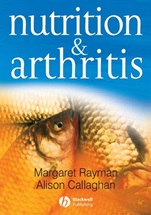
Nutrition and Arthritis
ISBN 9781405124188
Autor: Margaret Rayman, Alison Callaghan
Wydawca: Wiley
Dostępność: 3-6 tygodni
Cena: 473,55 zł
Przed złożeniem zamówienia prosimy o kontakt mailowy celem potwierdzenia ceny.
ISBN13: |
9781405124188 |
ISBN10: |
1405124180 |
Autor: |
Margaret Rayman, Alison Callaghan |
Oprawa: |
Paperback |
Rok Wydania: |
2006-08-02 |
Ilość stron: |
282 |
Wymiary: |
241x172 |
Tematy: |
MB |
Arthritis affects millions of people throughout the world and while its treatment is usually medical or surgical, there exists an increasingly large body of evidence concerning the positive effects of nutrition on the condition.
There are over two hundred forms of rheumatoid disease, with conditions varying in prevalence. In this important title the authors have focussed on osteoarthritis (OA) and rheumatoid arthritis (RA), the most common arthritic diseases with the largest body of dietary data. Including coverage of disease incidence and prevalence, pathology, aetiology and measures of disease assessment and dietary risk factors, Nutrition and Arthritis is a clear, concise and user–friendly book gathering the latest research to bring the reader state–of–the–art information on:
Micronutrients (e.g. vitamins C, D and selenium), food supplements and their potential to ameliorate arthritis
Polyunsaturated fatty acids, with particular attention paid to n–3 fatty acids
Glucosamine and chondroitin
The value of exclusion, vegetarian, vegan and other dietary approaches
Nutritionists and dietitians, including those working in the health services, rheumatologists, orthopaedic surgeons, general practitioners, osteopaths and commercial organisations involved in the formulation of dietary supplements will find this book an important and practical reference source. Libraries in medical schools and universities and research establishments where nutrition, dietetics and food science are studied and taught will find it a valuable addition to their shelves.
Spis treści:
Acknowledgements.
Abbreviations.
CHAPTER 1: INTRODUCTION.
1.1 The range of rheumatic diseases.
1.2 Rheumatoid arthritis (RA): description.
1.3 Osteoarthritis (OA): description.
1. 4 Incidence and prevalence.
1.5 Mortality.
1.6 Morbidity.
1.7 Economic cost of arthritis.
1.8
The aim of this book.
CHAPTER 2: CLASSIFICATION, PATHOLOGY AND MEASURES OF DISEASE ASSESSMENT.
2.1 Classification of OA.
2.2 Classification of RA.
2.3 Pathology of OA.
2.3.1 General features of OA.
2.3.3.1 Cartilage degradation.
2.3.3.2 Nitric oxide synthesis damages chondrocytes.
2.3.3.3 Sulphation pattern of GAGs in articular cartilage.
2.3.3.4 Bone changes.
2.3.3.5 Inflammation.
2.3.3.6 Angiogenesis.
2.3.3.7 Oxidative stress.
2.3.2 Structure of cartilage.
2.3.3 Pathogenesis of OA.
2.4 Pathology of RA.
2.4.1 General features of RA.
2.4.2 Immunopathogenesis and production of inflammatory mediators.
2.4.3 Autoantibodies: rheumatoid factor.
2.4.4 Glycosylation patterns of IgG and complement activation.
2.4.5 Dietary lectins, gut translocation and the shared epitope.
2.4.6 Abnormal gut microflora.
2.4.7 Reactive oxygen and nitrogen species involved in damage to the rheumatoid joint.
2.4.7.1 Phagocytosis.
2.4.7.2 Hypoxia–reperfusion injury and joint pH.
2.4.7.3 Involvement of nitric oxide and peroxynitrite.
2.4.7.4 Consequences of the production of reactive oxygen and nitrogen species in the RA joint.
2.4.8 Lipid abnormalities and cardiovascular risk in RA.
2.4.8.1 C–Reactive Protein (CRP).
2.4.8.2 Dyslipidaemia.
2.4.8.3 Endothelial dysfunction.
2.4.8.4 Oxidised–LDL in the joint and the formation of fatty streaks.
2.4.8.5 Adhesion molecules.
2.4.8.6 Haemostatic changes.
2.4.8.7 Elevated homocysteine and vitamin B6 status.
2.4.8.8 Elevated homocysteine and impaired sulphur metabolism.
2.4.8.9 Insulin resistance.
2.4.9 Angiogenesis.
2.4.10 Osteoporosis.
2.5 Assessment of severity of RA and OA.
2.5.1 Outcome measures for rheumatoid arthritis.
2.5.1.1 Patient′s global assessment.
2.5.1.2 Pain.
2.5.1.3 Disability.
2.5.1.4 Swollen and tender joint counts.
2.5.1.5 Acute phase reactants.
2.5.1.6 RA Quality of Life In
dex.
2.5.1.7 Radiological assessment.
2.5.2 Some outcome measures for OA.
2.5.2.1 Patient global assessment.
2.5.2.2 Pain score.
2.5.2.3 New joint score.
2.5.2.4 Severity score.
2.5.2.5 Disability.
2.5.2.6 Radiological assessment.
CHAPTER 3: AETIOLOGY AND RISK FACTORS FOR RHEUMATOID ARTHRITIS AND OSTEOARTHRITIS.
3.1 Introduction.
3.2 Genetic risk factors.
3.3 Age.
3.4 Gender.
3.5 Biomechanical factors as risk factors for OA.
3.5.1 Occupation, sport and physical activity.
3.5.2 Joint trauma and surgery.
3.5.3 Load distribution and malalignment.
3.5.4 Muscle weakness.
3.6 Obesity.
3.7 Smoking.
3.8 Dietary factors.
3.8.1 Olive oil.
3.8.2 Fish and n–3 PUFA.
3.8.3 Meat.
3.8.4 Fruit and Vegetables.
3.8.5 Antioxidants.
3.8.6 Vitamin C.
3.8.7 b–Cryptoxanthin.
3.9 Beverage consumption.
3.9.1 Coffee and tea.
3.9.2 Alcohol 3.10 Hormones, OA and RA 3.11 Medical risk factors for RA.
3.11.1 Infection and microorganisms 3.11.2 Blood transfusions.
3.11.3 Haemochromatosis.
CHAPTER 4: CURRENT MANAGEMENT OF OSTEOARTHRITIS AND RHEUMATOID ARTHRITIS.
4. 1 Overview of current treatment.
4.2 Medication.
4.2.1.Analgesia.
4.2.2 Nonsteroidal Anti–Inflammatory Drugs (NSAIDs).
4.2.3Disease Modifying Anti–Rheumatic Drugs (DMARDS).
4.2.4Biological agents (anti–cytokine therapy).
4.2.5Glucocorticoids4.3 Surgical management.
4.3.1 Preventative.
4.3.2 Preservative.
4.3.3 Corrective.
4.3.4 Salvage.
4.4 Physiotherapy and occupational therapy management.
4.4.1 Physiotherapy.
4.4.2 Occupational therapy.
4.5 Acupuncture.
CHAPTER 5: NUTRITIONAL STATUS AND ADEQUACY OF THE DIET IN RHEUMATOID ARTHRITIS AND OSTEOARTHRITIS.
5.1 Introduction.
5. 2 Body mass index (BMI).
5.2.1 Low BMI and rheumatoid cachexia.
5.2.1 High BMI.
5.3 Malnutrition and malnutrition screening.
5.4 Macronutrient intake.
5.5 Micronutrient i
ntake and deficiency in RA.
5.7 Importance of individual assessment.
5.6 Drug nutrient interactions.
CHAPTER 6: POPULAR DIETARY APPROACHES.
6.1 Introduction.
6.2 Well–known popular diets.
6.3 Food avoidance.
6. 4 Supplements.
CHAPTER 7: EXCLUSION, VEGETARIAN, VEGAN AND OTHER DIETARY APPROACHES IN RHEUMATOID ARTHRITIS.
7.1 Introduction.
7.2 Exclusion diets.
7.3 Vegan and vegetarian diets.
7.4 The Mediterranean diet.
7.5 Elemental diets.
7.6 Summary of dietary findings.
7.7 Possible mechanisms by which exclusion, elemental, vegan and vegetarian diets may exert their effects on RA.
7.7.1 Food allergy or intolerance.
7.7.2 Alteration of gastro–intestinal permeability.
7.7.3 Effect of lectins.
7.7.4 Alteration to gut flora: pre– and pro–biotic dietary components.
7.7.5 Weight reduction and associated immunosuppression.
7.7.6 Placebo effect.
7.8 Risks of undertaking dietary modifications.
CHAPTER 8: ROLE OF MICRONUTRIENTS IN THE AMELIORATION OF RHEUMATOID ARTHRITIS AND OSTEOARTHRITIS.
8.1 Introduction.
8. 2 Antioxidants in the body.
8. 3 Vitamins A, C and E and b–carotene and their role in RA and OA.
8.3.1 Description and functions of vitamins A, C and E and b–carotene.
8.3.2 Studies of vitamins A, C and E and b–carotene in RA and OA.
8.3.3 Conclusions and recommendations from these studies.
8.4 Selenium in RA and OA.
8.4.1 Functions of selenium relevant to RA and OA.
8.4.2 Selenium status in OA and RA patients.
8.4.3 Prospective and intervention studies with selenium.
8.4.4 Recommendations for selenium intake.
8.5 Copper, zinc and RA and OA.
8.5.1 Functions of copper and zinc relevant to RA and OA.
8.5.2 Copper and zinc status in OA and RA patients.
8.5.3 Intervention studies with copper and zinc.
8.5.4 Recommendations for intake of copper and zinc in RA and OA.
8. 6 Iron in RA and OA.
8.6.1 Functions of iro
Koszyk
Książek w koszyku: 0 szt.
Wartość zakupów: 0,00 zł
Informacje


Kontakt
Gambit
Centrum Oprogramowania
i Szkoleń Sp. z o.o.
Al. Pokoju 29b/22-24
31-564 Kraków
Siedziba Księgarni
ul. Kordylewskiego 1
31-542 Kraków
+48 12 410 5991
+48 12 410 5987
+48 12 410 5989
Subskrypcje
Administratorem danych osobowych jest firma Gambit COiS Sp. z o.o. Na podany adres będzie wysyłany wyłącznie biuletyn informacyjny.
Autoryzacja płatności

Informacje na temat autoryzacji płatności poprzez PayU.

© Copyright 2012: GAMBIT COiS Sp. z o.o. Wszelkie prawa zastrzeżone.
Projekt i wykonanie: Alchemia Studio Reklamy