


Wydawcy
Katalog tematyczny
- Archeologia (109)
- Ekonomia, finanse, business (13704)
- Filozofia (1445)
- Historia (3040)
- Języki i językoznawstwo (2356)
- Lifestyle, hobby i rozrywka (475)
- Medycyna (9704)
- Nauki humanistyczne (4)
- Nauki o Ziemi i środowisku (2638)
- Nauki ścisłe (20412)
- Nauki społeczne (8486)
- Nauki techniczne (13450)
- Prawo (1696)
- Publikacje informacyjne i interdyscyplinarne (1288)
- Religia i wierzenia (917)
- Technika komputerowa (4067)
- Zdrowie, relacje międzyludzkie i rozwój osobisty (657)





Informacje szczegółowe o książce
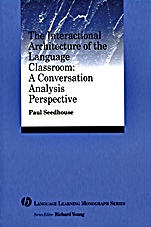
The Interactional Architecture of the Language Classroom: A Conversation Analysis Perspective
ISBN 9781405120098
Autor: Paul Seedhouse, Richard F. Young
Wydawca: Wiley
Dostępność: 3-6 tygodni
Cena: 241,50 zł
Przed złożeniem zamówienia prosimy o kontakt mailowy celem potwierdzenia ceny.
ISBN13: |
9781405120098 |
ISBN10: |
1405120096 |
Autor: |
Paul Seedhouse, Richard F. Young |
Oprawa: |
Paperback |
Rok Wydania: |
2005-01-05 |
Ilość stron: |
316 |
Wymiary: |
229x152 |
Tematy: |
CF |
Winner of the MLA Kenneth W. Mildenberger Prize 2005 This monograph provides a model of the organisation of L2 classroom interaction and a practical methodology for its analysis. The main thesis is that there is a reflexive relationship between pedagogy and interaction in the L2 classroom; this relationship is the foundation of its context–free architecture. Chapter 1 explains the basic principles of Conversation Analysis (CA), while Chapter 2 reviews the literature on L2 classroom interaction. Chapters 3 and 4 portray the reflexive relationship between the pedagogical focus of the interaction and the organisation of turn–taking, sequence and repair. As the pedagogical focus varies, so the organisation of turn, sequence and repair varies. Chapter 5 describes the overall organisation of L2 classroom interaction and Chapter 6 illustrates the use of the analytical methodology. Chapter 7 considers how CA can contribute to the research agendas of Applied Linguistics and Second Language Acquisition. The discussion is illustrated by numerous extracts from an extensive database of language lessons from around the world.
Series Editor’s Foreword. Acknowledgments. Chapter 1 Conversation Analysis Methodology. 1.1 History and Development of Conversation Analysis. 1.2 Ethnomethodology. 1.3 The Principles of Ethnomethodology. 1.4 Aims of Conversation Analysis. 1.5 Principles of Conversation Analysis. 1.6 Types of Interactional Organization. 1.7 Conversation Analysis Procedures. 1.8 Attitude Toward Context. 1.9 Ethnomethodological Conversation. 1.10 Chapter Summary. Notes. Chapter 2 Different Perspectives on Language Classroom Interaction. 2.1 Discourse Analysis Approaches. 2.2 The Communicative Approach to Second Language Classroom Interaction. 2.3 Dynamic and Variable Approaches to Classroom Interaction. 2.4 Database Issues. 2.5 Adequacy of Database for the Study of Second Language Classroom Interaction. 2.6 Ethnography. 2.7 The Pedagogical Landing–Ground Perspective. 2.8 A Conversation Analysis Institutional–Discourse Perspective. 2.9 Chapter Summary. Notes. Chapter 3 The Organization of Turn Taking and Sequence in Language Classrooms. 3.1 Turn Taking and Sequence in Form–and–Accuracy Contexts. 3.2 Turn Taking and Sequence in Meaning–and–Fluency Contexts. 3.3 Turn Taking and Sequence in Task–Oriented Contexts. 3.4 Turn Taking and Sequence in Procedural Contexts. 3.5 Methodological Issues. 3.6 Chapter Summary. Notes. Chapter 4 The Organization of Repair in Language Classrooms. 4.1 Repair in Form–and–Accuracy Contexts. 4.2 Repair in Meaning–and–Fluency Contexts. 4.3 Repair in Task–Oriented Contexts. 4.4 Discussion. 4.5 Practical Applications of a Contextual Approach to Repair. 4.6 The Preference Organization of Repair: The Case of the Missing “No.” 4.7 Strategies for Conducting Repair Without Using Direct Negative Evaluation. 4.8 Examples of the Use of Mitigated Negative Evaluation. 4.9 Why Is There a Dispreference for Direct and Unmitigated Negative Evaluation? 4.10 A Different Preference Structure in Relation to Procedural Trouble. 4.11 The Paradox: Pedagogy and Interaction in Opposition. 4.12 Conclusions. 4.13 Chapter Summary. Notes. Chapter 5 The Organization of Language Classroom Interaction. 5.1 A Sketch of the Interactional Architecture of the Second Language Classroom. 5.2 The Basic Sequence Organization. 5.3 A Methodology for the Analysis of Second Language Classroom Interaction. 5.4 Talking the Institution of the Second Language Classroom In and Out of Being. 5.5 The Concept of Second Language Classroom Contexts. 5.6 A Three–Way View of Context. 5.7 Creating a Second Language Classroom. 5.8 Managing Context Shift. 5.9 Chapter Summary. Notes. Chapter 6 Conversation Analysis, Applied Linguistics, and Second Language Acquisition. 6.1 Conversation Analysis and Applied Linguistics. 6.2 Conversation Analysis and Second Language Acquisition. 6.3 Recasts. 6.4 Focus–on–Form Instruction. 6.5 Conversation Analysis as a Social Science Research Methodology. 6.6 Chapter Summary. Notes. Chapter 7 Epilogue. Appendix 1 Transcription Conventions. Appendix 2 Resources for Conversation Analysis Research in Applied Linguistics and Second Language Acquisition. References. Index.
Dr. Paul Seedhouse is Postgraduate Research Director in the School of Education, communication and Language Sciences at the University of Newcastle upon Tyne, UK. After teaching ESOL, German and French in five different countries, he has published widely in journals of applied linguistics, language teaching and pragmatics and has edited the forthcoming collection Applying Conversation Analysis .
“The book has important implications for understanding what is possible in language classrooms as a part of educational institutions, and is particularly illuminating in challenging some of the tenets of communicative methodology. Given that CA attempts to describe the uniqueness of specific interactions, but uses what it claims is a ‘context–free’ machinery, and the fact that the database is wide–ranging, the book is likely to have relevance for second and foreign language teaching across a wide range of contexts .” – Thomas Morton, University of Leeds – Applied Linguistics
Koszyk
Książek w koszyku: 0 szt.
Wartość zakupów: 0,00 zł
Informacje


Kontakt
Gambit
Centrum Oprogramowania
i Szkoleń Sp. z o.o.
Al. Pokoju 29b/22-24
31-564 Kraków
Siedziba Księgarni
ul. Kordylewskiego 1
31-542 Kraków
+48 12 410 5991
+48 12 410 5987
+48 12 410 5989
Subskrypcje
Administratorem danych osobowych jest firma Gambit COiS Sp. z o.o. Na podany adres będzie wysyłany wyłącznie biuletyn informacyjny.
Autoryzacja płatności

Informacje na temat autoryzacji płatności poprzez PayU.

© Copyright 2012: GAMBIT COiS Sp. z o.o. Wszelkie prawa zastrzeżone.
Projekt i wykonanie: Alchemia Studio Reklamy