


Wydawcy
Katalog tematyczny
- Archeologia (109)
- Ekonomia, finanse, business (13704)
- Filozofia (1445)
- Historia (3040)
- Języki i językoznawstwo (2356)
- Lifestyle, hobby i rozrywka (475)
- Medycyna (9704)
- Nauki humanistyczne (4)
- Nauki o Ziemi i środowisku (2638)
- Nauki ścisłe (20412)
- Astronomia (294)
- Biologia (5119)
- Biochemia (575)
- Biologia człowieka (14)
- Biologia komórkowa (377)
- Biologia molekularna (398)
- Biologia rozwoju (130)
- Biologia, ogólnie (1277)
- Botanika (280)
- Hydrobiologia (92)
- Mikrobiologia (363)
- Mykologia (22)
- Zoologia (303)
- Chemia (6540)
- Fizyka (3309)
- Matematyka (4574)
- Nauki ścisłe, ogólnie (503)
- Nauki społeczne (8486)
- Nauki techniczne (13450)
- Prawo (1696)
- Publikacje informacyjne i interdyscyplinarne (1288)
- Religia i wierzenia (917)
- Technika komputerowa (4067)
- Zdrowie, relacje międzyludzkie i rozwój osobisty (657)





Informacje szczegółowe o książce
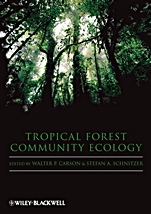
Tropical Forest Community Ecology
ISBN 9781405118972
Autor: Walter Carson, Stefan Schnitzer
Wydawca: Wiley
Dostępność: 3-6 tygodni
Cena: 403,20 zł
Przed złożeniem zamówienia prosimy o kontakt mailowy celem potwierdzenia ceny.
ISBN13: |
9781405118972 |
ISBN10: |
1405118970 |
Autor: |
Walter Carson, Stefan Schnitzer |
Oprawa: |
Paperback |
Rok Wydania: |
2008-09-12 |
Ilość stron: |
536 |
Wymiary: |
243x173 |
Tematy: |
PS |
Historically, tropical ecology has been a science often content with descriptive and demographic approaches, which is understandable given the difficulty of studying these ecosystems and the need for basic demographic information. Nonetheless, over the last several years, tropical ecologists have begun to test more sophisticated ecological theory and are now beginning to address a broad array of questions that are of particular importance to tropical systems, and ecology in general. Why are there are so many species in tropical forests and what mechanisms are responsible for the maintenance of that vast species diversity? What factors control species coexistence? Are there common patterns of species abundance and distribution across broad geographic scales? What is the role of trophic interactions in these complex ecosystems? How can these fragile ecosystems be conserved?
Tropical Forest Community Ecology includes contributions from some of the world’s leading tropical ecologists who address these key issues and many others, providing a unique and timely summary of this discipline.
Spis treści:
Preface. Walter P. Carson and Stefan A. Schnitzer.
Foreword. S. Joseph Wright.
List of Contributors.
SECTION 1 INTRODUCTION.
1 Scope of the Book and Key Contributions. Stefan A. Schnitzer and Walter P. Carson.
SECTION 2 LARGE–SCALE PATTERNS IN TROPICAL COMMUNITIES.
2 Spatial Variation in Tree Species Composition Across Tropical Forests: Pattern and Process. Jérôme Chave.
3 The Disparity in Tree Species Richness among Tropical, Temperate, and Boreal Biomes: The Geographic Area and Age Hypothesis. Paul V.A. Fine, Richard H. Ree, and Robyn J. Burnham.
4 Explaining Geographic Range Size by Species Age: A Test Using Neotropical Piper Species. John R. Paul and Stephen J. Tonsor.
5 Patterns of Herbivory and Defense in Tropical Dry and Rain
Forests. Rodolfo Dirzo and Karina Boege.
6 Ecological Organization, Biogeography, and the Phylogenetic Structure of Tropical Forest Tree Communities. Campbell O.Webb, Charles H. Cannon, and Stuart J. Davies.
7 Large Tropical Forest Dynamics Plots: Testing Explanations for the Maintenance of Species Diversity. Jess K. Zimmerman, Jill Thompson, and Nicholas Brokaw.
SECTION 3 TESTING THEORIES OF FOREST REGENERATION AND THE MAINTENANCE OF SPECIES DIVERSITY.
8 Tropical Forest Ecology: Sterile or Virgin for Theoreticians? Egbert G. Leigh, Jr.
9 Approaching Ecological Complexity from the Perspective of Symmetric Neutral Theory. Stephen P. Hubbell.
10 Functional Basis for Resource Niche Partitioning by Tropical Trees. Kaoru Kitajima and Lourens Poorter.
11 Colonization–related Trade–offs in Tropical Forests and Their Role in the Maintenance of Plant Species Diversity. Helene C. Muller–Landau.
12 Treefall Gaps and the Maintenance of Plant Species Diversity in Tropical Forests. Stefan A. Schnitzer, Joseph Mascaro, and Walter P. Carson.
13 Challenges Associated with Testing and Falsifying the Janzen–Connell Hypothesis: A Review and Critique. Walter P. Carson, Jill T. Anderson, Egbert G. Leigh, Jr, and Stefan A. Schnitzer.
14 Seed Limitation and the Coexistence of Pioneer Tree Species. James W. Dalling and Robert John.
15 Endophytic Fungi: Hidden Components of Tropical Community Ecology. A. Elizabeth Arnold.
SECTION 4 ANIMAL COMMUNITY ECOLOGY AND TROPHIC INTERACTIONS.
16 Tropical Tritrophic Interactions: Nasty Hosts and Ubiquitous Cascades. Lee A. Dyer.
17 Variation in Tree Seedling and Arbuscular Mycorrhizal Fungal Spore Responses to the Exclusion of Terrestrial Vertebrates: Implications for How Vertebrates Structure Tropical Communities. Tad C. Theimer and Catherine A. Gehring.
18 Ecosystem Decay in Clo
sed Forest Fragments. John Terborgh and Kenneth Feeley.
19 Resource Limitation of Insular Animals: Causes and Consequences. Gregory H. Adler.
20 Tropical Arboreal Ants: Linking Nutrition to Roles in Rainforest Ecosystems. Diane W. Davidson and Steven C. Cook.
21 Soil Fertility and Arboreal Mammal Biomass in Tropical Forests. Carlos A. Peres.
SECTION 5 SECONDARY FOREST SUCCESSION, DYNAMICS, AND INVASION.
22 Processes Constraining Woody Species Succession on Abandoned Pastures in the Tropics: On the Relevance of Temperate Models of Succession. Chris J. Peterson and Walter P. Carson.
23 Chance and Determinism in Tropical Forest Succession. Robin L. Chazdon.
24 Exotic Plant Invasions in Tropical Forests: Patterns and Hypotheses. Julie S. Denslow and Saara J. DeWalt.
SECTION 6 TROPICAL FOREST CONSERVATION.
25 Linking Insights from Ecological Research with Bioprospecting to Promote Conservation, Enhance Research Capacity, and Provide Economic Uses of Biodiversity. Thomas A. Kursar, Todd L. Capson, Luis Cubilla–Rios, Daniel A. Emmen, William Gerwick, Mahabir P. Gupta, Maria V. Heller, Kerry McPhail, Eduardo Ortega–Barría, Dora I. Quiros, Luz I. Romero, Pablo N. Solis, and Phyllis D. Coley.
26 Tropical Rainforest Conservation: A Global Perspective. Richard T. Corlett and Richard B. Primack.
27 Environmental Promise and Peril in the Amazon. William F. Laurance.
28 Contributions of Ecologists to Tropical Forest Conservation. Francis E. Putz and Pieter A. Zuidema.
Index
Nota biograficzna:
Dr. Walter P. Carson obtained his doctorate from Cornell University and did postdoctoral work at both Princeton University and the University of Minnesota USA. He has conducted extensive research on the ecology of both tropical and temperate forests. He is currently an Associate Professor at the University of Pittsburgh, PA
, USA.
Dr. Stefan A. Schnitzer obtained his doctorate from the University of Pittsburgh, followed by postdoctoral research at the University of Minnesota USA and Wageningen University in The Netherlands. He has studied tropical forests in Borneo, Costa Rica, Ecuador, French Guiana, and the Republic of Panama. Dr. Schnitzer is currently an Assistant Professor at the University of Wisconsin–Milwaukee, Wisconsin USA and a Research Associate with the Smithsonian Tropical Research Institute in the Republic of Panama.
Okładka tylna:
Historically, tropical ecology has been a science often content with descriptive and demographic approaches, which is understandable given the difficulty of studying these ecosystems and the need for basic demographic information. Nonetheless, over the last several years, tropical ecologists have begun to test more sophisticated ecological theory and are now beginning to address a broad array of questions that are of particular importance to tropical systems, and ecology in general. Why are there are so many species in tropical forests and what mechanisms are responsible for the maintenance of that vast species diversity? What factors control species coexistence? Are there common patterns of species abundance and distribution across broad geographic scales? What is the role of trophic interactions in these complex ecosystems? How can these fragile ecosystems be conserved?
Tropical Forest Community Ecology includes contributions from some of the world’s leading tropical ecologists who address these key issues and many others, providing a unique and timely summary of this discipline.
Koszyk
Książek w koszyku: 0 szt.
Wartość zakupów: 0,00 zł
Informacje


Kontakt
Gambit
Centrum Oprogramowania
i Szkoleń Sp. z o.o.
Al. Pokoju 29b/22-24
31-564 Kraków
Siedziba Księgarni
ul. Kordylewskiego 1
31-542 Kraków
+48 12 410 5991
+48 12 410 5987
+48 12 410 5989
Subskrypcje
Administratorem danych osobowych jest firma Gambit COiS Sp. z o.o. Na podany adres będzie wysyłany wyłącznie biuletyn informacyjny.
Autoryzacja płatności

Informacje na temat autoryzacji płatności poprzez PayU.

© Copyright 2012: GAMBIT COiS Sp. z o.o. Wszelkie prawa zastrzeżone.
Projekt i wykonanie: Alchemia Studio Reklamy