


Wydawcy
Katalog tematyczny
- Archeologia (109)
- Ekonomia, finanse, business (13704)
- Filozofia (1445)
- Historia (3040)
- Języki i językoznawstwo (2356)
- Lifestyle, hobby i rozrywka (475)
- Medycyna (9704)
- Nauki humanistyczne (4)
- Nauki o Ziemi i środowisku (2638)
- Nauki ścisłe (20412)
- Nauki społeczne (8486)
- Nauki techniczne (13450)
- Prawo (1696)
- Publikacje informacyjne i interdyscyplinarne (1288)
- Religia i wierzenia (917)
- Technika komputerowa (4067)
- Zdrowie, relacje międzyludzkie i rozwój osobisty (657)





Informacje szczegółowe o książce
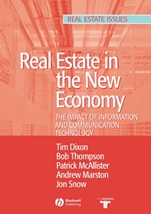
Real Estate and the New Economy: The Impact of Information and Communications Technology
ISBN 9781405117784
Autor: Tim Dixon, Bob Thompson, Patrick McAllister, Andrew Marston, Jon Snow
Wydawca: Wiley
Dostępność: 3-6 tygodni
Cena: 580,65 zł
Przed złożeniem zamówienia prosimy o kontakt mailowy celem potwierdzenia ceny.
ISBN13: |
9781405117784 |
ISBN10: |
1405117788 |
Autor: |
Tim Dixon, Bob Thompson, Patrick McAllister, Andrew Marston, Jon Snow |
Oprawa: |
Paperback |
Rok Wydania: |
2005-02-17 |
Ilość stron: |
440 |
Wymiary: |
243x173 |
Tematy: |
KM |
Private sector commercial property represents some £400 bn, or 34% of total UK business assets and is a vital fabric for housing commercial enterprise. Yet social and economic forces for change, linked with new technology, are making owners and occupiers question the very nature and purpose of property and real estate.
Printing, steam power; canals and railroads; mass media and, more recently, information and communications technology (ICT) have brought about major changes in both organisational and economic structures over the centuries. On the one hand, there has been much hype about the role that ICT would play in eliminating the need for physical real estate space; and on the other, some have suggested that institutional factors and fixed costs mitigate against transformative change in real estate.
Building on the authors′ own research and a growing body of new, international findings in the field, the book provides a balanced view between these two positions. It will demonstrate how ICT affects the shape and form of real estate in our towns and cities, with other forces in the new economy.
The book:
examines how ICT and organisational change, combined with social, political and economic factors, affects real estate space demand
analyses how real estate strategies are changing to reflect these trends
shows how technology affects the geography and space of real estate and infrastructure in our towns and cities
investigates future urban shape and form.
Spis treści:
The Authors.
Foreword by Paul McNamara, Prudential Property.
Investment Managers.
Preface.
Table of Responsibilities.
Introduction.
1.1 Background.
1.2 Aim and objectives.
1.3 Definitions.
1.4 Technological change; alternative perspectives.
1.5 Summary – an overview.
1.6 An integrative socio–technical framework for ICT and real estate.
1.7 Examples of the soc
io–technical approach.
1.8 Key themes of the book.
Section 1 Context and Framework.
2. The Social, Economics and Political Context of ICT Transformation.
2.1 Introduction.
2.2 Understanding the role of technological change in society.
2.3 Towards an information society and the new economy.
2.4 The role of knowledge and innovation in policy.
2.5 Information society policy development in the UK.
2.6 Measuring the information society.
2.7 Implications of the development of an information society.
2.8 Summary.
3.Technological Change: Diffusion and Adoption of ICT by Consumers, Businesses and Governments.
3.1 Introduction.
3.2 Technology diffusion.
3.3 Implications of ICT diffusion for consumers, businesses and government.
3.4 Internet–driven activities: eBusiness, eCommerce and eWork.
3.5 Some implications of ICT adoption for real estate.
3.6 Summary.
4. Business Process and Organisational Change.
4.1 Introduction.
4.2 Understanding corporate change.
4.3 ICT and the design of organisations.
4.4 Generic business processes.
4.5 Procurement.
4.6 Operational management.
4.7 Marketing.
4.8 Customer relationship management.
4.9 Accounting.
4.10 Recruitment.
4.11 Stock management.
4.12 Financial management.
4.13 Mapping processes to property.
4.14 Summary.
5. The New Economy and Real Estate.
5.1 Introduction.
5.2 What is the new economy.
5.3 The evidence for a new economy.
5.4 The role of real estate in the new economy.
5.5 Summary.
Section 2 Real Estate Spaces and the Impact of ICT.
6. Real Estate Spaces.
6.1 Introduction.
6.2 The paradox of location in the new economy.
6.3 Physical form and virtual reality.
6.4 Transactions in space.
6.5 Personal space.
6.6 Private space.
6.7 Summary.
7. Real Estate Use and ICT.
7.1 Introduction.
7.2 Sales.
7.3 Processing.
7.4 Manu
facturing.
7.5 Storage.
7.6 Leisure and living.
7.7 Summary.
8. Real Estate Service Providers and ICT.
8.1 Introduction.
8.2 The changing context of real estate investment.
8.3 The owner’s manager.
8.4 The occupier’s manager.
8.5 Appraisers.
8.6 Brokers.
8.7 Summary.
Section 3 The Future.
9. New directions and Policy Implications: The Future of Real Estate in the New Economy.
9.1 Introduction.
9.2 The socio–technical framework.
9.3 Summary.
9.4 New types of real estate.
9.5 Implications of ICT transformation for existing real estate.
9.6 Policy issues.
9.7 Future visions.
9.8 Is there still a future for real estate in the new economy?.
References.
Index
Okładka tylna:
Private sector commercial property represents some £400 bn, or 34% of total UK business assets and is a vital fabric for housing commercial enterprise. Yet social and economic forces for change, linked with new technology, are making owners and occupiers question the very nature and purpose of property and real estate.
Printing, steam power; canals and railroads; mass media and, more recently, information and communications technology (ICT) have brought about major changes in both organisational and economic structures over the centuries. On the one hand, there has been much hype about the role that ICT would play in eliminating the need for physical real estate space; and on the other, some have suggested that institutional factors and fixed costs mitigate against transformative change in real estate.
Building on the authors′ own research and a growing body of new, international findings in the field, the book provides a balanced view between these two positions. It will demonstrate how ICT affects the shape and form of real estate in our towns and cities, with other forces in the new economy.
The book:
examines how ICT and organisatio
nal change, combined with social, political and economic factors, affects real estate space demand
analyses how real estate strategies are changing to reflect these trends
shows how technology affects the geography and space of real estate and infrastructure in our towns and cities
investigates future urban shape and form.
Koszyk
Książek w koszyku: 0 szt.
Wartość zakupów: 0,00 zł
Informacje


Kontakt
Gambit
Centrum Oprogramowania
i Szkoleń Sp. z o.o.
Al. Pokoju 29b/22-24
31-564 Kraków
Siedziba Księgarni
ul. Kordylewskiego 1
31-542 Kraków
+48 12 410 5991
+48 12 410 5987
+48 12 410 5989
Subskrypcje
Administratorem danych osobowych jest firma Gambit COiS Sp. z o.o. Na podany adres będzie wysyłany wyłącznie biuletyn informacyjny.
Autoryzacja płatności

Informacje na temat autoryzacji płatności poprzez PayU.

© Copyright 2012: GAMBIT COiS Sp. z o.o. Wszelkie prawa zastrzeżone.
Projekt i wykonanie: Alchemia Studio Reklamy