


Wydawcy
Katalog tematyczny
- Archeologia (109)
- Ekonomia, finanse, business (13704)
- Filozofia (1445)
- Historia (3040)
- Języki i językoznawstwo (2356)
- Lifestyle, hobby i rozrywka (475)
- Medycyna (9704)
- Nauki humanistyczne (4)
- Nauki o Ziemi i środowisku (2638)
- Nauki ścisłe (20412)
- Nauki społeczne (8486)
- Nauki techniczne (13450)
- Prawo (1696)
- Publikacje informacyjne i interdyscyplinarne (1288)
- Religia i wierzenia (917)
- Technika komputerowa (4067)
- Zdrowie, relacje międzyludzkie i rozwój osobisty (657)





Informacje szczegółowe o książce
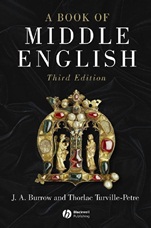
A Book of Middle English
ISBN 9781405117081
Autor: J. A. Burrow, Thorlac Turville–Petre
Wydawca: Wiley
Dostępność: 3-6 tygodni
Cena: 651,00 zł
Przed złożeniem zamówienia prosimy o kontakt mailowy celem potwierdzenia ceny.
ISBN13: |
9781405117081 |
ISBN10: |
1405117087 |
Autor: |
J. A. Burrow, Thorlac Turville–Petre |
Oprawa: |
Hardback |
Rok Wydania: |
2004-09-16 |
Numer Wydania: |
3rd Edition |
Ilość stron: |
436 |
Wymiary: |
240x155 |
Tematy: |
CF |
This authoritative textbook introduces readers to the wide range of literature written in England between 1150 and 1400. The book opens with an introduction to the language of the time, designed to enable the reader to understand the representative pieces of Middle English literature that follow. The authors describe the language as it was used in different parts of the country, show how it evolved over this period, and offer guidance on pronunciation, grammar, metre and vocabulary. Already a standard classroom text, A Book of Middle English has been extensively enhanced for the third edition. The authors have revised key works in light of new editions, updated bibliographic entries, and have added two substantial new extracts, from Pearl and from Chaucer′s Troilus and Criseyde .
List of illustrations. Preface to the Third Edition. Abbreviations. Part One: . 1 Introducing Middle English. 1.1 The Period. 1.1.1 From Old to Middle English. 1.1.2 From Middle to Modern English. 1.2 Varieties of Middle English. 1.2.1 Regional Dialects. 1.2.2 Early and Late Middle English. 1.2.3 Spelling. 2 Pronouncing Middle English. 2.1 Introduction. 2.2 Vowels. 2.2.1 The Long Vowels. 2.2.2 The Short Vowels. 2.2.3 Unstressed Final –e. 2.2.4 The Diphthongs. 2.3 Consonants. 2.4 Stress. 3 Vocabulary. 3.1 Introduction. 3.2 Scandinavian. 3.3 English, French and Latin. 3.4 Latin Loan–Words. 3.5 French Loan–Words. 4 Inflexions. 4.1 Introduction. 4.1.1 The Inflexional System. 4.1.2 Loss of Inflexional Endings. 4.2 Nouns. 4.2.1 Introduction. 4.2.2 Noun Inflexions: Early Southern Texts. 4.2.3 Developments in Noun Inflexions. 4.2.4 Genitive Singular Without Ending. 4.2.5 Unchanged Plurals. 4.2.6 Mutated Plurals. 4.3 Pronouns and Articles. 4.3.1 Forms of the Personal Pronouns. 4.3.2 First and Second Person Pronouns. 4.3.3 Third Person Pronouns: Masculine and Neuter Singular. 4.3.4 Third Person Pronouns: Feminine Singular. 4.3.5 Third Person Pronouns: Plural. 4.3.6 The Definite Article. 4.3.7 Demonstratives. 4.3.8 The Indefinite Article. 4.4. Adjectives and Adverbs. 4.4.1 Definite and Indefinite Inflexions. 4.4.2 Inflexions for Case. 4.4.3 Comparison of Adjectives. 4.4.4 Comparison of Adverbs. 4.5 Verbs. 4.5.1 Introduction. 4.5.2 Present Tense. 4.5.3 Past Tense and Past Participle. 4.5.4 Past of Weak Verbs. 4.5.5 The Verbs ‘Have’ and ‘Say’. 4.5.6 Past of Strong Verbs. 4.5.7 Irregular Verbs. 4.5.8 The Verb ‘To Be’. 5 Syntax. 5.1 Gender. 5.2 Number. 5.3 Use of Cases. 5.3.1 Nominative and Accusative. 5.3.2 Genitive. 5.3.3 Dative. 5.4 Pronouns and Articles. 5.4.1 Þou and Зe. 5.4.2 Non–expression of Personal Pronouns. 5.4.3 Man. 5.4.4 Self. 5.4.5 Reflexive Pronouns. 5.4.6 Relative Pronouns. 5.4.7 The Articles. 5.5. Adjectives and Adverbs. 5.5.1 Position. 5.5.2 Comparatives and Superlatives. 5.5.3 Adjectives as Nouns. 5.6 Verbs. 5.6.1 Use of Present Tense. 5.6.2 Use of Past Tense. 5.6.3 Auxiliaries of the Past. 5.6.4 Auxiliaries of the Future: shall and will. 5.6.5 The Infinitive. 5.6.6 The Subjunctive. 5.6.7 The Imperative. 5.6.8 Impersonal Verbs. 5.6.9 Verbs of Motion. 5.6.10 The Passive. 5.7 Negation. 5.8 Questions. 5.9 Word–Order. 5.9.1 Inversion. 5.9.2 The Object. 5.9.3 Prepositions. 5.9.4 Relative Clauses. 5.9.5 Adverbial Phrases. 5.9.6 Verb in Final Position. 5.10 Recapitulation and Anticipation. 6 Metre. 6.1 Introduction. 6.2 Rhymed Verse. 6.3 Alliterative Verse. 6.4 LaЗamon’s Brut. 7 From Manuscript to Printed Text. 8 Select Bibliography. 8.1 Bibliographies and Indexes. 8.2 Language Studies. 8.3 General Studies of the Literature. 8.4 Studies of Particular Genres. 8.5 Historical and Social Studies . Part Two: Prose and Verse Texts: . Note on Treatment of Texts. 1 The Peterborough Chronicle 1137. 2 The Owl and the Nightingale. 3 LaЗamon: Brut. 4 Ancrene Wisse. 5 Sir Orfeo. 6 The Cloud of Unknowing. 7 William Langland: Piers Plowman. 8 Patience. 9 Sir Gawain and the Green Knight. 10 Pearl. 11 St Erkenwald. 12 John Trevisa: Dialogue between a Lord and a Clerk. 13 John Gower: Confessio Amantis. 14 Lyrics. 15 The York Play of the Crucifixion. 16 Geoffrey Chaucer: The Parliament of Fowls. 17 Geoffrey Chaucer: Troilus and Criseyde. 18 Geoffrey Chaucer: The Canterbury Tales. Textual Notes. Glossary
J.A. Burrow is Emeritus Professor at Bristol University. His many publications include Medieval Writers and their Work (1982) and Gestures and Looks in Medieval Narrative (2002). Thorlac Turville–Petre is Professor of Medieval English Literature at the University of Nottingham. His previous publications include England the Nation (1996) and The Piers Plowman Electronic Archive , Vol. 2: Trinity College, Cambridge, MS B.15.19 (CD–ROM, 2000).
"Classroom experience with this authoritative and accessible introduction to Middle English confirms that this is now our best available vademecum to the subject. The appearance of a third edition of Burrow and Turville–Petre′s Book of Middle English is good news to teachers and students of Middle English." Fred Robinson, Yale University "Currently the most lucid and illuminating introduction to the language of Middle English, with an excellent selection of literary texts chosen and annotated to suggest the interest, sophistication, and variety of Middle English writing from the Peterborough Chronicle through the works of Chaucer and his contemporaries." Andrew Galloway, Cornell University
Koszyk
Książek w koszyku: 0 szt.
Wartość zakupów: 0,00 zł
Informacje


Kontakt
Gambit
Centrum Oprogramowania
i Szkoleń Sp. z o.o.
Al. Pokoju 29b/22-24
31-564 Kraków
Siedziba Księgarni
ul. Kordylewskiego 1
31-542 Kraków
+48 12 410 5991
+48 12 410 5987
+48 12 410 5989
Subskrypcje
Administratorem danych osobowych jest firma Gambit COiS Sp. z o.o. Na podany adres będzie wysyłany wyłącznie biuletyn informacyjny.
Autoryzacja płatności

Informacje na temat autoryzacji płatności poprzez PayU.

© Copyright 2012: GAMBIT COiS Sp. z o.o. Wszelkie prawa zastrzeżone.
Projekt i wykonanie: Alchemia Studio Reklamy