


Wydawcy
Katalog tematyczny
- Archeologia (109)
- Ekonomia, finanse, business (13704)
- Filozofia (1445)
- Historia (3040)
- Języki i językoznawstwo (2356)
- Lifestyle, hobby i rozrywka (475)
- Medycyna (9704)
- Nauki humanistyczne (4)
- Nauki o Ziemi i środowisku (2638)
- Nauki ścisłe (20412)
- Nauki społeczne (8486)
- Nauki techniczne (13450)
- Prawo (1696)
- Publikacje informacyjne i interdyscyplinarne (1288)
- Religia i wierzenia (917)
- Technika komputerowa (4067)
- Zdrowie, relacje międzyludzkie i rozwój osobisty (657)





Informacje szczegółowe o książce
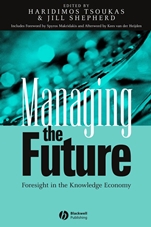
Managing the Future: Foresight in the Knowledge Economy
ISBN 9781405116152
Autor: Haridimos Tsoukas, Jill Shepherd
Wydawca: Wiley
Dostępność: 3-6 tygodni
Cena: 200,55 zł
Przed złożeniem zamówienia prosimy o kontakt mailowy celem potwierdzenia ceny.
ISBN13: |
9781405116152 |
ISBN10: |
1405116153 |
Autor: |
Haridimos Tsoukas, Jill Shepherd |
Oprawa: |
Paperback |
Rok Wydania: |
2004-05-18 |
Ilość stron: |
244 |
Wymiary: |
255x179 |
Tematy: |
KM |
At a time of ever–accelerating change, when more and more organizations find themselves operating in high–velocity environments, the ability to look ahead, prepare for the future, and help create it is more crucial than ever.
The book consists of ten papers written by leading authors from both sides of the Atlantic and from Asia, all of whom are distinguished scholars in the fields of strategy or organizational learning. The papers address four key issues: how organizational foresight can be conceptualized; how organizations make sense of themselves and their environments; how the capability for strategic foresight can be developed; and to what extent strategic foresight in organizations is possible.
Spis treści:
Figures.
Tables.
Notes on the Contributors.
Foreword: Foresight Matters (Spyros Makridakis).
1. Introduction: Organizations and The Future, From Forecasting To Foresight (Haridimos Tsoukas And Jill Shepherd).
Part I: Making Sense Of Organizational Foresight.
2. Re–Educating Attention: What Is Foresight And How Is It Cultivated (Robert Chia).
3. Invention And Navigation As Contrasting Metaphors Of The Pathways To The Future (V.K. Narayan And Liam Fahey).
4. Strategy And Time: Really Recognizing The Future (T.K. Das).
Part II: Foresight And Organizational Learning.
5. Foresight Or Foreseeing? A Social Action Explanation Of Complex Collective Knowing (David R. Schwandt And Margaret Gorman).
6. Retrospective Sensemaking And Foresight: Studying The Past To Prepare For The Future (Raanan Lipshitz, Neta Ron & Micha Popper).
7. Can Illusion Of Control Destroy A Firm’s Competence? The Case Of Forecasting Ability (Rudolph Durand).
Part III: Developing Foresightful Organizations.
8. Time Travelling: Organizational Foresight As Temporal Reflexivity (Miguel Pina E. Cunha).
9. The Concept Of "Weak Signals" Revisited: A Re–Description From A C
onstructivist Perspective (David Seidl).
10. Meta–Rules For Entrepreneurial Foresight (Ted Fuller, Paul Argyle and Paul Moran).
11. Autopoietic Limitations Of Probing The Future (Deborah Blackman And Steven Henderson).
Afterword: Insights Into Foresight (Kees van der Heijden).
Index
Nota biograficzna:
Haridimos Tsoukas is the George D. Mavros Research Professor of Organization and Management at the Athens Laboratory of Business Administration (ALBA), Greece and Professor of Organization Studies, Warwick Business School, UK. He has published widely in several leading academic journals, including the Academy of Management Review, Strategic Management Journal, Organization Studies, Organization Science, Journal of Management Studies, and Human Relations. He is the Editor–in–Chief of Organization Studies, serves on the Editorial Board of several journals and is co–editor of The Oxford Handbook of Organization Theory: Meta–theoretical Perspectives (OUP, 2003).
Jill Shepherd is Assistant Professor of Management at the Faculty of Business Administration, Simon Fraser University, and co–organizer of the First International Conference on Organizational Foresight in the Knowledge Economy. Her research interests centre around the use of evolutionary theory, particularly a branch called memetics, to investigate knowledge creation and innovation within corporates, high tech firms and clusters. Prior to becoming an academic, Jill worked in industry both in an international corporate setting and in a ‘dot.com’ and operated as an international management consultant for a number of years.
Okładka tylna:
At a time of ever–accelerating change, when more and more organizations find themselves operating in high–velocity environments, the ability to look ahead, prepare for the future, and help create it is more crucial than ever. The book consists of ten papers written by leading authors from both sides of the Atlantic and from Asia, all of whom are distinguished scholars in the fields of strategy or organizational learning. The papers address four key issues: how organizational foresight can be conceptualized; how organizations make sense of themselves and their environments; how the capability for strategic foresight can be developed; and to what extent strategic foresight in organizations is possible.
Koszyk
Książek w koszyku: 0 szt.
Wartość zakupów: 0,00 zł
Informacje


Kontakt
Gambit
Centrum Oprogramowania
i Szkoleń Sp. z o.o.
Al. Pokoju 29b/22-24
31-564 Kraków
Siedziba Księgarni
ul. Kordylewskiego 1
31-542 Kraków
+48 12 410 5991
+48 12 410 5987
+48 12 410 5989
Subskrypcje
Administratorem danych osobowych jest firma Gambit COiS Sp. z o.o. Na podany adres będzie wysyłany wyłącznie biuletyn informacyjny.
Autoryzacja płatności

Informacje na temat autoryzacji płatności poprzez PayU.

© Copyright 2012: GAMBIT COiS Sp. z o.o. Wszelkie prawa zastrzeżone.
Projekt i wykonanie: Alchemia Studio Reklamy