


Wydawcy
Katalog tematyczny
- Archeologia (109)
- Ekonomia, finanse, business (13704)
- Filozofia (1445)
- Historia (3040)
- Języki i językoznawstwo (2356)
- Lifestyle, hobby i rozrywka (475)
- Medycyna (9704)
- Nauki humanistyczne (4)
- Nauki o Ziemi i środowisku (2638)
- Nauki ścisłe (20412)
- Nauki społeczne (8486)
- Nauki techniczne (13450)
- Prawo (1696)
- Publikacje informacyjne i interdyscyplinarne (1288)
- Religia i wierzenia (917)
- Technika komputerowa (4067)
- Zdrowie, relacje międzyludzkie i rozwój osobisty (657)





Informacje szczegółowe o książce
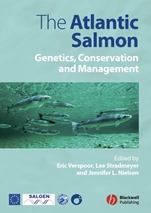
The Atlantic Salmon: Genetics, Conservation and Management
ISBN 9781405115827
Autor: Eric Verspoor, Lee Stradmeyer, Jennifer L. Nielsen
Wydawca: Wiley
Dostępność: 3-6 tygodni
Cena: 1 043,70 zł
Przed złożeniem zamówienia prosimy o kontakt mailowy celem potwierdzenia ceny.
ISBN13: |
9781405115827 |
ISBN10: |
1405115823 |
Autor: |
Eric Verspoor, Lee Stradmeyer, Jennifer L. Nielsen |
Oprawa: |
Hardback |
Rok Wydania: |
2007-04-19 |
Ilość stron: |
520 |
Wymiary: |
252x191 |
Tematy: |
KNAF |
Atlantic Salmon is a cultural icon throughout its North Atlantic range; it is the focus of probably the World’s highest profile recreational fishery and is the basis for one of the World’s largest aquaculture industries. Despite this, many wild stocks of salmon are in decline and underpinning this is a dearth of information on the nature and extent of population structuring and adaptive population differentiation, and its implications for species conservation.
This important new book will go a long way to rectify this situation by providing a thorough review of the genetics of Atlantic salmon. Sponsored by the European Union and the Atlantic Salmon Trust, this book comprises the work of an international team of scientists, carefully integrated and edited to provide a landmark book of vital interest to all those working with Atlantic salmon.
Spis treści:
Foreword.
Preface.
Acknowledgements.
1 Introduction.
E. Verspoor.
1.1 Background.
1.2 Genetics, management and conservation.
1.2 Purpose of this book.
1.3 Organisation of this book.
1.4 Summary and conclusions.
Part I Background.
2 The Atlantic Salmon.
J. Webb, E. Verspoor, N. Aubin–Horth, A. Romakkaniemi and P.Amiro.
2.1 Introduction.
2.2 Taxonomy and geographic range.
2.3 Life history variation.
2.4 Biology of anadromous populations.
2.4.1 Distribution and life in fresh water.
2.4.2 Reproduction.
2.4.3 Egg size, development and survival.
2.4.4 Emergence and dispersal of fry.
2.4.5 Free–swimming juvenile life and production.
2.4.6 Sexual maturation of parr.
2.4.7 Movements of parr.
2.4.8 Smolt migration.
2.4.9 Marine life and distribution.
2.4.10 Homing and return marine migration.
2.5 Biology of non–anadromous populations.
2.5.1 Geographic distribution.
2.5.2 Life history and behaviour.
2.5.3 Maturation and reproduction.
2.6 Summary and conclusions.
3 The Atla
ntic Salmon Genome.
P. Moran, E. Verspoor and W. S. Davidson.
3.1 DNA.
3.2 Chromatin and chromosomes.
3.2.1 Nature and structure.
3.2.2 Replication, cell division and growth.
3.2.3 Number and ploidy level.
3.3 Genes and genome organisation.
3.3.1 Molecular nature and structure.
3.3.2 Number and molecular distribution.
3.3.3 Extragenic DNA.
3.4 Genes and development.
3.4.1 Genotypes, alleles and loci.
3.4.2 Genes and traits.
3.4.3 Gene expression.
3.5 Variation among individuals.
3.5.1 Origin.
3.5.2 Scope.
3.5.3 Detection.
3.6 Summary and conclusions.
4 Investigating the Genetics of Populations.
M. M. Hansen, B. Villanueva, E. E. Nielsen and D. Bekkevold.
4.1 Overview.
4.2 Population genetics.
4.2.1 Basic concepts.
4.2.2 Models of population structure.
4.2.3 Population differentiation.
4.3 Quantitative genetics.
4.3.1 How does it differ from population genetics.
4.3.2 Quantitative genetic variation.
4.3.3 Genotype by environment interaction.
4.3.4 Integration of molecular and quantitative genetics.
4.4 The genetic characterisation of wild populations.
4.4.1 Allozyme electrophoresis.
4.4.2 Mitochondrial DNA.
4.4.3 Microsatellite DNA.
4.4.4 Other types of molecular markers.
4.5 Studying populations: issues and limitations.
4.5.1 Types of studies and their limitations.
4.5.2 Mixed–stock analysis and assignment tests.
4.5.3 Estimating effective population size and detecting population declines.
4.5.4 Parentage assignment.
4.5.5 Relatedness estimation.
4.6 Future perspectives: going beyond quantifying genetic differentiation and understanding local adaptation.
4.7 Summary and conclusions.
.
Part II Population Genetics.
5 Biodiversity and Population Structure.
T. L. King, E. Verspoor, A. P. Spidle, R. Gross, R. B. Phillips, M.–L. Koljonen, J. A. Sanchez and C. L. Morrison.
5.1 Introduction.
5.2 Evolut
ionary relatedness to other salmonids.
5.3 Phylogeographic diversity.
5.3.1 Range–wide.
5.3.2 Eastern Atlantic.
5.3.3 Western Atlantic.
5.3.4 Resident (non–anadromous) salmon.
5.3.5 Historical Origins.
5.4 Regional and local population structure.
5.4.1 Spatial scale and boundaries.
5.4.2 Metapopulation structure and gene flow.
5.5 Overview.
5.6 Summary and conclusions.
5.7 Management recommendations.
.
6 Mating System and Social Structure.
W. C. Jordan, I. A. Fleming and D. Garant.
6.1 Introduction.
6.1.1 Definitions, approach and organisation.
6.1.2 Genetic markers in the analysis of mating system and social structure.
6.2 Mating system.
6.2.1 Effective population size.
6.2.2 Factors affecting the variance in reproductive success of male alternative reproductive tactics.
6.2.3 Reproductive success estimates and mate choice under natural conditions.
6.2.4 Hybridisation.
6.3 Social structure.
6.3.1 Kin recognition and kin–biased behaviour.
6.3.2 Patterns of relatedness in nature and fitness.
6.4 Summary and conclusions.
6.5 Management recommendations.
.
7 Local Adaptation.
C. García de Leániz, I. A. Fleming, S. Einum, E. Verspoor, W. C. Jordan, S. Consuegra, N. Aubin–Horth, D. L. Lajus, B. Villanueva, A. Ferguson, A. F. Youngson, T. P. Quinn.
7.1 Introduction.
7.1.1 Phenotypic diversity and fitness in a changing world.
7.2 Scope for local adaptations in Atlantic salmon.
7.2.1 Genetic variation in fitness–related traits.
7.2.2 Environmental variation and differential selective pressures.
7.2.3 Reproductive isolation.
7.3 Evidence for the existence of local adaptations in Atlantic salmon.
7.3.1 Indirect, circumstantial evidence for local adaptations.
7.3.2 Direct evidence for local adaptations.
7.3.3 Challenges to the local adaptation hypothesis.
7.4 Summary and conclusions.
7.5 Management r
ecommendations.
.
Part III Management Issues.
8 Population Size Reductions.
S. Consuegra and E.E. Nielsen.
8.1 Introduction.
8.2 Loss of genetic variabilition in small populations.
8.2.1 Importance of the genetic diversity in natural populations.
8.2.2 Measuring loss of genetic variation in small populations: heterozygosity and allelic diversity.
8.3 Effective population size.
8.3.1 Minimum effective population size.
8.3.2 Relationship between census and effective population sizes (Ne/Nc).
8.3.3 Factors influencing genetically effective population size in Atlantic salmon.
8.3.4 Calculating effective population size.
8.4 The effects of genetic drift and selection in small populations.
8.5 The effects of inbreeding in small populations: inbreeding depression.
8.6 Population reductions, gene flow and local adaptation.
8.6.1 Small populations of Atlantic salmon and the metapopulation models.
8.7 Summary and conclusion.
8.8 Management recommendations.
.
9 Genetic Identification of Individuals and Populations.
M.–L. Koljonen, T. L. King and E. E. Nielsen.
9.1 Introduction.
9.2 Assignment of individuals.
9.2.1 Application to Atlantic salmon.
9.2.2 Background to Methodology.
9.3 Identification of population contributions.
9.3.1 Application to Pacific salmon fisheries.
9.3.2 Application to Atlantic salmon fisheries.
9.3.3 Background to Methodology.
9.4 Resolving power of different markers.
9.5 Summary and conclusions.
9.6 Management recommendations.
.
10 Fisheries Exploitation.
K. Hindar, C. García de Leániz, M.–L. Koljonen, J. Tufto and A. F. Youngson.
10.1 Introduction.
10.2 A historical perspective on fisheries exploitation.
10.2.1 Catch statistics.
10.2.2 Exploitation rates.
10.2.3 Potential for selection.
10.3 Fisheries exploitation as an ecological and evolutionary force.
10.3.1 Undirected genetic erosion.
10.3.2
Koszyk
Książek w koszyku: 0 szt.
Wartość zakupów: 0,00 zł
Informacje


Kontakt
Gambit
Centrum Oprogramowania
i Szkoleń Sp. z o.o.
Al. Pokoju 29b/22-24
31-564 Kraków
Siedziba Księgarni
ul. Kordylewskiego 1
31-542 Kraków
+48 12 410 5991
+48 12 410 5987
+48 12 410 5989
Subskrypcje
Administratorem danych osobowych jest firma Gambit COiS Sp. z o.o. Na podany adres będzie wysyłany wyłącznie biuletyn informacyjny.
Autoryzacja płatności

Informacje na temat autoryzacji płatności poprzez PayU.

© Copyright 2012: GAMBIT COiS Sp. z o.o. Wszelkie prawa zastrzeżone.
Projekt i wykonanie: Alchemia Studio Reklamy