


Wydawcy
Katalog tematyczny
- Archeologia (109)
- Ekonomia, finanse, business (13704)
- Filozofia (1445)
- Historia (3040)
- Języki i językoznawstwo (2356)
- Lifestyle, hobby i rozrywka (475)
- Medycyna (9704)
- Nauki humanistyczne (4)
- Nauki o Ziemi i środowisku (2638)
- Nauki ścisłe (20412)
- Nauki społeczne (8486)
- Nauki techniczne (13450)
- Prawo (1696)
- Publikacje informacyjne i interdyscyplinarne (1288)
- Religia i wierzenia (917)
- Technika komputerowa (4067)
- Zdrowie, relacje międzyludzkie i rozwój osobisty (657)





Informacje szczegółowe o książce
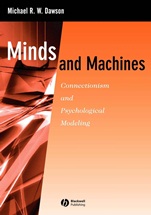
Minds and Machines: Connectionism and Psychological Modeling
ISBN 9781405113496
Autor: Michael R. W. Dawson
Wydawca: Wiley
Dostępność: 3-6 tygodni
Cena: 267,75 zł
Przed złożeniem zamówienia prosimy o kontakt mailowy celem potwierdzenia ceny.
ISBN13: |
9781405113496 |
ISBN10: |
1405113499 |
Autor: |
Michael R. W. Dawson |
Oprawa: |
Paperback |
Rok Wydania: |
2003-10-14 |
Ilość stron: |
296 |
Wymiary: |
246x171 |
Tematy: |
HP |
Models are important tools in psychology used to generate predictions to test the validity of theories.
Minds and Machines: Connectionism and Psychological Modeling examines three different kinds of models (models of data, mathematical models, and computer simulations) and discusses a synthetic approach to modeling. Connectionist models are introduced as tools that are both synthetic and representational and that can be used as the basis for conducting synthetic psychology. The book investigates some of the basic properties of connectionism in the context of synthetic psychology, including detailed accounts of how the internal structure of connectionist networks can be interpreted.
A website of supplementary material is available at www.bcp.psych.ualberta.ca/∼mike/Book2/ and includes free software for conducting the connectionist simulations described in the book as well as instructions for building simple robots to illustrate some of the principles of the synthetic approach.
List of Figures.
List of Tables.
1. The Kids in the Hall.
Synthetic Versus Analytic Traditions. .
2. Advantages and Disadvantages of Modeling.
What Is A Model?.
Advantages and Disadvantages of Models. .
3. Models of Data.
An Example of a Model of Data.
Properties of Models of Data. .
4. Mathematical Models.
An Example Mathematical Model.
Mathematical Models vs. Models of Data. .
5. Computer Simulations.
A Sample Computer Simulation.
Connectionist Models.
Properties of Computer Simulations. .
6. First Steps Toward Synthetic Psychology.
Introduction.
Building a Thoughtless Walker.
Step 1: Synthesis.
Step 2: Emergence.
Step 3: Analysis.
Issues Concerning Synthetic Psychology. .
7. Uphill Analysis, Downhill Synthesis.
Introduction.
From Homeostats to Tortoises.
Ashby s Homeostat.
Vehicles.
Synthesis and Emergence: Some Modern Examples.
The Law of Uphill Analysis and Downhill Synthesis. .
8. Connectionism As Synthetic Psychology.
Introduction.
Beyond Sensory Reflexes.
Connectionism, Synthesis, and Representation.
Summary and Conclusions. .
9. Building Associations.
From Associationism To Connectionism.
Building An Associative Memory.
Beyond the Limitations of Hebb Learning.
Associative Memory and Synthetic Psychology. .
10. Making Decisions.
The Limits of Linearity.
A Fundamental Nonlinearity.
Building a Perceptron: A Nonlinear Associative Memory.
The Psychology of Perceptrons.
The Need for Layers. .
11. Sequences of Decisions.
The Logic of Layers.
Training Multilayered Networks.
A Simple Case Study: Exclusive Or.
A Second Case Study: Classifying Musical Chords.
A Third Case Study: From Connectionism to Selectionism. .
12. From Synthesis To Analysis.
Representing Musical Chords in a Pdp Network.
Interpreting the Internal Structure of Value Unit Networks.
Network Interpretation and Synthetic Psychology. .
13. From Here To Synthetic Psychology.
References.
Index
Michael R. W. Dawson is a member of the Department of Psychology and the Biological Computation Project at the University of Alberta, Canada. His primary research interests concern the foundations of cognitive science, learning and representation in connectionist networks, and computational models of motion perception. He is the author of Understanding Cognitive Science (Blackwell Publishers, 1998).
"In this remarkable book, Dawson refines and develops synthetic psychology an approach to explaining mental capacities that takes as its inspiration the investigation of simple systems exhibiting emergent behavior. Rich with examples, the book shows with extraordinary clarity how ideas from embodied cognitive science, robotics, artificial life, and connectionism can be combined to shed new light on the workings of the mind. It′s hard to imagine a better book for anyone wishing to understand the latest advances in cognitive science." Larry Shapiro, University of Wisconsin <!––end––>
"Minds and Machines provides an easily understood introduction to synthetic psychology start with simple processes, see what emerges, and analyze the resulting system. Dawson lays a solid foundation describing the strengths and weaknesses of various modeling approaches in psychology, and then builds on this by giving concrete examples of how connectionism using the synthetic approach can be used to provide simple explanations of seemingly complex cognitive phenomena." David A. Medler, The Medical College of Wisconsin
"Thisis a wonderful book, both in terms of the thought–provoking technical content and the delightfully conversational style that readers have come to expect from the author of Understanding Cognitive Science. Dawson has a real gift for presenting complex ideas in an accessible and engaging way that does not dilute the scientific or philosophical intricacies involved." Stefan C. Kremer, University of Guelph, Canada
"An important virtue of this book is that the content and order of presentation has clearly been tested at length in the classroom of a dedicated and creative teacher. The book has many illustrations from teaching practice, and would be an excellent basis for a senior undergraduate or introductory graducate course on cognitive modelling, and I′d be delighted to use it for that purpose myself ... This is a fine book, and I suspect it would be a valuable resource for those who don′t know much about synthetic psychology but would like to get a clear sense of the lie of the land." David Spurrett, University of KwaZulu–Natal, Psychology in Society, 30, 2004, 77–79
Koszyk
Książek w koszyku: 0 szt.
Wartość zakupów: 0,00 zł
Informacje


Kontakt
Gambit
Centrum Oprogramowania
i Szkoleń Sp. z o.o.
Al. Pokoju 29b/22-24
31-564 Kraków
Siedziba Księgarni
ul. Kordylewskiego 1
31-542 Kraków
+48 12 410 5991
+48 12 410 5987
+48 12 410 5989
Subskrypcje
Administratorem danych osobowych jest firma Gambit COiS Sp. z o.o. Na podany adres będzie wysyłany wyłącznie biuletyn informacyjny.
Autoryzacja płatności

Informacje na temat autoryzacji płatności poprzez PayU.

© Copyright 2012: GAMBIT COiS Sp. z o.o. Wszelkie prawa zastrzeżone.
Projekt i wykonanie: Alchemia Studio Reklamy