


Wydawcy
Katalog tematyczny
- Archeologia (109)
- Ekonomia, finanse, business (13704)
- Filozofia (1445)
- Historia (3040)
- Języki i językoznawstwo (2356)
- Lifestyle, hobby i rozrywka (475)
- Medycyna (9704)
- Nauki humanistyczne (4)
- Nauki o Ziemi i środowisku (2638)
- Nauki ścisłe (20412)
- Nauki społeczne (8486)
- Nauki techniczne (13450)
- Prawo (1696)
- Publikacje informacyjne i interdyscyplinarne (1288)
- Religia i wierzenia (917)
- Technika komputerowa (4067)
- Zdrowie, relacje międzyludzkie i rozwój osobisty (657)





Informacje szczegółowe o książce
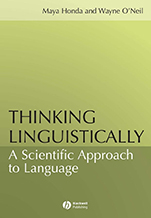
Thinking Linguistically: A Scientific Approach to Language
ISBN 9781405108324
Autor: Maya Honda, Wayne ONeil
Wydawca: Wiley
Dostępność: 3-6 tygodni
Cena: 228,90 zł
Przed złożeniem zamówienia prosimy o kontakt mailowy celem potwierdzenia ceny.
ISBN13: |
9781405108324 |
ISBN10: |
1405108320 |
Autor: |
Maya Honda, Wayne ONeil |
Oprawa: |
Paperback |
Rok Wydania: |
2007-11-02 |
Ilość stron: |
264 |
Wymiary: |
244x170 |
Tematy: |
CF |
Thinking Linguistically investigates knowledge of the structure of language and teaches students how to pursue serious, scientific inquiry by doing linguistics. Problem sets, primarily focused on NP pluralization and question formation across languages, are integrated into the text in order to guide students through the formulation and evaluation of hypotheses on the basis of linguistic data. Acquisition of the linguistic phenomena of the problem sets is also examined. Developed by two experienced teachers specifically for introductory courses on linguistics and language acquisition, this book enables students to reach conclusions about questions of linguistics while also understanding the reasoning and methodology behind them.
Preface.
Typographical Conventions.
An Introduction to Thinking Linguistically.
Problem Set 1. Plural Noun Formation in Armenian.
Part I: Noun Pluralization, or How to Talk About More than Two Dogs in Kiowa.
1. Noun Pluralization: An Introduction.
Problem Set 2. Plural Noun Formation in English.
2. Noun Pluralization: The Role of Phonology.
Problem Set 2, Revisited: Plural Noun Formation in English.
3. Noun Pluralization: Morphology Meets Phonology.
Problem Set 3. Regular–Irregular Noun Plurals in English.
Problems Set 4. Past Tense Formation in Englsih.
Problem Set 5. Plural Noun Formation in Spanish.
Problem Set 6. Plural Noun Formation in Brazilian Portuguese.
4. The Acquisition of Morphophonology.
5. Noun Pluralization: Morphology Meets Syntax and Meaning.
Problem Set 7. Plural Noun Formation in Nicaraguan English.
6. Noun Pluralization: The Interaction of Linguistic Features.
Problem Set 8. Plural Noun Formation in Mandarin Chinese.
Problem Set 9. Plural Noun Formation in Cherokee.
7. Noun Pluralization: A Summary.
Part II: Question Formation, or How to Find Out Whether the Cat Is Sleeping in Tohono O′odham.
8. Merge.
Problem Set 10. Merging, Transforming, and Converging.
9. An Introduction to the Syntax of Question Formation.
Problem Set 11. WH–Question Formation in Mandarin Chinese.
10. Syntactic Movement and Question Formation.
Problem Set 12. Yes/No Question Formation in Tohono O′odham.
Problem Set 13. WH–Question Formation in English.
Problem Set 14. WH–Question Formation in Brazilian Portuguese.
11. Question Formation: A Summary.
Problem Set 15. WH–Question Formation in Tohono O′odham.
12. Acquisition of WH–Question Formation.
Problem Set 16. Indonesian Speakers′ Acquisition of English WH–Question Formation.
Part III: Constraints, or Why You Can′t Say Wanna Whenever You Wanna.
13. Syntactic Constraints on Contraction in English.
Problem Set 17. The Syntax of Wanna–Contraction in English.
Problem Set 18. The Syntax of Is–Contraction in English.
14. Contraction in English: Its Acquisition and Related Topics.
Part IV: Meaning, and –– Finally –– about Counting Dogs in Kiowa.
15. Meaning: An Introduction.
16. Beyond Pluralization: Inversion and Noun Modification in Kiowa.
Problem Set 19. So How Do Kiowas Talk About More Than Two Dogs?.
17. Argument Structure: The Conceptual System of Language.
Problem Set 20. Theta–Roles in Prepositions in English.
On Thinking Linguistically: Looking Back and Looking Ahead.
References.
Index.
Maya Honda is Associate Professor of Human Development at Wheelock College. Her work includes Understanding First and Second Language Acquisition (with Wayne O’Neil, 2004) and papers in Noam Chomsky: Critical Assessments (1994) and The View from Building 20 (1993).
Wayne O’Neil is Professor of Linguistics at MIT. His publications include The Generative Study of Second Language Acquisition (edited with Suzanne Flynn and Gita Martohardjono, 1998) and Image, Language, Brain (edited with Alec Marantz and Yasushi Miyashita, 2000).
"If you are a veteran linguist or linguistics teacher, this book will propel you back to what first captivated you about linguistic inquiry. If you are new to the field, this textbook is a delightful laboratory manual for thinking linguistically." ( The Modern Language Journal, autumn 2010)
Koszyk
Książek w koszyku: 0 szt.
Wartość zakupów: 0,00 zł
Informacje


Kontakt
Gambit
Centrum Oprogramowania
i Szkoleń Sp. z o.o.
Al. Pokoju 29b/22-24
31-564 Kraków
Siedziba Księgarni
ul. Kordylewskiego 1
31-542 Kraków
+48 12 410 5991
+48 12 410 5987
+48 12 410 5989
Subskrypcje
Administratorem danych osobowych jest firma Gambit COiS Sp. z o.o. Na podany adres będzie wysyłany wyłącznie biuletyn informacyjny.
Autoryzacja płatności

Informacje na temat autoryzacji płatności poprzez PayU.

© Copyright 2012: GAMBIT COiS Sp. z o.o. Wszelkie prawa zastrzeżone.
Projekt i wykonanie: Alchemia Studio Reklamy