


Wydawcy
Katalog tematyczny
- Archeologia (109)
- Ekonomia, finanse, business (13704)
- Filozofia (1445)
- Historia (3040)
- Języki i językoznawstwo (2356)
- Lifestyle, hobby i rozrywka (475)
- Medycyna (9704)
- Nauki humanistyczne (4)
- Nauki o Ziemi i środowisku (2638)
- Geografia (299)
- Nauki o Ziemi (1661)
- Geologia (414)
- Hydrologia (237)
- Meteorologia i klimatologia (114)
- Paleontologia (33)
- Wulkanologia i sejsmologia (44)
- Planowanie przestrzenne (53)
- Środowisko (607)
- Nauki ścisłe (20412)
- Nauki społeczne (8486)
- Nauki techniczne (13450)
- Prawo (1696)
- Publikacje informacyjne i interdyscyplinarne (1288)
- Religia i wierzenia (917)
- Technika komputerowa (4067)
- Zdrowie, relacje międzyludzkie i rozwój osobisty (657)





Informacje szczegółowe o książce
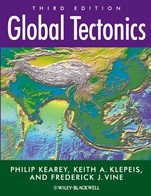
Global Tectonics
ISBN 9781405107778
Autor: Philip Kearey, Keith A. Klepeis, Frederick J. Vine
Wydawca: Wiley
Dostępność: 3-6 tygodni
Cena: 322,35 zł
Przed złożeniem zamówienia prosimy o kontakt mailowy celem potwierdzenia ceny.
ISBN13: |
9781405107778 |
ISBN10: |
1405107774 |
Autor: |
Philip Kearey, Keith A. Klepeis, Frederick J. Vine |
Oprawa: |
Paperback |
Rok Wydania: |
2009-02-13 |
Numer Wydania: |
3rd Edition |
Ilość stron: |
496 |
Wymiary: |
248x195 |
Tematy: |
RB |
The third edition of this widely acclaimed textbook provides a comprehensive introduction to all aspects of global tectonics. Revisions to this new edition reflect the most significant recent advances in the field, providing a thorough, accessible, and up–to–date text. Combining a historical approach with process science, Global Tectonics provides a careful balance between geological and geophysical material in both continental and oceanic regimes.
New and expanded chapters in this third edition include Precambrian tectonics and the supercontinent cycle; mantle processes, including mantle plumes; the implications of plate tectonics for environmental change; large igneous provinces; rifted continental margins; ocean ridges; continental transforms; subduction zones; and numerous orogenic examples.
Written in an engaging style, this important text is an essential reference for undergraduates and graduate students who have a basic introduction in the geosciences.
Spis treści:
Preface.
Acknowledgments.
1. Historical perspective.
1.1 Continental drift.
1.2 Sea floor spreading and the birth of plate tectonics.
1.3 Geosynclinal theory.
1.4 Impact of plate tectonics.
2. The interior of the Earth.
2.1 Earthquake seismology.
2.1.1 Introduction.
2.1.2 Earthquake descriptors.
2.1.3 Seismic waves.
2.1.4 Earthquake location.
2.1.5 Mechanism of earthquakes.
2.1.6 Focal mechanism solutions of earthquakes.
2.1.7 Ambiguity in focal mechanism solutions.
2.1.8 Seismic tomography.
2.2 Velocity structure of the Earth.
2.3 Composition of the Earth.
2.4 The crust.
2.4.1 The continental crust.
2.4.2 Upper continental crust.
2.4.3 Middle and lower continental crust.
2.4.4 The oceanic crust.
2.4.5 Oceanic layer 1.
2.4.6 Oceanic layer 2.
2.4.7 Oceanic layer 3.
2.5 Ophiolites.
2.6 Metamorphism of oceanic crust.
2.7 Differences between continental a
nd oceanic crust.
2.8 The mantle.
2.8.1 Introduction.
2.8.2 Seismic structure of the mantle.
2.8.3 Mantle composition.
2.8.4 The mantle low velocity zone.
2.8.5 The mantle transition zone.
2.8.6 The lower mantle.
2.9 The core.
2.10 Rheology of the crust and mantle.
2.10.1 Introduction.
2.10.2 Brittle deformation.
2.10.3 Ductile deformation.
2.10.4 Lithospheric strength profiles,.
2.10.5 Measuring continental deformation.
2.10.6 Deformation in the mantle.
2.11 Isostasy.
2.11.1 Introduction.
2.11.2 Airy’s hypothesis.
2.11.3 Pratt’s hypothesis.
2.11.4 Flexure of the lithosphere.
2.11.5 Isostatic rebound.
2.11.6 Tests of isostasy.
2.12 Lithosphere and asthenosphere.
2.13 Terrestrial heat flow.
3. Continental drift.
3.1 Introduction.
3.2 Continental reconstructions.
3.2.1 Euler’s theorem.
3.2.2 Geometric reconstructions of continents.
3.2.3 The reconstruction of continents around the Atlantic.
3.2.4 The reconstruction of Gondwana.
3.3 Geologic evidence for continental drift.
3.4 Paleoclimatology.
3.5 Paleontologic evidence for continental drift.
3.6 Paleomagnetism.
3.6.1 Introduction.
3.6.2 Rock magnetism.
3.6.3 Natural remanent magnetization.
3.6.4 The past and present geomagnetic field.
3.6.5 Apparent polar wander curves.
3.6.6 Paleogeographic reconstructions based on paleomagnetism.
4. Sea floor spreading and transform faults.
4.1 Sea floor spreading.
4.1.1 Introduction.
4.1.2 Marine magnetic anomalies.
4.1.3 Geomagnetic reversals.
4.1.4 Sea floor spreading.
4.1.5 The Vine–Matthews hypothesis.
4.1.6 Magnetostratigraphy.
4.1.7 Dating of the ocean floor.
4.2 Transform faults.
4.2.1 Introduction.
4.2.2 Ridge–ridge transform faults.
4.2.3 Ridge jumps and transform fault offsets.
5. The framework of plate tectonics.
5.1 Plates and plate margins.
5.2 Dist
ribution of earthquakes.
5.3 Relative plate motions.
5.4 Absolute plate motions.
5.5 Hotspots.
5.6 True polar wander.
5.7 Cretaceous superplume.
5.8 Direct measurement of relative plate motions.
5.9 Finite plate motions.
5.10 Stability of triple junctions.
5.11 Present day triple junctions.
6. Ocean ridges.
6.1 Ocean ridge topography.
6.2 Broad structure of the upper mantle below ridges.
6.3 Origin of anomalous upper mantle beneath ridges.
6.4 Depth–age relationship of oceanic lithosphere.
6.5 Heat flow and hydrothermal circulation.
6.6 Seismic evidence for an axial magma chamber.
6.7 Along–axis segmentation of oceanic ridges.
6.8 Petrology of ocean ridges.
6.9 Shallow structure of the axial region.
6.10 Origin of the oceanic crust.
6.11 Propagating rifts and microplates.
6.12 Oceanic fracture zones.
7. Continental rifts and rifted margins.
7.1 Introduction.
7.2 General characteristics of narrow rifts.
7.3 General characteristics of wide rifts.
7.4 Volcanic activity.
7.4.1 Large igneous provinces.
7.4.2 Petrogenesis of rift rocks.
7.4.3 Mantle upwelling beneath rifts.
7.5 Rift initiation.
7.6 Strain localization and delocalization processes.
7.6.1 Introduction.
7.6.2 Lithospheric stretching.
7.6.3 Buoyancy forces and lower crustal flow.
7.6.4 Lithospheric flexure.
7.6.5 Strain–induced weakening.
7.6.6 Rheological stratification of the lithosphere.
7.6.7 Magma–assisted rifting.
7.7 Rifted continental margins.
7.7.1 Volcanic margins.
7.7.2 Nonvolcanic margins.
7.7.3 The evolution of rifted margins.
7.8 Case studies: the transition from rift to rifted margin.
7.8.1 The East African Rift system.
7.8.2 The Woodlark Rift.
7.9 The Wilson cycle.
8. Continental transforms and strike–slip faults.
8.1 Introduction.
8.2 Fault styles and physiography.
8.3 The deep structure of
continental transforms.
8.3.1 The Dead Sea Transform.
8.3.2 The San Andreas Fault.
8.3.3 The Alpine Fault.
8.4 Transform continental margins.
8.5 Continuous versus discontinuous deformation.
8.5.1 Introduction.
8.5.2 Relative plate motions and surface velocity fields.
8.5.3 Model sensitivities.
8.6 Strain localization and delocalization mechanisms.
8.6.1 Introduction.
8.6.2 Lithospheric heterogeneity.
8.6.3 Strain–softening feedbacks.
8.7 Measuring the strength of transforms.
9. Subduction zones.
9.1 Ocean trenches.
9.2 General morphology of island arc systems.
9.3 Gravity anomalies of subduction zones.
9.4 Structure of subduction zones from earthquakes.
9.5 Thermal structure of the downgoing slab.
9.6 Variations in subduction zone characteristics.
9.7 Accretionary prisms.
9.8 Volcanic and plutonic activity.
9.9 Metamorphism at convergent margins.
9.10 Backarc basins.
10. Orogenic belts.
10.1 Introduction.
10.2 Ocean–continent convergence.
10.2.1 Introduction.
10.2.2 Seismicity, plate motions and subduction geometry.
10.2.3 General geology of the central and southern Andes.
10.2.4 Deep structure of the central Andes.
10.2.5 Mechanisms of noncollisional orogenesis.
10.3 Compressional sedimentary basins.
10.3.1 Introduction.
10.3.2 Foreland basins.
10.3.3 Basin inversion.
10.3.4 Modes of shortening in foreland fold–thrust belts.
10.4 Continent–continent collision.
10.4.1 Introduction.
10.4.2 Relative plate motions and collisional history.
10.4.3 Surface velocity fields and seismicity.
10.4.4 General geology of the Himalayan–Tibetan orogen.
10.4.5 Deep structure.
10.4.6 Mechanisms of continental collision.
10.5 Arc–continent collision.
10.6 Terrane accretion and continental growth.
10.6.1 Terrane analysis.
10.6.2 Structure of accretionary orogens.
10.6.3 Mechanisms of terran
e accretion.
11. Precambrian tectonics and the supercontinent cycle.
11.1 Introduction.
11.2 Precambrian heat flow.
11.3 Archean tectonics.
11.3.1 General characteristics of cratonic mantle lithosphere.
11.3.2 General geology of Archean cratons.
11.3.3 The formation of Archean lithosphere.
11.3.4 Crustal structure.
11.3.5 Horizontal and vertical tectonics.
11.4 Proterozoic tectonics.
11.4.1 General geology of Proterozoic crust.
11.4.2 Continental growth and craton stabilization.
11.4.3 Proterozoic plate tectonics.
11.5 The supercontinent cycle.
11.5.1 Introduction.
11.5.2 Pre–Mesozoic reconstructions.
11.5.3 A Late Proterozoic supercontinent.
11.5.4 Earlier supercontinents.
11.5.5 Gondwana–Pangea assembly and dispersal.
12. The mechanism of plate tectonics.
12.1 Introduction.
12.2 Contracting Earth hypothesis.
12.3 Expanding Earth hypothesis.
12.3.1 Calculation of the ancient moment of inertia of the Earth.
12.3.2 Calculation of the ancient radius of the Earth.
12.4 Implications of heat flow.
12.5 Convection in the mantle.
12.5.1 The convection process.
12.5.2 Feasibility of mantle convection.
12.5.3 The vertical extent of convection.
12.6 The forces acting on plates.
12.7 Driving mechanism of plate tectonics.
12.7.1 Mantle drag mechanism.
12.7.2 Edge–force mechanism.
12.8 Evidence for convection in the mantle.
12.8.1 Introduction.
12.8.2 Seismic tomography.
12.8.3 Superswells.
12.8.4 The D” layer.
12.9 The nature of convection in the mantle.
12.10 Plumes.
12.11 The mechanism of the supercontinent cycle.
13. Implications of plate tectonics.
13.1 Environmental change.
13.1.1 Changes in sea level and sea water chemistry.
13.1.2 Changes in oceanic circulation and the Earth’s climate.
13.1.3 Land areas and climate.
13.2 Economic geology.
13.2.1 Introduction.
13.2.2 Autoch
thonous and allochthonous mineral deposits.
13.2.3 Deposits of sedimentary basins.
13.2.4 Deposits related to climate.
13.2.5 Geothermal power.
13.3 Natural hazards.
Review questions.
Appendix: The geological timescale and stratigraphic column.
References.
Index
Nota biograficzna:
Phil Kearey was Senior Lecturer in Applied Geophysics in the Department of Earth Sciences at Bristol University, U.K. prior to his premature death in 2003. In his research he used various types of geophysical data, but gravity and magnetic data in particular, to elucidate crustal structure in the eastern Caribbean, Canadian shield and southern England.
Keith Klepeis is a Professor in the Department of Geology at the University of Vermont, U.S.A. He specializes in the areas of structural geology and continental tectonics and has worked extensively on the evolution of orogenic belts and fault systems in New Zealand, Patagonia, West Antarctica, Australia, British Columbia and southeast Alaska.
Fred Vine is an Emeritus Professor in the School of Environmental Sciences at the University of East Anglia, Norwich, U.K. He was made a Fellow of the Royal Society of London and has received numerous awards for work on the interpretation of oceanic magnetic anomalies and ophiolites, fragments of oceanic crust thrust up on land, in terms of sea floor spreading.
Okładka tylna:
The third edition of this widely acclaimed textbook provides a comprehensive introduction to all aspects of global tectonics. Revisions to this new edition reflect the most significant recent advances in the field, providing a thorough, accessible, and up–to–date text. Combining a historical approach with process science, Global Tectonics provides a careful balance between geological and geophysical material in both continental and oceanic regimes.
New and expanded chapters in this third edition include Precambria
n tectonics and the supercontinent cycle; mantle processes, including mantle plumes; the implications of plate tectonics for environmental change; large igneous provinces; rifted continental margins; ocean ridges; continental transforms; subduction zones; and numerous orogenic examples.
Written in an engaging style, this important text is an essential reference for undergraduates and graduate students who have a basic introduction in the geosciences.
Koszyk
Książek w koszyku: 0 szt.
Wartość zakupów: 0,00 zł
Informacje


Kontakt
Gambit
Centrum Oprogramowania
i Szkoleń Sp. z o.o.
Al. Pokoju 29b/22-24
31-564 Kraków
Siedziba Księgarni
ul. Kordylewskiego 1
31-542 Kraków
+48 12 410 5991
+48 12 410 5987
+48 12 410 5989
Subskrypcje
Administratorem danych osobowych jest firma Gambit COiS Sp. z o.o. Na podany adres będzie wysyłany wyłącznie biuletyn informacyjny.
Autoryzacja płatności

Informacje na temat autoryzacji płatności poprzez PayU.

© Copyright 2012: GAMBIT COiS Sp. z o.o. Wszelkie prawa zastrzeżone.
Projekt i wykonanie: Alchemia Studio Reklamy