


Wydawcy
Katalog tematyczny
- Archeologia (109)
- Ekonomia, finanse, business (13704)
- Filozofia (1445)
- Historia (3040)
- Języki i językoznawstwo (2356)
- Lifestyle, hobby i rozrywka (475)
- Medycyna (9704)
- Nauki humanistyczne (4)
- Nauki o Ziemi i środowisku (2638)
- Nauki ścisłe (20412)
- Nauki społeczne (8486)
- Nauki techniczne (13450)
- Prawo (1696)
- Publikacje informacyjne i interdyscyplinarne (1288)
- Religia i wierzenia (917)
- Technika komputerowa (4067)
- Zdrowie, relacje międzyludzkie i rozwój osobisty (657)





Informacje szczegółowe o książce
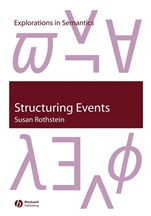
Structuring Events: A Study in the Semantics of Lexical Aspect
ISBN 9781405106672
Autor: Susan Rothstein
Wydawca: Wiley
Dostępność: 3-6 tygodni
Cena: 694,05 zł
Przed złożeniem zamówienia prosimy o kontakt mailowy celem potwierdzenia ceny.
ISBN13: |
9781405106672 |
ISBN10: |
1405106670 |
Autor: |
Susan Rothstein |
Oprawa: |
Hardback |
Rok Wydania: |
2003-11-28 |
Ilość stron: |
216 |
Wymiary: |
241x184 |
Tematy: |
CF |
Structuring Events presents a novel semantic theory of lexical aspect. The first chapter provides an introduction to aspectual classes and aspectual distinctions such as quantization and cumulativity, stages and changes, and telicity and atelicity. Two in–depth case studies of progressive achievements and resultative predication form the basis of a new account of the lexical semantics of accomplishments; this theory is then used in a new analysis of the telic/atelic distinction. Throughout, the emerging theory of aspect is extensively compared with alternative theories, and the book concludes with general reflections on the semantic structure of the lexical aspectual classes.
Written accessibly, Structuring Events is an invaluable resource for semanticists or syntacticians interested in the study of verb meanings, as well as for people in the neighboring fields of pragmatics and philosophy of language.
Preface.
1. Verb Classes and Aspectual Classification:.
Introduction.
Aspectual Classes of Verbs.
The four aspectual classes.
Testing for temporal constitution.
Semelfactives.
Can verbs, as opposed to VPs be aspectually categorized?.
2. Progressive Achievements:.
Introduction.
Progressive achievements and the imperfective paradox.
Achievements are not accomplishments.
Temporal Modification.
Progressive achievements are different from progressive accomplishments.
Deriving Progressive Achievements.
Explanations.
3. Resultative Predication:.
Introduction.
The syntax of secondary predication a fast review.
The semantic interpretation of secondary predication.
Secondary predication as a summing operation.
Semantic constraints on the secondary predication operation.
The semantic interpretation of depictive predication.
Object–oriented depictive predication.
Subject oriented secondary predication.
The semantics of resultatives.
The interpretation of simple resultatives.
The direct object restriction.
Non–accomplishment resultatives.
Type shifting in non–accomplishment resultatives.
The rest of the questions.
Dethematicised resultatives.
Why do resultatives not occur with achievements or states?.
Fake reflexives.
Subject–oriented resultatives.
Conclusions and the next set of questions.
4. The Structure of Accomplishments:.
Incremental Themes and the notion of ′extent′.
Introduction.
′Measuring out′ and incrementality.
Krifka′s theory of quantization.
A Theory of Accomplishments.
What Are Incremental Themes?.
Culminations.
Incremental processes and incremental relations.
Answering Some Questions about Accomplishments.
Aspectual ambiguity with wipe and read.
The incremental role of the incremental theme.
Kennedy and Levin: Telicity in terms of degree measurements.
5. The Interpretation of Derived Accomplishments:.
Aspectual Shift in Resultatives.
Transitive Accomplishments.
Intransitive resultatives.
Why do resultatives have a ′result′ meaning?.
PPs as paths and PPs as results.
Aspectual Shift in Progressive Achievements.
The structure of the shift operation.
The content of the activity and BECOME events.
6. Quantization, Telicity and Change:.
Quantization.
Krifka′s theory of quantization.
Telicity and Change.
7. Telicity and Atomicity:.
Telicity and atomicity.
Events have their denotation in the count domain.
Homogeneity and S–cumulativity in the domain of individuals.
Defining sets of atoms.
Atomic structure in the domain of events.
Atomicty and BECOME events.
A note on degree predicates.
For a time and in a time.
8. Event Structure and Aspectual Classification:.
What are semelfactives?.
Why does S–cumulativity characterise states and activities?.
Why do we have the lexical aspectual classes that we do?.
The general picture: lexical aspect and the structure of the domain of events.
References.
Index
Susan Rothstein is Professor of Linguistics at Bar–Ilan University. She has published widely on such issues as syntax, semantics, and the syntax semantics interface. She is author of Predicates and Their Subjects (2000), and editor of Events and Grammar (1998) and Perspectives on Phrase Structure: Heads and Licensing (1991).
"This is the most important book on lexical aspect since David Dowty′s seminal Word Meaning and Montague Grammar." Angelika Kratzer, University of Massachusetts Amherst <!––end––>
"As well as providing a clear introduction to the subject, this excellent book extends our knowledge of the lexical aspectual properties of verbs and verb phrases in new and original directions. Rothstein′s careful exploitation of the flexibility of event–based semantics in providing a solid foundation for the interpretation of verbal aspect establishes the theory as central to any explanation of this often difficult but ever fascinating topic." Ronnie Cann, University of Edinburgh
"This outstanding book represents a new breakthrough in the general theory of lexical aspect. The discussions of the previous research are distinguished by clarity as well as new challenges and insights. In a highly engaging way Rothstein also advances new solutions to some of the most thorny issues including aspectual shifts, progressive achievements, and resultative predication which will shape the future research in lexical aspect." Hana Filip, Stanford University
"Rothstein s book contains many observations, deep intuitions and exciting analyses which will doubtless be very influential in a variety of areas. Empirically, the book contains a treasure trove of interesting data that will no doubt be mulled over for years to come." Lingua
Koszyk
Książek w koszyku: 0 szt.
Wartość zakupów: 0,00 zł
Informacje


Kontakt
Gambit
Centrum Oprogramowania
i Szkoleń Sp. z o.o.
Al. Pokoju 29b/22-24
31-564 Kraków
Siedziba Księgarni
ul. Kordylewskiego 1
31-542 Kraków
+48 12 410 5991
+48 12 410 5987
+48 12 410 5989
Subskrypcje
Administratorem danych osobowych jest firma Gambit COiS Sp. z o.o. Na podany adres będzie wysyłany wyłącznie biuletyn informacyjny.
Autoryzacja płatności

Informacje na temat autoryzacji płatności poprzez PayU.

© Copyright 2012: GAMBIT COiS Sp. z o.o. Wszelkie prawa zastrzeżone.
Projekt i wykonanie: Alchemia Studio Reklamy