


Wydawcy
Katalog tematyczny
- Archeologia (109)
- Ekonomia, finanse, business (13704)
- Filozofia (1445)
- Historia (3040)
- Języki i językoznawstwo (2356)
- Lifestyle, hobby i rozrywka (475)
- Medycyna (9704)
- Nauki humanistyczne (4)
- Nauki o Ziemi i środowisku (2638)
- Nauki ścisłe (20412)
- Nauki społeczne (8486)
- Edukacja (229)
- Kryminologia, opieka spełeczna (284)
- Obronność (10)
- Polityka (1389)
- Psychologia (777)
- Socjologia (410)
- Społeczeństwo i kultura (187)
- Nauki techniczne (13450)
- Prawo (1696)
- Publikacje informacyjne i interdyscyplinarne (1288)
- Religia i wierzenia (917)
- Technika komputerowa (4067)
- Zdrowie, relacje międzyludzkie i rozwój osobisty (657)





Informacje szczegółowe o książce
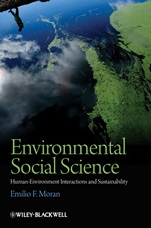
Environmental Social Science: Human – Environment interactions and Sustainability
ISBN 9781405105743
Autor: Emilio F. Moran
Wydawca: Wiley
Dostępność: 3-6 tygodni
Cena: 197,40 zł
Przed złożeniem zamówienia prosimy o kontakt mailowy celem potwierdzenia ceny.
ISBN13: |
9781405105743 |
ISBN10: |
1405105747 |
Autor: |
Emilio F. Moran |
Oprawa: |
Paperback |
Rok Wydania: |
2010-01-22 |
Ilość stron: |
230 |
Wymiary: |
228x158 |
Tematy: |
JBK |
The past decade has witnessed a rapid growth in the development of research on the human dimensions of global environmental change. Environmental Social Science offers a synthesis of this new cross–disciplinary enterprise, and provides a foundation for scholars and policy makers to address the urgent needs and better understand these globally–scaled processes. With increasing evidence of climate change, loss of biodiversity, rapid deforestation in the tropics, and an impending crisis in availability of potable water, the book argues that the fate of our planet hangs in the balance. It reveals how ongoing environmental research demands the breakdown of traditional disciplinary boundaries and requires a better understanding of the complexities of current human–environment interactions. In recommending a new collaborative approach that makes environmental theoryies and research methods accessible across the natural and social sciences, the book outlines a mutually beneficial research agenda for all concerned.
Spis treści:
Preface.
1. The Challenge of Human–Environment Interactions Research.
The Evolution of Social Ecological Systems.
Characterization of Contemporary Global Environmental Changes.
History of the Development of the Human Dimensions Agenda.
Characteristics of the Research on the Human Dimensions.
The Way Forward: Integrative Science.
2. Theories and Concepts from the Social Sciences.
Population, Technology and Central Place Theories .
Population and Environment Theories.
Agency and History.
Decision–theoretic Approaches.
Political Economy and Political Ecology.
Cultural Ecology.
3. Theories and Concepts from the Biological Sciences.
Evolution by Natural Selection.
Species respond individualistically, not as communities, to environmental change.
Interactions with other species help determine if a particular spe
cies will persist in a particular place (Niche and Neutral Theories).
Top–down vs. bottom–up control in ecosystems.
Succession.
Island Biogeography.
Equilibrium/non–equilibrium theories of competition, coexistence, community composition
Biodiversity and ecosystem processes/services.
The Ecosystem Concept in Biology and the Social Sciences.
4. Spatially–Explicit Approaches.
Remote Sensing and GIS.
A Case Study using GIS/ Remote Sensing to study Amazonian Deforestation.
Urban–rural spatial dynamics.
Modeling and GIS.
5. Multi–Scale and Multi–temporal Analysis.
An approach to multi–disciplinary, multi–scale research.
Scale.
Local level of analysis.
Regional Level of Analysis.
Global Level of Analysis.
Future Directions.
6. Bio–complexity in Ecological Systems.
Spatially–explicit Processes in Ecological and Social Systems.
Agent–Based Modeling of Complex Systems.
Hierarchical Modeling.
Conclusions.
7. Environmental Decision–Making.
Institutional Analysis.
Individual Behavior and Environmental Decisions.
Decisions and Social Context.
Conclusions.
8. Towards Sustainability Science.
Sustainability Science Research Priorities.
Scales of Sustainability.
Cities and Sustainability Science.
Climate Change and Sustainability.
Conclusions.
Bibliography.
Nota biograficzna:
Emilio F. Moran is Distinguished Professor and Rudy Professor of Anthropology and Professor of Environmental Sciences at Indiana University in Bloomington. He is the author of Through Amazonian Eyes: the human ecology of Amazonian Populations (1993), Human Adaptability, 3rd Edition (2007), and People and Nature (2006, Blackwell).
Okładka tylna:
The past decade has witnessed a rapid growth in the development of research on the human
dimensions of global environmental change. Environmental Social Science offers a synthesis of this new cross–disciplinary enterprise, and provides a foundation for scholars and policy makers to address the urgent needs and better understand these globally–scaled processes. With increasing evidence of climate change, loss of biodiversity, rapid deforestation in the tropics, and an impending crisis in availability of potable water, the book argues that the fate of our planet hangs in the balance. It reveals how ongoing environmental research demands the breakdown of traditional disciplinary boundaries and requires a better understanding of the complexities of current human–environment interactions. In recommending a new collaborative approach that makes environmental theoryies and research methods accessible across the natural and social sciences, the book outlines a mutually beneficial research agenda for all concerned.
Koszyk
Książek w koszyku: 0 szt.
Wartość zakupów: 0,00 zł
Informacje


Kontakt
Gambit
Centrum Oprogramowania
i Szkoleń Sp. z o.o.
Al. Pokoju 29b/22-24
31-564 Kraków
Siedziba Księgarni
ul. Kordylewskiego 1
31-542 Kraków
+48 12 410 5991
+48 12 410 5987
+48 12 410 5989
Subskrypcje
Administratorem danych osobowych jest firma Gambit COiS Sp. z o.o. Na podany adres będzie wysyłany wyłącznie biuletyn informacyjny.
Autoryzacja płatności

Informacje na temat autoryzacji płatności poprzez PayU.

© Copyright 2012: GAMBIT COiS Sp. z o.o. Wszelkie prawa zastrzeżone.
Projekt i wykonanie: Alchemia Studio Reklamy