


Wydawcy
Katalog tematyczny
- Archeologia (109)
- Ekonomia, finanse, business (13704)
- Filozofia (1445)
- Historia (3040)
- Języki i językoznawstwo (2356)
- Lifestyle, hobby i rozrywka (475)
- Medycyna (9704)
- Nauki humanistyczne (4)
- Nauki o Ziemi i środowisku (2638)
- Nauki ścisłe (20412)
- Nauki społeczne (8486)
- Nauki techniczne (13450)
- Prawo (1696)
- Publikacje informacyjne i interdyscyplinarne (1288)
- Religia i wierzenia (917)
- Technika komputerowa (4067)
- Zdrowie, relacje międzyludzkie i rozwój osobisty (657)





Informacje szczegółowe o książce
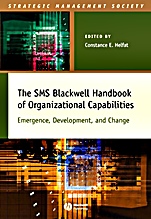
The SMS Blackwell Handbook of Organizational Capabilities: Emergence, Development, and Change
ISBN 9781405103046
Autor: Constance E. Helfat
Wydawca: Wiley
Dostępność: 3-6 tygodni
Cena: 527,10 zł
Przed złożeniem zamówienia prosimy o kontakt mailowy celem potwierdzenia ceny.
ISBN13: |
9781405103046 |
ISBN10: |
1405103043 |
Autor: |
Constance E. Helfat |
Oprawa: |
Hardback |
Rok Wydania: |
2003-07-23 |
Ilość stron: |
452 |
Wymiary: |
263x186 |
Tematy: |
KM |
How do the resources and capabilities of organizations emerge and develop over time? This Handbook brings together scholars of strategic management, economics, history, organizational theory, international business, and technology management in order to address this question.
Many of the contributions present new theoretical or empirical material which enhances our understanding of how organizational resources and capabilities evolve. Others offer thought–provoking commentary on current streams of research. Several themes recur throughout the volume, including: the role of geographic location and social networks; the influence of managerial mindset; and the co–evolution of resources and capabilities with other factors, including products. The chapters are organized according to a time line of resource and capability evolution.
This body of work provides a firm basis for future research and practice, promoting a better understanding of why firms, industries, technologies, and even entire economies fare well or poorly.
Spis treści:
List of Contributors.
Acknowledgements.
1. Stylized Facts Regarding the Evolution of Organizational Resources and Capabilities (Constance E. Helfat).
Part I: Emergence of Resources and Capabilities.
2. Dominance by Birthright: Entry of Prior Radio Producers and Competitive Ramifications in the US Television Receiver Industry (Steven Klepper and Kenneth L. Simons).
3. The Nature, Sources, and Consequences of Firm Differences in the Early History of the Semiconductor Industry (Daniel Holbrook, Wesley M. Cohen, David A Hounshel, and Steven Klepper).
4. Superstores and the Evolution of Firm Capabilities in American Bookselling (Daniel M.G. Raff).
5. Commentary on Chapters by Klepper and Simons, by Holbrook et al., and by Raff (Keith Pavitt).
7. Imprinting or Emergence, Structure or Rules, or Why Dirty Dancing Is Always Better When You Are More Than Two (Bruce Kog
ut).
8. Strategic Capabilities in Emerging Fields: Navigating Ambiguity, Leveraging Social Capitla, and Creating Identity in Silicon Alley (Theresa K. Lant).
Part II: Incremental Development and Change.
9. Why Do Firms Tend to Become Different? (Birger Wernerfelt).
10. Firm Capabilities and Competition and Industrial Policies in a "History Friendly" Model of the Evolution of the Computer Industry (Franco Malerba, Richard Nelson,, Luigi Orsenigo, and Sidney G. Winter).
11. Problem–solving Behaviors, Organizational Forms, and the Complexity of Tasks (Giovanni Dosi, Mike Hobday, and Luigi Marengo).
12. Product Sequencing: Co–evolution of Knowledge, Capabilities, and Products (Constance E. Helfat and Ruth S. Raubitschek).
13. Path–dependent and Path–breaking Change: Reconfiguring Business Resources Following Acquisitions in the US Medical Sector, 1978–1995 (Samina Karim and Will Mitchell).
14. Commentary on Karim–Mitchell and Helfat–Raubitschek Chapters (James Brian Quinn).
15. The Relational Organization: From Relational Rents to Alliance Capability (Harbir Singh).
16. Innovative Routines in Large Firms: What the Evidence Suggests (Keith Pavitt).
17. The Evolutionary Roots of Resource–based theory (Jay B. Barney).
Part III: Dealing with Radical Change.
18. The Satisfying Principle in Capability Learning (Sidney G. Winter).
19. Untangling the Origins of Competitive Advantage (Iain M. Cockburn, Rebecca M. Henderson, and Scott Stern).
20. Strategy and Circumstance: The Response of American Firms to Japanese Competition in Semiconductors, 1980–1995 (Richard N. Langlois and W. Edward Steinmueller).
21. Dynamic Capabilities : What Are They (Jatgkeeb M. Eisenhardt and Jeffrey A. Nartin).
22. Leadership, Capabilities, and Technological Change: the Transformation of NCR in the Electronic Era (Richard S. Rosenbloom).
23. Capabilities, Cognition, and Inertia:
Evidence from Digital Imaging ()Mary Tripsas and Giovanni Gavetti).
24. Leadership and Cognition: Or, What Could Those Folks at the Top Have Been Thinking? Commentary on Chapters by Rosenblom and Tripsas and Gavetti (Steven W. Usselman).
25. Toward Developing an Organizational Capability of Learning from Mistakes (Sydney Finkelstein).
26. Resources, Capabilities, Core Competencies, Invisible Assets, and Knowledge Assets: Label Proliferation and Theory Development in the Field of Strategic Management (Jay B. Barney).
Index.
Nota biograficzna:
Constance E. Helfat is Professor of Strategy and Technology at the Tuck School of Business at Dartmouth. Her work has been published widely in journals such as Strategic Management Journal, Management Science, Organization Science and the Journal of Industrial Economics. She has also published a book entitled Investment Choices in Industry (1988). She serves on the editorial boards of Strategic Management Journal, Management Science Organization Science and Strategic Organization.
Okładka tylna:
How do the resources and capabilities of organizations emerge and develop over time? This Handbook brings together scholars of strategic management, economics, history, organizational theory, international business, and technology management in order to address this question.
Many of the contributions present new theoretical or empirical material which enhances our understanding of how organizational resources and capabilities evolve. Others offer thought–provoking commentary on current streams of research. Several themes recur throughout the volume, including: the role of geographic location and social networks; the influence of managerial mindset; and the co–evolution of resources and capabilities with other factors, including products. The chapters are organized according to a time line of resource and capability evoluti
on.
This body of work provides a firm basis for future research and practice, promoting a better understanding of why firms, industries, technologies, and even entire economies fare well or poorly.
Koszyk
Książek w koszyku: 0 szt.
Wartość zakupów: 0,00 zł
Informacje


Kontakt
Gambit
Centrum Oprogramowania
i Szkoleń Sp. z o.o.
Al. Pokoju 29b/22-24
31-564 Kraków
Siedziba Księgarni
ul. Kordylewskiego 1
31-542 Kraków
+48 12 410 5991
+48 12 410 5987
+48 12 410 5989
Subskrypcje
Administratorem danych osobowych jest firma Gambit COiS Sp. z o.o. Na podany adres będzie wysyłany wyłącznie biuletyn informacyjny.
Autoryzacja płatności

Informacje na temat autoryzacji płatności poprzez PayU.

© Copyright 2012: GAMBIT COiS Sp. z o.o. Wszelkie prawa zastrzeżone.
Projekt i wykonanie: Alchemia Studio Reklamy