


Wydawcy
Katalog tematyczny
- Archeologia (109)
- Ekonomia, finanse, business (13704)
- Filozofia (1445)
- Historia (3040)
- Języki i językoznawstwo (2356)
- Lifestyle, hobby i rozrywka (475)
- Medycyna (9704)
- Nauki humanistyczne (4)
- Nauki o Ziemi i środowisku (2638)
- Nauki ścisłe (20412)
- Nauki społeczne (8486)
- Nauki techniczne (13450)
- Prawo (1696)
- Publikacje informacyjne i interdyscyplinarne (1288)
- Religia i wierzenia (917)
- Technika komputerowa (4067)
- Zdrowie, relacje międzyludzkie i rozwój osobisty (657)





Informacje szczegółowe o książce
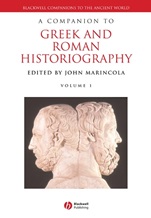
A Companion to Greek and Roman Historiography
ISBN 9781405102162
Autor: John Marincola
Wydawca: Wiley
Dostępność: 3-6 tygodni
Cena: 1 219,05 zł
Przed złożeniem zamówienia prosimy o kontakt mailowy celem potwierdzenia ceny.
ISBN13: |
9781405102162 |
ISBN10: |
1405102160 |
Autor: |
John Marincola |
Oprawa: |
Hardback |
Rok Wydania: |
2007-12-12 |
Ilość stron: |
752 |
Wymiary: |
257x187 |
Tematy: |
CS |
A Companion to Greek and Roman Historiography reflects the new directions and interpretations that have arisen in the field of classical historiography in the past few decades. In a series of cutting–edge articles by authoritative scholars, these volumes communicate the results of recent research, and demonstrate the diversity of approaches towards the past in studies of the ancient world. This two–volume Companion includes five sections. The first presents broad, diachronic treatments of important issues in the writing of history in antiquity. In the second section, the major genres and sub–genres of classical historiography are covered in individual articles. The third section presents readings of individual historians and works, while the fourth section looks at those genres – biography, epic and fiction – on the borders of historiography. The final part explores the transition into late Antiquity.
Notes on Contributors. Preface. Acknowledgements. Ancient Authors: Abbreviations. Reference Works: Abbreviations. Introduction : John Marincola (Florida State University). Part I: Contexts:. 1 The Place of History in the Ancient World: Roberto Nicolai (University of Sassari). 2 The Origin of Greek Historiography: Catherine Darbo–Peschanski (École des Hautes Études en Sciences Sociales). 3 History and Historia: Inquiry in the Greek Historians: Guido Schepens (K. U. Leuven). 4 Documents and the Greek Historian: P. J. Rhodes (Formerly University of Durham). 5 The Prehistory of Roman Historiography: T. P. Wiseman (Formerly University of Exeter). 6 Myth and History: Suzanne Saïd (Columbia University). 7 The Construction of Meaning in the First Three Historians: Carolyn Dewald (Bard College). 8 Characterisation in Ancient Historiography: L. V. Pitcher (University of Durham). 9 Speeches in Greek and Roman Historiography: John Marincola (Florida State University). 10 Readers and Reception: A Text Case: A. J. Woodman (University of Virginia). Part II: Surveys:. 11 The Development of the War Monograph: Tim Rood (St Hugh’s College, Oxford). 12 Continuous Histories (Hellenika): Christopher Tuplin (University of Liverpool). 13 Universal History from Ephorus to Diodorus: John Marincola (Florida State University). 14 Local History and Atthidography: Philip Harding (University of British Columbia). 15 Western Greek Historiography: Riccardo Vattuone (University of Bologna). 16 The Greek Historians of Persia: Dominique Lenfant (University of Strasbourg (France)). 17 The Historians of Alexander: Andrea Zambrini (Università della Tuscia in Viterbo). 18 Greek Historians of the Near East: Clio’s ‘Other Sons’: John Dillery (University of Virginia). 19 The Greek Historians of Judaea: Gregory Sterling (University of Notre Dame). 20 The Greek Encounter with Rome: Christopher Pelling (University of Oxford). 21 The Early Roman Tradition: Hans Beck (McGill University in Montreal). 22 Memoirs and Autobiography in Repubican Rome: Andrew Riggsby (University of Texas at Austin). 23 Roman Historiography in the Late Republic: David Levene (New York University). 24 The Emperor and his Historians: John Matthews (University of Wales Swansea). 25 The Epitomising Tradition in Late Antiquity: Thomas Banchich (Canisius College in Buffalo, New York). Part III: Readings:. 26 To Each His Own: Herodotus and Simonides on Thermopylae: Pietro Vannicelli (University of Urbino). 27 Rhampsinitos and the Clever Thief (Herodotus 2.121): Stephanie West (Hertford College, University of Oxford). 28 The Enigma of Discourse: a View of Thucydides: Leone Porciani (University of Pavia at Cremona). 29 Contest (Agōn) in Thucydides: Donald Lateiner (Ohio Wesleyan University). 30 Narrative Manner and Xenophon’s More Routine Hellenica: Vivienne Gray (University of Auckland, New Zealand). 31 Fortune (tychē) in Polybius: Frank Walbank (Previously of the University of Liverpool). 32 Polybius and Aetolia: A Historiographical Approach: Craige Champion (Syracuse University). 33 Diodorus Siculus on the Third Sacred War: Peter Green (University of Texas at Austin). 34 Clothing Cincinnatus: Dionysius of Halicarnassus: Clemence Schultze (University of Durham). 35 Caesar’s Account of the Battle of Massilia (BC 1.34–2.22): Some Historiographical and Narratological Approaches: Christina Shuttleworth Kraus (University of Yale). 36 The Politics of Sallustian Style: Ellen O’Gorman (University of Bristol). 37 The Translation of Catiline: Andrew Feldherr (Princeton University). 38 Claudius Quadrigarius and Livy’s Second Pentad: Gary Forsythe (Texas Tech University). 39 Fog on the Mountain: Philip and Mt. Haemus in Livy, 40.21–22: Mary Jaeger (University of Oregon). 40 The Imperial Republic of Velleius Paterculus: Alain Gowing (University of Washington in Seattle). 41 Josephus and the Cannibalism of Mary (B.J. 6.199–219): Honora Howell Chapman (California State University, Fresno). 42 Quintus Curtius Rufus on the ‘Good King’: The Dioxippus Episode in Book 9.7.16–26: Elizabeth Baynham (University of Newcastle, Australia). 43 Tacitus and the Battle of Mons Graupius: An Historiographical Road Map? Rhiannon Ash (University College London). 44 Feast Your Eyes on This: Vitellius as a Stock Tyrant (Tac. Hist. 3.36–39): Elizabeth Keitel (University of Massachusetts at Amherst). 45 Arrian, Alexander and the Pursuit of Glory: A. B. Bosworth (University of Western Australia). 46 Towards a Literary Evaluation of Appian’s Civil Wars, Book 1: Gregory Bucher (Creighton University). 47 Cassius Dio: A Senator and Historian in the Age of Anxiety: Martin Hose (Ludwig–Maximilians Universität, Munich). 48 Ammianus’ Roman Digressions and the Audience of the Res Gestae: David Rohrbacher (New College of Florida). 49 ‘To Forge their Tongues to Grander Styles: Ammianus’ Epilogue: Gavin Kelly (University of Edinburgh). Part IV: Neighbours:. 50 History and Epic at Rome: Matthew Leigh (St. Anne’s College, University of Oxford). 51 History and Ethnography: Emma Dench (Birkbeck College, University of London). 52 History and Tragedy: Richard Rutherford (University of Oxford). 53 History and Biography: Philip Stadter (University of North Carolina at Chapel Hill). 54 Antiquarianism and History: Benedetto Bravo (Previously of the University of Warsaw). 55 Geography and History: Johannes Engels (Institut für Altertumskunde at University of Cologne (Germany)). 56 History and Fiction: John Morgan (University of Wales Swansea). Part V: Transition:. 57 Late Antique Historiography, 250–650 CE: Brian Croke (Catholic Education Commission, Sydney). Bibliography. Index Locorum. Index
John Marincola is Professor of Classics at Florida State University. He is the author of Authority and Tradition in Ancient Historiography (1997), Greek Historians (2001) and, with Michael A. Flower, Herodotus: Histories Book IX (2002). He is currently at work on a book on Hellenistic historiography.
"This is a major work … that any library serving scholars in or relating to this field—and there will be many and widely distributed among disciplines—will need to purchase … .It is logically planned and constructed." ( Reference Reviews , Issue 5 2008) "Marincola personally speaks with authority on the entire tradition of ancient historiography, both Greek and Roman … and has collected a fine supporting cast of no fewer than 56 scholars." ( The Anglo–Hellenic Review , Autumn 2008) “This new Companion gives a hearty boost to the ‘We are winning!’ camp, in its sustained engagement with this important issue … and also in its sheer energy and vivacity. One finds oneself with a veritable host of companions at one′s elbow, each with a distinctive style and personality, and the product of various nationalities and scholarly traditions. The juxtaposition captures vividly the flavor of current scholarly debate, particularly since the majority of contributors are central figures in their area of scholarship. The volume represents an exhilarating compendium of cutting–edge perspectives on a range of themes. This tremendously valuable two–tome assembly of a stellar array of scholars and scholarship–its whole indeed greater than the sum of its parts–is a credit to its editor and publisher, displays the vibrancy of the field, and will well serve scholars and students in years to come.” ( New England Classical Journal , November 2008) "All that you ever needed to know about Greek and Roman historians and current academic study thereon." ( Journal of Classics Teaching ) “Major work on a major genre … with no rival in English (or any other language) … .An indispensable guide to the subject. Essential.” ( Choice ) “Thorough, vigorous and up–to–date treatment of the subject, it should find a place on the shelves of scholars and students of antiquity alike.” ( Bryn Mawr Classical Review )
Koszyk
Książek w koszyku: 0 szt.
Wartość zakupów: 0,00 zł
Informacje


Kontakt
Gambit
Centrum Oprogramowania
i Szkoleń Sp. z o.o.
Al. Pokoju 29b/22-24
31-564 Kraków
Siedziba Księgarni
ul. Kordylewskiego 1
31-542 Kraków
+48 12 410 5991
+48 12 410 5987
+48 12 410 5989
Subskrypcje
Administratorem danych osobowych jest firma Gambit COiS Sp. z o.o. Na podany adres będzie wysyłany wyłącznie biuletyn informacyjny.
Autoryzacja płatności

Informacje na temat autoryzacji płatności poprzez PayU.

© Copyright 2012: GAMBIT COiS Sp. z o.o. Wszelkie prawa zastrzeżone.
Projekt i wykonanie: Alchemia Studio Reklamy