


Wydawcy
Katalog tematyczny
- Archeologia (109)
- Ekonomia, finanse, business (13704)
- Filozofia (1445)
- Historia (3040)
- Języki i językoznawstwo (2356)
- Lifestyle, hobby i rozrywka (475)
- Medycyna (9704)
- Nauki humanistyczne (4)
- Nauki o Ziemi i środowisku (2638)
- Nauki ścisłe (20412)
- Nauki społeczne (8486)
- Nauki techniczne (13450)
- Prawo (1696)
- Publikacje informacyjne i interdyscyplinarne (1288)
- Religia i wierzenia (917)
- Technika komputerowa (4067)
- Zdrowie, relacje międzyludzkie i rozwój osobisty (657)





Informacje szczegółowe o książce
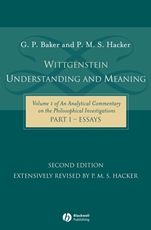
Wittgenstein: Understanding and Meaning: Volume 1 of an Analytical Commentary on the Philosophical Investigations, Part I: Essays
ISBN 9781405101769
Autor: Gordon P. Baker, P. M. S. Hacker
Wydawca: Wiley
Dostępność: 3-6 tygodni
Cena: 257,25 zł
Przed złożeniem zamówienia prosimy o kontakt mailowy celem potwierdzenia ceny.
ISBN13: |
9781405101769 |
ISBN10: |
1405101768 |
Autor: |
Gordon P. Baker, P. M. S. Hacker |
Oprawa: |
Hardback |
Rok Wydania: |
2004-12-17 |
Numer Wydania: |
2nd Edition |
Ilość stron: |
424 |
Wymiary: |
234x156 |
Tematy: |
CF |
Published to widespread acclaim between 1980 and 1996, the monumental four– volume Analytical Commentary on the Philosophical Investigations has become the definitive reference work on Wittgenstein’s masterpiece. This revised edition of Volume I, Wittgenstein: Understanding and Meaning , which itself comprises two parts (‘Essays’ and ‘Exegesis §§1–184’), takes into account much material that was unavailable when the first edition was written. Following G.P. Baker’s death in 2002, P.M.S. Hacker has thoroughly revised both parts, rewriting many sections completely and often proposing fresh interpretations. Part I: Essays now includes two new essays: ‘Meaning and Use’ and ‘The Recantation of a Metaphysician’, while Part II: Exegesis §§1 – 184 has been exhaustively reworked in the light of the electronic publication of Wittgenstein’s Nachlass . These revisions will ensure that this remains the essential reference work on the Philosophical Investigations for the foreseeable future.
Acknowledgements. Introduction to Part 1 – the Essays. Abbreviations. I. THE AUGUSTINIAN CONCEPTION OF LANGUAGE (§1). 1. Augustine’s picture. 2. The Augustinian family. (a) word–meaning. (b) correlating words with meanings. (c) ostensive explanation. (d) metapsychological corollaries. (e) sentence–meaning. 3. Moving off in new directions. 4. Frege. 5. Russell. 6. The Tractatus. II. EXPLANATION (§6) . 1 . Training, teaching, and explaining. 2. Explanation and meaning. 3. Explanation and grammar. 4. Explanation and understanding. III. THE LANGUAGE–GAME METHOD (§7). 1. The emergence of the game analogy. 2.An intermediate phase: comparisons with invented calculi. 3. The emergence of the language–game method. 4. Invented language–games. 5. Natural language–games. IV. DESCRIPTIONS AND THE USES OF SENTENCES (§18). 1. Flying in the face of the facts. 2. Sentences as descriptions of facts: surface–grammatical paraphrase. 3. Sentences as descriptions: depth–grammatical analysis and descriptive contents. 4. Sentences as instruments. 5.Assertions, questions, commands make contact in language. V. OSTENSIVE DEFINITION AND ITS RAMIFICATIONS (§28). 1. Connecting language and reality. 2. The range and limits of ostensive explanations. 3. The normativity of ostensive definition. 4. Samples. 5. Misunderstandings resolved. 6. Samples and simples. VI. INDEXICALS (§39) . VII. LOGICALLY PROPER NAMES (§39) . 1. Russell. 2. The Tractatus . 3. The criticisms of the Investigations : assailing the motivation. 4. The criticisms of the Investigations : real proper names and simple names. VIII. MEANING AND USE (§43). 1. The concept of meaning. 2. Setting the stage. 3. Wittgenstein: meaning and its internal relations. 4. Qualifications. IX. CONTEXTUAL DICTA AND CONTEXTUAL PRINCIPLES (§50) . 1. The problems of a principle. 2. Frege. 3. The Tractatus . 4. After the Tractatus . 5. Compositional theories of meaning. 6. Computational theories of understanding. X. THE STANDARD METRE (§50). 1. The rudiments of measurement. 2. The standard metre and canonical samples. 3. Fixing the reference or explaining the meaning?. 4. Defusing paradoxes. XI. FAMILY RESEMBLANCE (§65). 1. Background: definition, logical constituents and analysis. 2. Family–resemblance: precursors and anticipations. 3. Family resemblance: a minimalist interpretation. 4. Sapping the defences of orthodoxy. 5. Problems about family–resemblance concepts. 6. Psychological concepts. 7. Formal concepts. XII. PROPER NAMES (§79). 1. Stage–setting. 2. Frege and Russell: simple abbreviation theories. 3. Cluster theories of proper names. 4. Some general principles. 5. Some critical consequences. 6. The significance of proper names. 7. Proper names and meaning. XIII. TURNING THE EXAMINATION AROUND: THE RECANTATION OF A METAPHYSICIAN (§89). 1. Re–orienting the investigation. 2. The sublime vision. 3. Diagnosis: projecting the mode of representation onto what is represented. 4. Idealizing the prototype. 5. Misunderstanding the role of the Ideal. 6. Turning the examination around. XIV. PHILOSOPHY (§109). 1. A revolution in philosophy. 2. The sources of philosophical problems. 3. The goals of philosophy: conceptual geography and intellectual therapy. 4. The difficulty of philosophy. 5. The methods of philosophy. 6. Negative corollaries. 7. Misunderstandings. 8. Retrospect: the Tractatus and the Investigations . XV. SURVEYABILITY AND SURVEYABLE REPRESENTATIONS (§122). 1. Surveyability. 2. Precursors: Hertz, Boltzmann, Ernst, Goethe, Spengler. 3. The morphological method and the difficulty of surveying grammar. 4. Surveyable representations. XVI. TRUTH AND THE GENERAL PROPOSITIONAL FORM (§134). 1. The demands of the picture theory. 2. ′That′s the way the cookie crumbles′. 3. ′. . . do we have a single concept of proposition?′ (PG 112). 4. ′... the use of the words "true" and "false" ... belongs to our concept "proposition" but does not "fit" it ...′ (PI §136). 5. Truth, correspondence and multi–valued logic. XVII. UNDERSTANDING AND ABILITY (§143) . 1. The place of the elucidation of understanding in the Investigations . 2. Meaning and understanding as the soul of signs. 3. Categorial misconceptions of understanding. 4. Categorial clarification. a. Understanding is not an experience. b. Understanding is not a process. c. Understanding is not a mental state. d. Understanding is neither a dispositional state of the brain nor a disposition. 5. Powers and abilities. 6. Understanding and ability. INDEX.
G.P. Baker was a Fellow of St John’s College, Oxford from 1967 until his death in 2002. He is the co–author with P.M.S. Hacker of the first two volumes of the four–volume Analytical Commentary on the Philosophical Investigations (Blackwell, 1980–96), and with Katherine Morris of Descartes’ Dualism (1996). He also wrote numerous articles on Wittgenstein, Frege, Russell, Waismann and Descartes. P.M.S. Hacker is the leading authority on the philosophy of Wittgenstein. He is author of the four–volume Analytical Commentary on the Philosophical Investigations, the first two volumes co–authored with G.P. Baker, (Blackwell, 1980–96) and of Wittgenstein’s Place in Twentieth–century Analytic Philosophy (Blackwell, 1996). He has also written extensively on philosophy of language and philosophy of mind, most recently The Philosophical Foundations of Neuroscience (Blackwell, 2003), co–authored with M.R. Bennett.
"The essays...are scholarly, and profound, and also acute, confident, and full of good sense and judgment" (Colin Radford, Mind ) "This book is a landmark in Wittgenstein studies, raising to a new level the criteria for an adequate understanding of Wittgenstein." ( Philosophical Studies ) "For someone who wants to understand, point for point and in detail, how Wittgenstein′s later philosophy upsets the philosophies of Russell, Frege and the Tractatus , this is the book to read." ( Philosophical Books ) "[The authors′] interpretive essays develop with care, subtlety, and in considerable detail...they have performed a great service in presenting the programmatic views clearly, carefully and dispassionately." ––James Bogen "Wittgenstein: Meaning and Understanding is a sort of compendium which I wouldn’t want to do without. As a matter of fact, I cannot do without it, both in the sense that I need it to get all kinds of historical or philological information, as well as philosophical stimulation, and in the sense that I have become addicted to the book′s magisterial way of bringing out and dealing with the difficulties of Wittgenstein’s masterpiece." ––Joachim Schulte, University of Bielefeld
Koszyk
Książek w koszyku: 0 szt.
Wartość zakupów: 0,00 zł
Informacje


Kontakt
Gambit
Centrum Oprogramowania
i Szkoleń Sp. z o.o.
Al. Pokoju 29b/22-24
31-564 Kraków
Siedziba Księgarni
ul. Kordylewskiego 1
31-542 Kraków
+48 12 410 5991
+48 12 410 5987
+48 12 410 5989
Subskrypcje
Administratorem danych osobowych jest firma Gambit COiS Sp. z o.o. Na podany adres będzie wysyłany wyłącznie biuletyn informacyjny.
Autoryzacja płatności

Informacje na temat autoryzacji płatności poprzez PayU.

© Copyright 2012: GAMBIT COiS Sp. z o.o. Wszelkie prawa zastrzeżone.
Projekt i wykonanie: Alchemia Studio Reklamy