


Wydawcy
Katalog tematyczny
- Archeologia (109)
- Ekonomia, finanse, business (13704)
- Filozofia (1445)
- Historia (3040)
- Języki i językoznawstwo (2356)
- Lifestyle, hobby i rozrywka (475)
- Medycyna (9704)
- Nauki humanistyczne (4)
- Nauki o Ziemi i środowisku (2638)
- Nauki ścisłe (20412)
- Nauki społeczne (8486)
- Edukacja (229)
- Kryminologia, opieka spełeczna (284)
- Obronność (10)
- Polityka (1389)
- Psychologia (777)
- Socjologia (410)
- Społeczeństwo i kultura (187)
- Nauki techniczne (13450)
- Prawo (1696)
- Publikacje informacyjne i interdyscyplinarne (1288)
- Religia i wierzenia (917)
- Technika komputerowa (4067)
- Zdrowie, relacje międzyludzkie i rozwój osobisty (657)





Informacje szczegółowe o książce
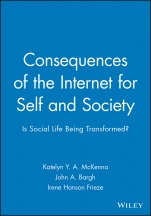
Consequences of the Internet for Self and Society: Is Social Life Being Transformed?
ISBN 9781405100786
Autor: Katelyn Y. A. McKenna, John A. Bargh, Irene Hanson Frieze
Wydawca: Wiley
Dostępność: 3-6 tygodni
Cena: 213,15 zł
Przed złożeniem zamówienia prosimy o kontakt mailowy celem potwierdzenia ceny.
ISBN13: |
9781405100786 |
ISBN10: |
1405100788 |
Autor: |
Katelyn Y. A. McKenna, John A. Bargh, Irene Hanson Frieze |
Oprawa: |
Paperback |
Rok Wydania: |
2002-03-09 |
Ilość stron: |
216 |
Wymiary: |
231x157 |
Tematy: |
JC |
The Internet is only 10 years old, but it has already had a great impact on the world. In its ′early′ days, it was both heralded as a liberating force for the spread of democracy, and condemned as a grave threat to the social fabric. However, as the present articles indicate, our knowledge of the Internet across a variety of social science perspectives has now accumulated to where we have a good initial picture of how the Internet really is (or isn′t) affecting social life. One theme stands out: these effects depend on how the unique qualities of Internet communication modes interact with the particular characteristics and goals of the individuals, groups, and communities using them.
Spis treści:
Part I: Introduction:.
1. Introduction to the issue: John A. Bargh, Department of Psychology, New York University.
Part II: The Internet and the Individual:.
2.Relationship Formation on the Internet: What′s the Big Attraction?: Katelyn Y. A. McKenna, Amie S. Green, & Marci E. J. Gleason, Department of Psychology, New York University.
3. Can You See the Real Me? Activation and Expression of the ‘True self′ on the Internet: John A. Bargh, Katelyn Y. A. McKenna, & Grainne M. Fitzsimons, Department of Psychology, New York University.
4. Internet Paradox Revisited: Robert Kraut, Sara Kiesler, Bonka Boneva, Jonathon Cummings, Vicki Helgeson, & Anne Crawford, Department of Human–Computer.Interaction, Carnegie–Mellon University.
5. Internet Use and Well–Being in Adolescence: Elisheva F. Gross, Jaana Juvonen, & Shelly L. Gable, Department of Psychology, University of California – Los Angeles.
Part III: The Internet and the Organization:.
6.When are Net Effects Gross Products? The Power of Influence and the Influence of Power in Computer–Mediated Communication: Russell Spears & Tom Postmes, Department of Social P
sychology, University of Amsterdam; Martin Lea, Department of Psychology, Manchester University; Anka Wolbert, Department of Social Psychology, University of Amsterdam.
7. Negotiating via Information Technology: Theory and Application: Leigh Thompson, Kellogg Graduate School of Business, Northwestern University, Janice Nadler, Northwestern University and American Bar Foundation.
Part IV: The Internet and Government:.
8.Civic Culture Meets the Digital Divide: The Role of Community: Electronic Networks: Eugene Borgida, John L. Sullivan, Alina Oxendine, Melinda S. Jackson, Eric Riedel, & Amy Gangl, Departments of Law and Psychology, University of Minnesota.
9. Dark Guests and Great Firewalls: The Internet and Chinese Security Policy: Ronald J. Deibert, Department of Political Science, University of Toronto.
Part V: Methodological Techniques and Issues:.
10.eResearch: Ethics, Security, Design, and Control in Psychological Research on the Internet: Brian Nosek & Mahzarin R. Banaji, Department of Psychology, Yale University, Anthony G. Greenwald, Department of Psychology, University of Washington.
11. Studying Hate Crime with the Internet: What Makes Racists Advocate Racial Violence? Jack Glaser & Jay Dixit, Goldman School of Public Policy, University of California – Berkeley; Donald Green, Department of Political Science, Yale University.
Part VI: Concluding Perspective:.
12.Is the Internet Changing Social Life? It Seems the More Things Change, the More They Stay the Same: Tom R. Tyler: Department of Psychology, New York University.
Nota biograficzna:
Katelyn Y. A. McKenna holds a PhD and is a Research Professor in the Department of Psychology, New York University. She received her B.A. with honors from Tulane University, and her PhD from Ohio University in 1998. Her research interests focus on relationship cognition and social identity processes, especially as these un
fold over the Internet.
John A. Bargh holds a PhD and is a Professor in the Department of Psychology, New York University. He received his Bachelors summa cum laude from University of Illinois in 1977, Ph.D. in Social Psychology from University of Michigan in 1981. Since 1981 he has been on the faculty of the New York University Psychology Department. He is the editor of four books, including Unintended Thought (Guilford, 1989), Psychology of Action (Guilford, 1996), The Use and Abuse of Power(Psychology Press, 2001), and Unraveling the Complexities of Social Life: A Festschrift in Honor of Robert B. Zajonc (American Psychological Association, 2001). His research focuses mainly on the role of nonconscious influences on emotion, judgment, and social behavior. He is a recipient of the Early Career Contribution Award from the American Psychological Association and a John Simon Guggenheim Memorial Foundation fellowship.
Okładka tylna:
The Internet is only 10 years old, but it has already had a great impact on the world. In its ′early′ days, it was both heralded as a liberating force for the spread of democracy, and condemned as a grave threat to the social fabric. However, as the present articles indicate, our knowledge of the Internet across a variety of social science perspectives has now accumulated to where we have a good initial picture of how the Internet really is (or isn′t) affecting social life. One theme stands out: these effects depend on how the unique qualities of Internet communication modes interact with the particular characteristics and goals of the individuals, groups, and communities using them.
Koszyk
Książek w koszyku: 0 szt.
Wartość zakupów: 0,00 zł
Informacje


Kontakt
Gambit
Centrum Oprogramowania
i Szkoleń Sp. z o.o.
Al. Pokoju 29b/22-24
31-564 Kraków
Siedziba Księgarni
ul. Kordylewskiego 1
31-542 Kraków
+48 12 410 5991
+48 12 410 5987
+48 12 410 5989
Subskrypcje
Administratorem danych osobowych jest firma Gambit COiS Sp. z o.o. Na podany adres będzie wysyłany wyłącznie biuletyn informacyjny.
Autoryzacja płatności

Informacje na temat autoryzacji płatności poprzez PayU.

© Copyright 2012: GAMBIT COiS Sp. z o.o. Wszelkie prawa zastrzeżone.
Projekt i wykonanie: Alchemia Studio Reklamy