


Wydawcy
Katalog tematyczny
- Archeologia (109)
- Ekonomia, finanse, business (13704)
- Filozofia (1445)
- Historia (3040)
- Języki i językoznawstwo (2356)
- Lifestyle, hobby i rozrywka (475)
- Medycyna (9704)
- Nauki humanistyczne (4)
- Nauki o Ziemi i środowisku (2638)
- Nauki ścisłe (20412)
- Nauki społeczne (8486)
- Nauki techniczne (13450)
- Prawo (1696)
- Publikacje informacyjne i interdyscyplinarne (1288)
- Religia i wierzenia (917)
- Technika komputerowa (4067)
- Zdrowie, relacje międzyludzkie i rozwój osobisty (657)





Informacje szczegółowe o książce
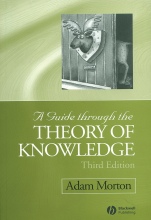
A Guide through the Theory of Knowledge
ISBN 9781405100120
Autor: Adam Morton
Wydawca: Wiley
Dostępność: 3-6 tygodni
Cena: 197,40 zł
Przed złożeniem zamówienia prosimy o kontakt mailowy celem potwierdzenia ceny.
ISBN13: |
9781405100120 |
ISBN10: |
1405100125 |
Autor: |
Adam Morton |
Oprawa: |
Paperback |
Rok Wydania: |
2002-07-12 |
Numer Wydania: |
3rd Edition |
Ilość stron: |
208 |
Wymiary: |
231x152 |
Tematy: |
HP |
The third edition of this highly acclaimed text is ideal for introductory courses in epistemology. Assuming little or no philosophical knowledge, it guides beginning students through the landmarks in epistemology, covering historically important topics as well as current issues and debates.
This edition includes an entirelynew chapter on externalism and epistemic virtues, and extensive revisions to other chapters. The suggestions for further reading, including electronic resources, have also been updated. It engagingly covers mainstream topics such as beliefs and perception, induction and probability, and knowledge of minds, as well as newer topics such as naturalistic epistemology, Bayesian epistemology, externalism, and moral knowledge.
At the end of each chapter are reading questions that test students' understanding of the presented information and thinking questions that challenge students and invite them into deeper reflection.
Foreword for Students.
Acknowledgments.
1. Beliefs And Their Qualities:.
Defending and Attacking Beliefs.
Epistemic Ideals.
The Basic Concepts.
The Basic Questions of The Theory Of Knowledge.
Two Extreme Views.
2. Perception:.
The Issues.
The Concepts.
Empiricism.
Some Experiments.
Evidence Without Certainty.
What is Special About Perception?.
3. Apriori Beliefs:.
Knowledge Just By Thinking.
Apriori, Analytic, Necessary.
Kant on the Synthetic Apriori.
Quine on the Analytic/Synthetic Distinction.
Conceptual Truths.
The Uses of Reasoning.
4. Inductive Reasoning:.
Simple Induction.
Hume′s Problem.
Goodman′s Problem.
Sampling.
Solutions to Goodman′s Problem.
Justifying Induction.
The Safeness of Induction.
IBE.
Safeness Reconsidered.
5. Middleword: Fallibilism:.
Error versus Ignorance.
Foundationalism versus Holism.
Fallibilisms.
How the Web Changes.
6. Defining Knowledge:.
Top–grade Belief.
Lehrer′s Principle.
Reliability: The Case of the Ancient Mariner.
Missing Information.
Knowledge and Trust.
7. Externalism and Epistemic Virtues:.
The Escape from Justification.
Externalism.
Cousins of Knowledge.
Skepticism and Knowing that You Know.
Virtues.
The Externalist Attitude.
8. Knowledge Of Minds:.
Psychological Beliefs.
Self–centered Theories.
Behavioral Theories.
Folk Psychology.
Materialist Theories.
Errors of Self–attribution.
Dispositions, Occurrences, and Reliability.
Conclusion: The Indispensability of Psychology.
9. Moral Knowledge:.
Knowing Right from Wrong.
Thick and Thin Moral Beliefs.
Analogies: Color, Humor, and Witches.
Cognitivsm.
Knowing What You Know.
10. Bayesian And Naturalist Theories:.
Why Probability?.
A Guide Through The Theory Of Probability.
The Bayesian Picture of Evidence.
Objections to Bayesianism.
Background Beliefs.
Rationality Naturalized.
Bayesianism vs. Naturalism.
11. Afterword: Some Future Epistemology:.
Definitions.
Appendix for Teachers.
Index.
Adam Morton is Professor of Philosophy at the University of Oklahoma. His publications include Frames of Mind (1980), Disasters and Dilemmas (Blackwell, 1991), and Philosophy in Practice: An Introduction to the Main Questions (Blackwell, 1995).
"Morton′s highly readable third edition treats a notoriously difficult topic with pizzazz. Colorful illustrations encourage readers to think deeply about complex issues, not just memorize what philosophers have said about them. One could hardly hope for a better guide through the rough terrain of epistemology." Martin Montminy, University of Ottawa <!––end––>
"This new edition of Adam Morton′s well–established introduction to epistemology will be extremely helpful to students and teachers. The book is particularly suited for those coming to the area for the first time. It is clear without being simplistic, engaging without being patronizing, and introductory without being bland. This new edition brings the discussion up to date, while the new chapter on externalism and epistemic virtues explores the issues very well. Once again, Morton′s guidance will be invaluable to many." Robert Stern, University of Sheffield
Koszyk
Książek w koszyku: 0 szt.
Wartość zakupów: 0,00 zł
Informacje


Kontakt
Gambit
Centrum Oprogramowania
i Szkoleń Sp. z o.o.
Al. Pokoju 29b/22-24
31-564 Kraków
Siedziba Księgarni
ul. Kordylewskiego 1
31-542 Kraków
+48 12 410 5991
+48 12 410 5987
+48 12 410 5989
Subskrypcje
Administratorem danych osobowych jest firma Gambit COiS Sp. z o.o. Na podany adres będzie wysyłany wyłącznie biuletyn informacyjny.
Autoryzacja płatności

Informacje na temat autoryzacji płatności poprzez PayU.

© Copyright 2012: GAMBIT COiS Sp. z o.o. Wszelkie prawa zastrzeżone.
Projekt i wykonanie: Alchemia Studio Reklamy