


Wydawcy
Katalog tematyczny
- Archeologia (109)
- Ekonomia, finanse, business (13704)
- Filozofia (1445)
- Historia (3040)
- Języki i językoznawstwo (2356)
- Lifestyle, hobby i rozrywka (475)
- Medycyna (9704)
- Nauki humanistyczne (4)
- Nauki o Ziemi i środowisku (2638)
- Nauki ścisłe (20412)
- Nauki społeczne (8486)
- Nauki techniczne (13450)
- Prawo (1696)
- Publikacje informacyjne i interdyscyplinarne (1288)
- Religia i wierzenia (917)
- Technika komputerowa (4067)
- Zdrowie, relacje międzyludzkie i rozwój osobisty (657)





Informacje szczegółowe o książce
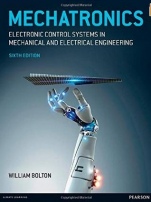
Mechatronics: Electronic Control Systems in Mechanical and Electrical Engineering, 6 Rev ed.
ISBN 9781292076683
Autor: W. Bolton
Wydawca: Pearson Education
Dostępność: Wysyłka w ciągu 2-3 dni
Cena: 397,95 zł
ISBN13: |
9781292076683 |
ISBN10: |
1292076682 |
Autor: |
W. Bolton |
Oprawa: |
Paperback |
Rok Wydania: |
2015-03-02 |
Numer Wydania: |
6 |
Ilość stron: |
664 |
The integration of electronic engineering, mechanical engineering, control and computer engineering – Mechatronics – lies at the heart of the innumerable gadgets, processes and technology without which modern life would seem impossible. From auto-focus cameras to car engine management systems, and from state-of-the-art robots to the humble washing machine, Mechatronics has a hand in them all.
Preface
Introduction
1 Introducing mechatronics
Chapter objectives
1.1 What is mechatronics?
1.2 The design process
1.3 Systems
1.4 Measurement systems
1.5 Control systems
1.6 Programmable logic controller
1.7 Examples of mechatronic systems
Summary
Problems
Sensors and signal conditioning
2 Sensors and transducers
Chapter objectives
2.1 Sensors and transducers
2.2 Performance terminology
2.3 Displacement, position and proximity
2.4 Velocity and motion
2.5 Force
2.6 Fluid pressure
2.7 Liquid flow
2.8 Liquid level
2.9 Temperature
2.10 Light sensors
2.11 Selection of sensors
2.12 Inputting data by switches
Summary
Problems
3 Signal conditioning
Chapter objectives
3.1 Signal conditioning
3.2 The operational amplifier
3.3 Protection
3.4 Filtering
3.5 Wheatstone bridge
3.6 Pulse modulation
3.7 Problems with signals
3.8 Power transfer
Summary
Problems
4 Digital signals
Chapter objectives
4.1 Digital signals
4.2 Analogue and digital signals
4.3 Digital-to-analogue and analogue-to-digital converters
4.4 Multiplexers
4.5 Data acquisition
4.6 Digital signal processing
Summary
Problems
5 Digital logic
Chapter objectives
5.1 Digital logic
5.2 Logic gates
5.3 Applications of logic gates
5.4 Sequential logic
Summary
Problems
6 Data presentation systems
Chapter objectives
6.1 Displays
6.2 Data presentation elements
6.3 Magnetic recording
6.4 Optical recording
6.5 Displays
6.6 Data acquisition systems
6.7 Measurement systems
6.8 Testing and calibration
Summary
Problems
Actuation
7 Pneumatic and hydraulic actuation systems
Chapter objectives
7.1 Actuation systems
7.2 Pneumatic and hydraulic systems
7.3 Directional control valves
7.4 Pressure control valves
7.5 Cylinders
7.6 Servo and proportional control valves
7.7 Process control valves
7.8 Rotary actuators
Summary
Problems
8 Mechanical actuation systems
Chapter objectives
8.1 Mechanical systems
8.2 Types of motion
8.3 Kinematic chains
8.4 Cams
8.5 Gear trains
8.6 Ratchet and pawl
8.7 Belt and chain drives
8.8 Bearings
8.9 Mechanical aspects of motor selection
Summary
Problems
9 Electrical actuation systems
Chapter objectives
9.1 Electrical systems
9.2 Mechanical switches
9.3 Solid-state switches
9.4 Solenoids
9.5 D.C. motors
9.6 A.C. motors
9.7 Stepper motors
Summary
Problems
Microprocessor systems
10 Microprocessors and microcontrollers
Chapter objectives
10.1 Control
10.2 Microprocessor systems
10.3 Microcontrollers
10.4 Applications
10.5 Programming
Summary
Problems
11 Assembly language
Chapter objectives
11.1 Languages
11.2 Instruction sets
11.3 Assembly language programs
11.4 Subroutines
11.5 Look-up tables
11.6 Embedded systems
Summary
Problems
12 C language
12.1 Why C?
12.2 Program structure
12.3 Branches and loops
12.4 Arrays
12.5 Pointers
12.6 Program development
12.7 Examples of programs
12.8 Arduino programs
Summary
Problems
13 Input/output systems
Chapter Objectives
13.1 Interfacing
13.2 Input/output addressing
13.3 Interface requirements
13.4 Peripheral interface adapters
13.5 Serial communications interface
13.6 Examples of interfacing
Summary
Problems
14 Programmable logic controllers
Chapter objectives
14.1 Programmable logic controllers
14.2 Basic PLC structure
14.3 Input/output processing
14.4 Ladder programming
14.5 Instruction lists
14.6 Latching and internal relays
14.7 Sequencing
14.8 Timers and counters
14.9 Shift registers
14.10 Master and jump controls
14.11 Data handling
14.12 Analogue input/output
Summary
Problems
15 Communication systems
Chapter objectives
15.1 Digital communications
15.2 Centralised, hierarchical and distributed control
15.3 Networks
15.4 Protocols
15.5 Open Systems Interconnection communication model
15.6 Serial communication interfaces
15.7 Parallel communication interfaces
15.8 Wireless protocols
Summary
Problems
16 Fault finding
Chapter objectives
16.1 Fault-detection techniques
16.2 Watchdog timer
16.3 Parity and error coding checks
16.4 Common hardware faults
16.5 Microprocessor systems
16.6 Emulation and simulation
16.7 PLC systems
Summary
Problems
System models
17 Basic system models
Chapter objectives
17.1 Mathematical models
17.2 Mechanical system building blocks
17.3 Electrical system building blocks
17.4 Fluid system building blocks
17.5 Thermal system building blocks
Summary
Problems
18 System models
Chapter objectives
18.1 Engineering systems
18.2 Rotational–translational systems
18.3 Electromechanical systems
18.4 Linearity
18.5 Hydraulic–mechanical systems
Summary
Problems
19 Dynamic responses of systems
Chapter objectives
19.1 Modelling dynamic systems
19.2 Terminology
19.3 First-order systems
19.4 Second-order systems
19.5 Performance measures for second-order systems
19.6 System identification
Summary
Problems
20 System transfer functions
Chapter objectives
20.1 The transfer function
20.2 First-order systems
20.3 Second-order systems
20.4 Systems in series
20.5 Systems with feedback loops
20.6 Effect of pole location on transient response
Summary
Problems
21 Frequency response
Chapter objectives
21.1 Sinusoidal input
21.2 Phasors
21.3 Frequency response
21.4 Bode plots
21.5 Performance specifications
21.6 Stability
Summary
Problems
22 Closed-loop controllers
Chapter objectives
22.1 Continuous and discrete control processes
22.2 Terminology
22.3 Two-step mode
22.4 Proportional mode
22.5 Derivative control
22.6 Integral control
22.7 PID controller
22.8 Digital controllers
22.9 Control system performance
22.10 Controller tuning
22.11 Velocity control
22.12 Adaptive control
Summary
Problems
23 Artificial intelligence
Chapter objectives
23.1 What is meant by artificial intelligence?
23.2 Perception and cognition
23.3 Reasoning
23.4 Learning
Summary
Problems
Conclusion
24 Mechatronics systems
Chapter objectives
24.1 Mechatronic designs
24.2 Case studies
24.3 Robotics
Summary
Problems and assignments
Appendices
A The Laplace transform
A.1 The Laplace transform
A.2 Unit steps and impulses
A.3 Standard Laplace transforms
A.4 The inverse transform
Problems
B Number systems
B.1 Number systems
B.2 Binary mathematics
B.3 Floating numbers
B.4 Gray code
Problems
C Boolean algebra
C.1 Laws of Boolean algebra
C.2 De Morgan laws
C.3 Boolean function generation from truth tables
C.4 Karnaugh maps
Problems
D Instruction sets
E C library functions
F MATLAB and SIMULINK
F.1 MATLAB
F.2 SIMULINK
G Electrical circuit analysis
G.1 D.C. circuits
G.2 A.C. circuits
Further information
Answers
Index
Koszyk
Książek w koszyku: 0 szt.
Wartość zakupów: 0,00 zł
Informacje


Kontakt
Gambit
Centrum Oprogramowania
i Szkoleń Sp. z o.o.
Al. Pokoju 29b/22-24
31-564 Kraków
Siedziba Księgarni
ul. Kordylewskiego 1
31-542 Kraków
+48 12 410 5991
+48 12 410 5987
+48 12 410 5989
Subskrypcje
Administratorem danych osobowych jest firma Gambit COiS Sp. z o.o. Na podany adres będzie wysyłany wyłącznie biuletyn informacyjny.
Autoryzacja płatności

Informacje na temat autoryzacji płatności poprzez PayU.

© Copyright 2012: GAMBIT COiS Sp. z o.o. Wszelkie prawa zastrzeżone.
Projekt i wykonanie: Alchemia Studio Reklamy