


Wydawcy
Katalog tematyczny
- Archeologia (109)
- Ekonomia, finanse, business (13704)
- Filozofia (1445)
- Historia (3040)
- Języki i językoznawstwo (2356)
- Lifestyle, hobby i rozrywka (475)
- Medycyna (9704)
- Nauki humanistyczne (4)
- Nauki o Ziemi i środowisku (2638)
- Nauki ścisłe (20412)
- Nauki społeczne (8486)
- Nauki techniczne (13450)
- Prawo (1696)
- Publikacje informacyjne i interdyscyplinarne (1288)
- Religia i wierzenia (917)
- Technika komputerowa (4067)
- Zdrowie, relacje międzyludzkie i rozwój osobisty (657)





Informacje szczegółowe o książce
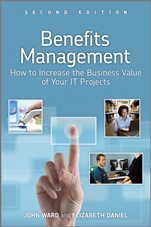
Benefits Management: How to Increase the Business Value of Your IT Projects
ISBN 9781119993261
Autor: John Ward, Elizabeth Daniel
Wydawca: Wiley
Dostępność: 3-6 tygodni
Cena: 263,55 zł
Przed złożeniem zamówienia prosimy o kontakt mailowy celem potwierdzenia ceny.
ISBN13: |
9781119993261 |
ISBN10: |
1119993261 |
Autor: |
John Ward, Elizabeth Daniel |
Oprawa: |
Hardback |
Rok Wydania: |
2012-08-10 |
Numer Wydania: |
2nd Edition |
Ilość stron: |
362 |
Wymiary: |
237x166 |
Tematy: |
KJ |
Benefits Management Second Edition shows how the enduring challenges of achieving business value from information systems and technology projects can be addressed successfully. The approach, which is synthesized from best practices, sound theories and proven techniques from a range of management disciplines, is exemplified from the authors′ extensive experience of working with a wide range of organizations. With examples from a wide variety of projects including non–IT projects, the book is written in an accessible style, ideal for practicing managers, and includes check lists and templates for using the processes, tools and techniques and real–life case studies of their application and impacts.
"A must read for anyone who wants to understand, articulate or prove how technology delivers real bottom–line business value" Sarah Harries, Head of Business Improvement, BT plc
"An invaluable reference for driving more value from your IT and project spend" Jason Haines, Finance and Operations Director, Allen & Overy LLP
"The Benefits Management book is one of the most relevant books I have ever read. Benefits management is a key success factor for any project or program and this book describes how to do it in a pragmatic and logical way." Dr. Axel Uhl, Head of Business Transformation Academy, SAP
About the authors xi
Preface xiii
1 The challenges of IS/IT projects 1
Dissatisfaction with current approaches to benefits delivery 4
The need for a fresh approach: benefits management 8
Benefits delivery 9
A focus on value 10
A business case linked to organizational strategy 11
The importance of change management 12
Commitment from business managers 13
IS/IT sufficient to do the job 13
Involvement of stakeholders 14
Educated in the use of technology 15
Post–implementation benefits review 16
The importance of a common language 17
Summary 19
2 Understanding the strategic context 21
The external and internal perspectives of business strategy: the competitive forces and resource–based views 22
Resources, competences and capabilities 23
Ends, ways and means 26
PEST analysis 28
Industry attractiveness and competitive forces analysis 28
External value chain analysis 34
Internal value chain analysis 37
Alternative internal value chain configurations 40
Balancing the external and internal contexts: the dimensions of competence 44
Linking business, IS and IT strategies 47
Managing the portfolio of IS/IT investments 49
Organizational information competences 56
Summary 59
3 The foundations of benefits management 61
The gaps in existing methods and the implications 62
The origins of the benefits management approach and process 67
An overview of the benefits management process 68
Step 1: Identifying and structuring the benefits 69
Step 2: Planning benefits realization 73
Step 3: Executing the benefits plan 75
Step 4: Reviewing and evaluating the results 78
Step 5: Establishing the potential for further benefits 79
What is different about this approach? 80
Summary 83
4 Establishing the why, what and how 85
Why: identifying business and organizational drivers 86
Establishing investment objectives 91
Linking the investment objectives to the drivers 93
What: the business benefits 94
How: the benefi ts dependency network 95
Measurement and ownership 103
Benefi t and change templates 111
Worked example: improved control within a food processing organization 111
Summary 121
5 Building the business case 127
Arguing the value of the project 129
Maintaining dependency: benefits are the result of changes 132
A structure for analysing and describing the benefits 133
Quantifying the benefits: the major challenge 136
Ways of overcoming the quantification problem 137
Financial benefits 144
Cost reductions 147
Revenue increases 148
Project cost assessment 150
Investment appraisal techniques 150
Variations in benefi ts and changes across the investment portfolio 152
Risk assessment 156
Completing the business case 161
Summary business case for the FoodCo project 163
Summary 166
6 Stakeholder and change management 169
Assessing the feasibility of achieving the benefit 170
Stakeholder analysis and management techniques 173
From analysis to action 178
Completing the benefits plan 182
Approaches to managing change 184
Matching the management approach and stakeholder behaviours 185
The nature of IT–enabled change management: is it different? 186
Alternative change management strategies 193
Summary 197
7 Implementing a benefi ts management approach 199
Rationales for introducing benefits management 200
Initiating and managing a benefits–driven project 204
The project sponsor 206
The business project manager 207
The role of project management offi ces (PMOs) 209
The first workshop 211
Activities between workshops 212
The second workshop 212
Inclusion of the benefi ts plan in the management of the project 217
Monitoring the benefits after implementation 223
Fit with other methodologies 224
Organizational benefits management maturity 225
Summary 234
8 The importance of context 235
Factors to take into account 236
The public sector 237
Small and medium–sized businesses (SMEs) 241
Multi–unit businesses: replicated deployments 242
Variations across the applications portfolio 245
Problem–based: key operational and support investments 247
Innovation–based: strategic and high potential
investments 248
Different application types 252
E–commerce and e–business 252
Information management (IM) 253
Customer relationship management (CRM) systems 256
Enterprise resource planning (ERP) systems 259
Infrastructure investments 263
Non–IT projects 266
Different IS/IT supply arrangements 267
Summary 271
9 From projects to programmes to portfolios 273
Defining programmes 274
Planned and emergent programmes 276
Programme dependency networks 276
The management of programme benefits 282
Managing the IS/IT project investment portfolio 284
Governance and portfolio management 285
Setting priorities 287
Links to drivers 290
Benefits management lite 293
Project portfolio management in practice 295
Summary 295
10 Creating a better future 299
The continuing challenge of IS/IT projects 300
Characteristics of the benefits management approach 300
The value of the process 301
Using benefits management to formulate and implement strategy 303
Incorporating benefits management into strategic thinking 308
Examples of benefits–driven strategies 311
Future trends in IS/IT and their implications for benefits management 312
A final word or two 323
Glossary 325
References 329
Index 337
John Ward is Emeritus Professor at Cranfield University, School of Management. He was previously Professor of Strategic Information Systems and Director of the Information Systems Research Centre. Prior to joining Cranfield, he worked in industry for 15 years and continues to be a consultant to a number of major organizations. As well as publishing many papers and articles, he is co–author of the book Strategic Planning for Information Systems. He is a Fellow of the Chartered Institute of Management Accountants and has served two terms as President of the UK Academy for Information Systems.
Elizabeth Daniel is Professor of Information Management and Associate Dean of Research and Scholarship at the Open University Business School (OUBS). Prior to joining OUBS in 2005, she worked in the IS Research Centre at Cranfield School of Management. Elizabeth s research has addressed a number of areas including benefits management and IS in marketing and supply chains. Recent work has included studies of home–based online businesses and the uses of consumer and employee data. She has published many papers in leading academic journals and a number of management reports.
Koszyk
Książek w koszyku: 0 szt.
Wartość zakupów: 0,00 zł
Informacje


Kontakt
Gambit
Centrum Oprogramowania
i Szkoleń Sp. z o.o.
Al. Pokoju 29b/22-24
31-564 Kraków
Siedziba Księgarni
ul. Kordylewskiego 1
31-542 Kraków
+48 12 410 5991
+48 12 410 5987
+48 12 410 5989
Subskrypcje
Administratorem danych osobowych jest firma Gambit COiS Sp. z o.o. Na podany adres będzie wysyłany wyłącznie biuletyn informacyjny.
Autoryzacja płatności

Informacje na temat autoryzacji płatności poprzez PayU.

© Copyright 2012: GAMBIT COiS Sp. z o.o. Wszelkie prawa zastrzeżone.
Projekt i wykonanie: Alchemia Studio Reklamy