


Wydawcy
Katalog tematyczny
- Archeologia (109)
- Ekonomia, finanse, business (13704)
- Filozofia (1445)
- Historia (3040)
- Języki i językoznawstwo (2356)
- Lifestyle, hobby i rozrywka (475)
- Medycyna (9704)
- Chirurgia (272)
- Inne gałęzie medycyny (1871)
- Medycyna kliniczna (4187)
- Medycyna niekonwencjonalna (14)
- Medycyna przedkliniczna (269)
- Medycyna, ogólnie (1740)
- Historia medycyny (3)
- Lekarze, sprawy zawodowe (8)
- Medycyna, aspekty prawne (10)
- Służba zdrowia (36)
- Wyposażenie medyczne (157)
- Zdrowie publiczne (460)
- Medyczne służby pomocnicze (745)
- Studia medyczne (16)
- Weterynaria (548)
- Nauki humanistyczne (4)
- Nauki o Ziemi i środowisku (2638)
- Nauki ścisłe (20412)
- Nauki społeczne (8486)
- Nauki techniczne (13450)
- Prawo (1696)
- Publikacje informacyjne i interdyscyplinarne (1288)
- Religia i wierzenia (917)
- Technika komputerowa (4067)
- Zdrowie, relacje międzyludzkie i rozwój osobisty (657)





Informacje szczegółowe o książce
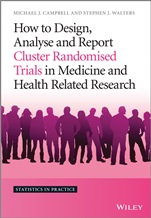
How to Design, Analyse and Report Cluster Randomised Trials in Medicine and Health Related Research
ISBN 9781119992028
Autor: Michael J. Campbell, Stephen J. Walters
Wydawca: Wiley
Dostępność: 3-6 tygodni
Cena: 389,55 zł
Przed złożeniem zamówienia prosimy o kontakt mailowy celem potwierdzenia ceny.
ISBN13: |
9781119992028 |
ISBN10: |
1119992028 |
Autor: |
Michael J. Campbell, Stephen J. Walters |
Oprawa: |
Hardback |
Rok Wydania: |
2014-05-16 |
Ilość stron: |
264 |
Wymiary: |
259x185 |
Tematy: |
MBNS |
A complete guide to understanding cluster randomised trials Written by two researchers with extensive experience in the field, this book presents a complete guide to the design, analysis and reporting of cluster randomised trials. It spans a wide range of applications: trials in developing countries, trials in primary care, trials in the health services. A key feature is the use of R code and code from other popular packages to plan and analyse cluster trials, using data from actual trials. The book contains clear technical descriptions of the models used, and considers in detail the ethics involved in such trials and the problems in planning them. For readers and students who do not intend to run a trial but wish to be a critical reader of the literature, there are sections on the CONSORT statement, and exercises in reading published trials. Written in a clear, accessible style Features real examples taken from the authors’ extensive practitioner experience of designing and analysing clinical trials Demonstrates the use of R, Stata and SPSS for statistical analysis Includes computer code so the reader can replicate all the analyses Discusses neglected areas such as ethics and practical issues in running cluster randomised trial How to Design, Analyse and Report Cluster Randomised Trials in Medicine and Health Related Research provides an excellent reference tool and can be read with profit by statisticians, health services researchers, systematic reviewers and critical readers of cluster randomised trials.
Preface Acronyms and abbreviations 1 Introduction 1.1 Randomised controlled trials 1.1.1 A–Allocation at random 1.1.2 B–Blindness 1.1.3 C–Control 1.2 Complex interventions 1.3 History of cluster randomised trials 1.4 Cohort and field trials 1.5 The field/community trial 1.5.1 The REACT trial 1.5.2 The Informed Choice leaflets trial 1.5.3 The Mwanza trial 1.5.4 The paramedics practitioner trial 1.6 The cohort trial 1.6.1 The PoNDER trial 1.6.2 The DESMOND trial 1.6.3 The Diabetes Care from Diagnosis trial 1.6.4 The REPOSE trial 1.6.5 Other examples of cohort cluster trials 1.7 Field versus cohort designs 1.8 Reasons for cluster trials 1.9 Between– and within–cluster variation 1.10 Random–effects models for continuous outcomes 1.10.1 The model 1.10.2 The intracluster correlation coefficient 1.10.3 Estimating the intracluster correlation (ICC) coefficient 1.10.4 Link between the Pearson correlation coefficient and the intraclass correlation coefficient 1.11 Random–effects models for binary outcomes 1.11.1 The model 1.11.2 The ICC for binary data 1.11.3 The coefficient of variation 1.11.4 Relationship between cvc and for binary data 1.12 The design effect 1.13 Commonly asked questions 1.14 Websources Exercise Appendix 1.A 2 Design issues 2.1 Introduction 2.2 Issues for a simple intervention 2.2.1 Phases of a trial 2.2.2 ‘Pragmatic’ and ‘explanatory’ trials 2.2.3 Intention–to–treat and per–protocol analyses 2.2.4 Non–inferiority and equivalence trials 2.3 Complex interventions 2.3.1 Design of complex interventions 2.3.2 Phase I modelling/qualitative designs 2.3.3 Pilot or feasibility studies 2.3.4 Example of pilot/feasibility studies in cluster trials 2.4 Recruitment bias 2.5 Matched–pair trials 2.5.1 Design of matched–pair studies 2.5.2 Limitations of matched–pairs designs 2.5.3 Example of matched–pair design: The Family Heart Study 2.6 Other types of designs 2.6.1 Cluster factorial designs 2.6.2 Example cluster factorial trial 2.6.3 Cluster crossover trials 2.6.4 Example of a cluster crossover trial 2.6.5 Stepped wedge 2.6.6 Pseudorandomised trials 2.7 Other design issues 2.8 Strategies for improving precision 2.9 Randomisation 2.9.1 Reasons for randomisation 2.9.2 Simple randomisation 2.9.3 Stratified randomisation 2.9.4 Restricted randomisation 2.9.5 Minimisation Exercise Appendix 2.A 3 Sample size: How many subjects/clusters do I need for my cluster randomised controlled trial? 3.1 Introduction 3.1.1 Justification of the requirement for a sample size 3.1.2 Significance tests, P –values and power 3.1.3 Sample size and cluster trials 3.2 Sample size for continuous data – comparing two means 3.2.1 Basic formulae 3.2.2 The design effect (DE) in cluster RCTs 3.2.3 Example from general practice 3.3 Sample size for binary data – comparing two proportions 3.3.1 Sample size formula 3.3.2 Example calculations 3.3.3 Example: The Informed Choice leaflets study 3.4 Sample size for ordered categorical (ordinal) data 3.4.1 Sample size formula 3.4.2 Example calculations 3.5 Sample size for rates 3.5.1 Formulae 3.5.2 Example comparing rates 3.6 Sample size for survival 3.6.1 Formulae 3.6.2 Example of sample size for survival 3.7 Equivalence/non–inferiority studies 3.7.1 Equivalence/non–inferiority versus superiority 3.7.2 Continuous data – comparing the equivalence of two means 3.7.3 Example calculations for continuous data 3.7.4 Binary data – comparing the equivalence of two proportions 3.8 Unknown standard deviation and effect size 3.9 Practical problems 3.9.1 Tips on getting the SD 3.9.2 Non–response 3.9.3 Unequal groups 3.10 Number of clusters fixed 3.10.1 Number of clusters and number of subjects per cluster 3.10.2 Example with number of clusters fixed 3.10.3 Increasing the number of clusters or number of patients per cluster? 3.11 Values of the ICC 3.12 Allowing for imprecision in the ICC 3.13 Allowing for varying cluster sizes 3.13.1 Formulae 3.13.2 Example of effect of variable cluster size 3.14 Sample size re–estimation 3.14.1 Adjusting for covariates 3.15 Matched–pair studies 3.15.1 Sample sizes for matched designs 3.15.2 Example of a sample size calculation for a matched study 3.16 Multiple outcomes/endpoints 3.17 Three or more groups 3.18 Crossover trials 3.18.1 Formulae 3.18.2 Example of a sample size formula in a crossover trial 3.19 Post hoc sample size calculations 3.20 Conclusion: Usefulness of sample size calculations 3.21 Commonly asked questions Exercise Appendix 3.A 4 Simple analysis of cRCT outcomes using aggregate cluster–level summaries 4.1 Introduction 4.1.1 Methods of analysing cluster randomised trials 4.1.2 Choosing the statistical method 4.2 Aggregate cluster–level analysis – carried out at the cluster level, using aggregate summary data 4.3 Statistical methods for continuous outcomes 4.3.1 Two independent–samples t –test 4.3.2 Example 4.4 Mann–Whitney U test 4.5 Statistical methods for binary outcomes 4.6 Analysis of a matched design 4.7 Discussion 4.8 Commonly asked question Exercise Appendix 4.A 5 Regression methods of analysis for continuous outcomes using individual person–level data 5.1 Introduction 5.2 Incorrect models 5.2.1 The simple (independence) model 5.2.2 Fixed effects 5.3 Linear regression with robust standard errors 5.3.1 Robust standard errors 5.3.2 Example of use of robust standard errors 5.3.3 Cluster–specific versus population–averaged models 5.4 Random–effects general linear models in a cohort study 5.4.1 General models 5.4.2 Fitting a random–effects model 5.4.3 Example of a random–effects model from the PoNDER study 5.4.4 Checking the assumptions 5.5 Marginal general linear model with coefficients estimated by generalised estimating equations (GEE) 5.5.1 Generalised estimating equations 5.5.2 Example of a marginal model from the PoNDER study 5.6 Summary of methods 5.7 Adjusting for individual–level covariates in cohort studies 5.8 Adjusting for cluster–level covariates in cohort studies 5.9 Models for cross–sectional designs 5.10 Discussion of model fitting Exercise Appendix 5.A 6 Regression methods of analysis for binary, count and time–to–event outcomes for a cluster randomised controlled trial 6.1 Introduction 6.2 Difference between a cluster–specific model and a population–averaged or marginal model for binary data 6.3 Analysis of binary data using logistic regression 6.4 Review of past simulations to determine efficiency of different methods for binary data 6.5 Analysis using summary measures 6.6 Analysis using logistic regression (ignoring clustering) 6.7 Random–effects logistic regression 6.8 Marginal models using generalised estimating equations 6.9 Analysis of count data 6.10 Survival analysis with cluster trials 6.11 Missing data 6.12 Discussion Exercise Appendix 6.A 7 The protocol 7.1 Introduction 7.2 Abstract 7.3 Protocol background 7.4 Research objectives 7.5 Outcome measures 7.6 Design 7.7 Intervention details 7.8 Eligibility 7.9 Randomisation 7.10 Assessment and data collection 7.11 Statistical considerations 7.11.1 Sample size 7.11.2 Statistical analysis 7.11.3 Interim analyses 7.12 Ethics 7.12.1 Declaration of Helsinki 7.12.2 Informed consent 7.13 Organisation 7.13.1 The team 7.13.2 Trial forms 7.13.3 Data management 7.13.4 Protocol amendments 7.14 Further reading Exercise 8 Reporting of cRCTs 8.1 Introduction: Extended CONSORT guidelines for reporting and presenting the results from cRCTs 8.2 Patient flow diagram 8.3 Comparison of entry characteristics 8.4 Incomplete data 8.5 Reporting the main outcome 8.6 Subgroup analysis and analysis of secondary outcomes/endpoints 8.7 Estimates of between–cluster variability 8.7.1 Example of reporting the ICC: The PoNDER cRCT 8.8 Further reading Exercise 9 Practical issues 9.1 Preventing bias in cluster randomised controlled trials 9.1.1 Problems with identifying and recruiting patients to cluster trials 9.1.2 Preventing biased recruitment 9.2 Developing complex interventions 9.3 Choice of method of analysis 9.4 Missing data 9.5 Example sensitivity analysis: Imputation of missing 6–month EPDS data for at–risk women from the PoNDER cRCT 9.6 Multiplicity of outcomes 9.6.1 Limiting the number of confirmatory tests 9.6.2 Summary measures and statistics 9.6.3 Global tests and multiple comparison procedures 9.6.4 Which multiple comparison procedure to use? 10 Computing software 10.1 R 10.1.1 History 10.1.2 Installing R 10.1.3 Simple use of R 10.1.4 An example of an R program 10.2 Stata (version 12) 10.2.1 Introduction to Stata 10.2.2 Aggregate cluster–level analysis – carried out at the cluster level, using aggregate summary data 10.2.3 Random–effects models – continuous outcomes 10.2.4 Random–effects models – binary outcomes 10.2.5 Random–effects models – count outcomes 10.2.6 Marginal models – continuous outcomes 10.2.7 Marginal models – binary outcomes 10.2.8 Marginal models – count outcomes 10.3 SPSS (version 19) 10.3.1 Introduction to SPSS 10.3.2 Comparing cluster means using aggregate cluster–level analysis –carried out at the cluster level, using aggregate summary data 10.3.3 Marginal models 10.3.4 Random–effects models 10.4 Conclusion and further reading References Index
Koszyk
Książek w koszyku: 0 szt.
Wartość zakupów: 0,00 zł
Informacje


Kontakt
Gambit
Centrum Oprogramowania
i Szkoleń Sp. z o.o.
Al. Pokoju 29b/22-24
31-564 Kraków
Siedziba Księgarni
ul. Kordylewskiego 1
31-542 Kraków
+48 12 410 5991
+48 12 410 5987
+48 12 410 5989
Subskrypcje
Administratorem danych osobowych jest firma Gambit COiS Sp. z o.o. Na podany adres będzie wysyłany wyłącznie biuletyn informacyjny.
Autoryzacja płatności

Informacje na temat autoryzacji płatności poprzez PayU.

© Copyright 2012: GAMBIT COiS Sp. z o.o. Wszelkie prawa zastrzeżone.
Projekt i wykonanie: Alchemia Studio Reklamy