


Wydawcy
Katalog tematyczny
- Archeologia (109)
- Ekonomia, finanse, business (13704)
- Filozofia (1445)
- Historia (3040)
- Języki i językoznawstwo (2356)
- Lifestyle, hobby i rozrywka (475)
- Medycyna (9704)
- Nauki humanistyczne (4)
- Nauki o Ziemi i środowisku (2638)
- Nauki ścisłe (20412)
- Nauki społeczne (8486)
- Nauki techniczne (13450)
- Prawo (1696)
- Publikacje informacyjne i interdyscyplinarne (1288)
- Religia i wierzenia (917)
- Technika komputerowa (4067)
- Zdrowie, relacje międzyludzkie i rozwój osobisty (657)





Informacje szczegółowe o książce
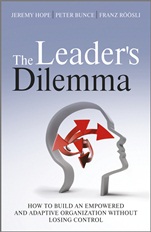
The Leaders Dilemma: How to Build an Empowered and Adaptive Organization Without Losing Control
ISBN 9781119970002
Autor: Jeremy Hope, Peter Bunce, Franz Röösli
Wydawca: Wiley
Dostępność: 3-6 tygodni
Cena: 157,50 zł
Przed złożeniem zamówienia prosimy o kontakt mailowy celem potwierdzenia ceny.
ISBN13: |
9781119970002 |
ISBN10: |
1119970008 |
Autor: |
Jeremy Hope, Peter Bunce, Franz Röösli |
Oprawa: |
Hardback |
Rok Wydania: |
2011-04-12 |
Ilość stron: |
344 |
Wymiary: |
238x160 |
Tematy: |
KJ |
Many leaders realize that in today′s economy it will no longer be the smart highly paid people in the corporate center that drive success. Instead it will come from harnessing the knowledge and creativity of all their people, especially those that work at the interface between the organization and its customers. They also know that their budget–driven management processes are too slow, rigid and expensive and encourage the wrong behaviour. But business leaders are on the horns of a dilemma. How do they empower their people and adapt to change without losing control? This book is about rethinking how we manage organizations in a post–industrial, post credit crunch world where innovative management models represent the only remaining source of sustainable competitive advantage. Above all The Leader′s Dilemma is about learning how to change business – based on best practice and innovation drawn from leaders world–wide who have built and managed successful organizations. "Every executive will have already had to face the well–known dilemma between trust and control. Based on the principles described, the authors succeed in finding a way out of this dilemma. Supported by concrete practical examples, these twelve principles add up to an integral management model which encompasses employee engagement, efficiency and innovation intelligently." Philippe Hertig, Managing Partner, Egon Zehnder International (Switzerland) "As Albert Einstein once accurately stated, problems can never be solved using the same approach as that out of which they came. The management approach in The Leader′s Dilemma is not subject to this unconscious, but very frequent mistake. It shows an entirely new approach on leadership and management, which regards organizations as living systems." Erich Harsch, CEO, dm drogerie–markt "Executives are increasingly recognizing that the traditional model by which they manage their organizations is obsolete and counter–productive. In The Leader′s Dilemma, Hope, Bunce and Röösli radically re–define the core principles of management – including accountability, goals, rewards, planning and coordination – to bring management into the 21st century." Dr Jules Goddard, Research Fellow, MLab, London Business School "In a dozen clear principles, The Leader′s Dilemma codifies a rethink of the conventional management model. The book′s approach should be studied by any company aiming to survive and thrive in a transforming business landscape." Vineet Nayar, CEO of HCL Technologies and author of Employees First, Customers Second
Foreword. Preface. Some definitions. Introduction. The organization as an adaptive system. 1 Principle #1 – Values. Bind people to a common cause, not a central plan. 2 Principle #2 – Governance. Govern through shared values and sound judgment, not detailed rules and regulations. 3 Principle #3 – Transparency. Make information open and transparent; don′t restrict and control it. 4 Principle #4 – Teams. Organize around a seamless network of accountable teams, not centralized functions. 5 Principle #5 – Trust. Trust teams to regulate and improve their performance; don′t micro–manage them. 6 Principle #6 – Accountability. Base accountability on holistic criteria and peer reviews, not on hierarchical relationships. 7 Principle #7 – Goals. Set ambitious medium–term goals, not short–term fixed targets. 8 Principle #8 – Rewards. Base rewards on relative performance, not fixed targets. 9 Principle #9 – Planning. Make planning a continuous and inclusive process, not a top–down annual event. 10 Principle #10 – Coordination. Coordinate interactions dynamically, not through annual budgets. 11 Principle #11 – Resources. Make resources available just–in–time, not just–in–case. 12 Principle #12 – Controls. Base controls on fast, frequent feedback, not on budget variances. 13 Implementation insights. 14 Make management change your legacy. Notes. Index.
Jeremy Hope is co–founder of the Beyond Budgeting Round Table, a not–for–profit collaborative dedicated to helping organizations improve their management models. He is a chartered accountant and a co–author of Transforming the Bottom Line , Competing in the Third Wave and Beyond Budgeting . He is also author of Reinventing the CFO . He lives in West Yorkshire, England and can be contacted at jeremyhope@bbrt.org . Peter Bunce is a co–founder of the Beyond Budgeting Round Table (BBRT), a not–for–profit collaborative dedicated to helping organizations improve their management models. He is a Chartered Engineer and has held various posts in manufacturing engineering and collaborative research. He lives in Hampshire, England and can be contacted at peterbunce@bbrt.org . Franz Röösli is a professor and management trainer at the University of Applied Sciences North Western Switzerland (FHNW) and Director of the Beyond Budgeting Round Table (BBRT), an international shared learning network for management development. He has experienced many years in management positions in different industries. He lives in Switzerland and can be contacted at franz.roeoesli@bbrt.org .
Koszyk
Książek w koszyku: 0 szt.
Wartość zakupów: 0,00 zł
Informacje


Kontakt
Gambit
Centrum Oprogramowania
i Szkoleń Sp. z o.o.
Al. Pokoju 29b/22-24
31-564 Kraków
Siedziba Księgarni
ul. Kordylewskiego 1
31-542 Kraków
+48 12 410 5991
+48 12 410 5987
+48 12 410 5989
Subskrypcje
Administratorem danych osobowych jest firma Gambit COiS Sp. z o.o. Na podany adres będzie wysyłany wyłącznie biuletyn informacyjny.
Autoryzacja płatności

Informacje na temat autoryzacji płatności poprzez PayU.

© Copyright 2012: GAMBIT COiS Sp. z o.o. Wszelkie prawa zastrzeżone.
Projekt i wykonanie: Alchemia Studio Reklamy