


Wydawcy
Katalog tematyczny
- Archeologia (109)
- Ekonomia, finanse, business (13704)
- Filozofia (1445)
- Historia (3040)
- Języki i językoznawstwo (2356)
- Lifestyle, hobby i rozrywka (475)
- Medycyna (9704)
- Nauki humanistyczne (4)
- Nauki o Ziemi i środowisku (2638)
- Nauki ścisłe (20412)
- Nauki społeczne (8486)
- Nauki techniczne (13450)
- Budownictwo lądowe (1045)
- Chemia przemysłowa (2258)
- Elektronika i telekomunikacja (3287)
- Energetyka (1122)
- Inne nauki stosowane (363)
- Inżynieria biochemiczna (507)
- Inżynieria transportu (232)
- Mechanika i materiały (3316)
- Nauka o środowisku (321)
- Rolnictwo (507)
- Technika, ogólnie (475)
- Prawo (1696)
- Publikacje informacyjne i interdyscyplinarne (1288)
- Religia i wierzenia (917)
- Technika komputerowa (4067)
- Zdrowie, relacje międzyludzkie i rozwój osobisty (657)








Informacje szczegółowe o książce
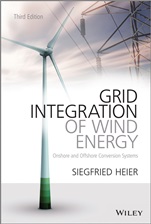
Grid Integration of Wind Energy: Onshore and Offshore Conversion Systems
ISBN 9781119962946
Autor: Siegfried Heier
Wydawca: Wiley
Dostępność: 3-6 tygodni
Cena: 536,55 zł
Przed złożeniem zamówienia prosimy o kontakt mailowy celem potwierdzenia ceny.
ISBN13: |
9781119962946 |
ISBN10: |
1119962943 |
Autor: |
Siegfried Heier |
Oprawa: |
Hardback |
Rok Wydania: |
2014-06-13 |
Numer Wydania: |
3rd Edition |
Ilość stron: |
520 |
Wymiary: |
244x177 |
Tematy: |
TJ |
This popular reference describes the integration of wind–generated power into electrical power systems and, with the use of advanced control systems, illustrates how wind farms can be made to operate like conventional power plants. Fully revised, the third edition provides up–to–date coverage on new generator developments for wind turbines, recent technical developments in electrical power conversion systems, control design, and essential operating conditions. With expanded coverage of offshore technologies, this edition looks at the characteristics and static and dynamic behavior of offshore wind farms and their connection to the mainland grid. Brand new material includes: • comprehensive treatment of onshore and offshore grid integration; • updated legislative guidelines for the design, construction, and installation of wind power plants; • the fundamental characteristics and theoretical tools of electrical and mechanical components and their interactions; • new and future types of generators, converters, power electronics, and controller designs; • improved use of grid capacities and grid support for fixed– and variable–speed controlled wind power plants; • options for grid control and power reserve provision in wind power plants and wind farms. This resource is an excellent guide for researchers and practitioners involved in the planning, installation, and grid integration of wind turbines and power plants. It is also highly beneficial to university students studying wind power technology, renewable energy, and power systems, and to practitioners in wind engineering, turbine design and manufacture, and electrical power engineering.
Preface xi Notation xiii 1 Wind Energy Power Plants 1 1.1 Wind Turbine Structures 1 1.2 A Brief History 4 1.3 Milestones of Development 5 1.4 Functional Structures of Wind Turbines 20 References 30 2 Wind Energy Conversion Systems 31 2.1 Drive Torque and Rotor Power 31 2.1.1 Inputs and outputs of a wind turbine 31 2.1.2 Power extraction from the airstream 32 2.1.3 Determining power or driving torque by the blade element method 34 2.1.4 Simplifying the computation method 38 2.1.5 Modeling turbine characteristics 40 2.2 Turbines 46 2.2.1 Hub and turbine design 50 2.2.2 Rotor blade geometry 51 2.3 Power Control by Turbine Manipulation 57 2.3.1 Turbine yawing 57 2.3.2 Rotor blade pitch variation 67 2.3.3 Limiting power by stall control 97 2.3.4 Power control using speed variation 100 2.4 Mechanical Drive Trains 102 2.5 System Data of a Wind Power Plant 108 2.5.1 Turbine and drive train data 108 2.5.2 Machine and tower masses 110 2.5.3 Machine costs 111 References 116 3 Generating Electrical Energy from Mechanical Energy 119 3.1 Constraints and Demands on the Generator 119 3.2 Energy Converter Systems 122 3.2.1 Asynchronous generator construction 125 3.2.2 Synchronous generator construction 126 3.3 Operational Ranges of Asynchronous and Synchronous Machines 126 3.4 Static and Dynamic Torque 132 3.4.1 Static torque 133 3.4.2 Dynamic torque 147 3.5 Generator Simulation 154 3.5.1 Synchronous machines 155 3.5.2 Asynchronous machines 160 3.6 Design Aspects 161 3.6.1 Asynchronous generators 162 3.6.2 Synchronous generators for gearless plants 174 3.6.3 Multi–generator concept (Dissertation A. Ezzahraoui) 187 3.6.4 Ring generator with magnetic bearings (Dissertation K. Messol) 194 3.6.5 Compact superconductive and other new generator concepts 197 3.7 Machine Data 199 3.7.1 Mass and cost relationships 200 3.7.2 Characteristic values of asynchronous machines 202 3.7.3 Characteristic values of synchronous machines 204 References 208 4 The Transfer of Electrical Energy to the Supply Grid 210 4.1 Power Conditioning and Grid Connection 210 4.1.1 Converter systems 212 4.1.2 Power semiconductors for converters 215 4.1.3 Functional characteristics of power converters 218 4.1.4 Converter designs 222 4.1.5 Indirect converter 223 4.1.6 Electromagnetic compatibility (EMC) 236 4.1.7 Protective measures during power conditioning 237 4.2 Grid Protection 238 4.2.1 Fuses and grid disconnection 239 4.2.2 Short–circuiting power 239 4.2.3 Increase of short–circuit power 242 4.2.4 Isolated operation and rapid auto–reclosure 245 4.2.5 Overvoltages in the event of grid faults 247 4.3 Grid Effects 247 4.3.1 General compatibility and interference 247 4.3.2 Output behavior of wind power plants 248 4.3.3 Voltage response in grid supply 260 4.3.4 Harmonics and subharmonics 271 4.3.5 Voltage faults and the fault–ride–through (FRT) 279 4.4 Resonance Effects in the Grid During Normal Operation 284 4.5 Remedial Measures against Grid Effects and Grid Resonances 290 4.5.1 Filters 290 4.5.2 Filter design 292 4.5.3 Function of harmonic absorber filters and compensation units 293 4.5.4 Grid–specific filter layout 294 4.5.5 Utilizing compensating effects 297 4.6 Grid Control and Protection 300 4.6.1 Supply by wind turbines 300 4.6.2 Grid support and grid control with wind turbines and other renewable systems 301 4.6.3 Central reactive power control 305 4.6.4 System services and operation 308 4.6.5 Connection of wind turbine to the transmission grid 310 4.7 Grid Connection Rules 311 4.8 Grid Connection in the Offshore Region 317 4.8.1 Offshore wind farm properties 317 4.8.2 Stationary and dynamic behavior of offshore wind farms 319 4.8.3 Wind farm and cluster formation at sea and grid connection 319 4.8.4 Electrical energy transmission to the mainland 323 4.8.5 Reactive power requirement and reactive power provision in the offshore grid 325 4.8.6 Flexible AC transmission systems (FACTS) 330 4.9 Integration of the Wind Energy into the Grid and Provision of Energy 333 4.9.1 Grid extension 333 4.9.2 Provision of energy 335 4.9.3 Control and reserve power 337 4.9.4 Power reserve provision with wind farms (Dissertation A. J. Gesino) 338 4.9.5 Intercontinental grid connections 346 References 346 5 Control and Supervision of Wind Turbines 355 5.1 System Requirements and Operating Modes 356 5.2 Isolated Operation of Wind Turbines 358 5.2.1 Turbines without a blade pitch adjustment mechanism 359 5.2.2 Plants with a blade pitch adjustment mechanism 360 5.2.3 Plants with load management 362 5.2.4 Turbine control by means of a bypass 362 5.3 Grid Operation of Wind Turbines 363 5.4 Control Concepts 367 5.4.1 Control in isolated operation 367 5.4.2 Regulation of variable–speed turbines 371 5.4.3 Regulation of variable–slip asynchronous generators 373 5.4.4 Regulation of turbines with a rigid connection to the grid 388 5.4.5 Wind turbine control using hydrodynamic variable–speed superimposing gears 390 5.5 Controller Design 390 5.5.1 Adjustment processes and torsional moments at the rotor blades 392 5.5.2 Standardizing and linearizing the variables 395 5.5.3 Control circuits and simplified dimensioning 400 5.5.4 Improving the control characteristics 404 5.5.5 Control design for wind turbines 410 5.6 Management System 411 5.6.1 Operating states 412 5.6.2 Faults 423 5.6.3 Determining the state of system components 424 5.7 Monitoring and Safety Systems 424 5.7.1 Wind measuring devices 425 5.7.2 Oscillation monitoring 425 5.7.3 Grid surveillance and lightning protection 426 5.7.4 Surveillance computer 426 5.7.5 Fault prediction 427 5.7.6 Voltage limitation 429 References 430 6 UsingWind Energy 436 6.1 Wind Conditions and Energy Yields 436 6.1.1 Global wind conditions 436 6.1.2 Local wind conditions and annual available power from the wind 438 6.1.3 Calculation of site–specific and regional turbine yields 440 6.1.4 Wind atlas methods 444 6.2 Potential and Expansion 449 6.2.1 Wind energy use on land 449 6.2.2 Offshore wind energy use 451 6.2.3 Repowering 453 6.3 Economic Considerations 455 6.3.1 Purchase and maintenance costs 457 6.3.2 Power supply and financial yields 457 6.3.3 Blue section 460 6.3.4 Commercial calculation methods 461 6.4 Legal Aspects and the Installation of Turbines 463 6.4.1 Immission protection 464 6.4.2 Nature and landscape conservation 467 6.4.3 Building laws 468 6.4.4 Planning and planning permission 469 6.4.5 Procedure for erecting a wind turbine 470 6.4.6 Offshore utilization of wind energy 472 6.5 Ecological Balance 474 6.5.1 Contribution to climate protection 474 6.5.2 Landscape utilization 475 6.5.3 Bird strike 475 6.5.4 Bats 475 6.5.5 Recycling of wind turbines 475 6.5.6 Energetic amortization time and harvest factor 476 References 476 Index 483
Professor Siegfried Heier , Universitaet Kassel, Institut fuer Elektrische Energietechnik, Germany Siegfried Heier is currently the Head of the Wind Engineering department at Kassel University, Germany. He has been a Professor at the university since 1979. He is the initiator and head of many research projects in the field of wind engineering and he has published more than 70 articles about generator systems, and control and grid integration of wind energy converts. Professor Heier has also written books in the area, such as Windkraftanlagen (B.G. Teubner), now in its 5 th Edition. Siegfried currently holds two patents.
Foreword, 2nd Edition XIII
Foreword, 1st Edition XV
1 Introduction 1
1.1 Reliability, Security, Economy 1
1.2 Legal, Political and Social Restrictions 2
1.3 Needs for Power System Planning 4
1.4 Basic, Development and Project Planning 5
1.4.1 Basic Planning 5
1.4.2 System Development Planning 7
1.4.3 Project Planning 7
1.5 Instruments for Power System Planning 7
1.6 Further Tasks of Power System Engineering 10
2 Power System Load 11
2.1 General 11
2.2 Load Forecast with Load Increase Factors 12
2.3 Load Forecast with Economic Characteristic Data 13
2.4 Load Forecast with Estimated Values 14
2.5 Load Forecast with Specific Loads and Degrees of Electrification 14
2.6 Load Forecast with Standardized Load Curves 17
2.7 Typical Time Course of Power System Load 20
2.8 Smart Grid and Smart Domestic Appliances 23
3 Planning Principles and Planning Criteria 27
3.1 Planning Principles 27
3.2 Basics of Planning 30
3.3 Planning Criteria 34
3.3.1 Voltage Band According to IEC 60038 34
3.3.2 Voltage Criteria 35
3.3.2.1 Low-Voltage Systems 35
3.3.2.2 Medium-Voltage Systems 36
3.3.2.3 High- and Extra-High-Voltage Systems 36
3.3.3 Loading Criteria 37
3.3.4 Stability Criteria 38
4 Economic Consideration and Loss Evaluation 41
4.1 Present Value and Annuity Method 41
4.2 Evaluation of Losses 42
4.2.1 Energy Losses 43
4.2.2 Power Losses 44
5 Topologies of Electrical Power Systems 49
5.1 Development of Power Systems 49
5.2 Recommended Voltage Levels 51
5.3 Topology of Power Systems 52
5.3.1 Radial Systems 52
5.3.2 Ring-Main Systems 54
5.3.2.1 Ring-Main System – Simple Topology 54
5.3.2.2 Ring-Main System with Remote Station (Without Supply) 56
5.3.2.3 Ring-Main System with Reserve Line 57
5.3.2.4 Ring-Main System with Feeding Remote Station 60
5.3.2.5 Ring-Main System as Tuple System 61
5.3.2.6 Ring-Main System with Cross-Link 62
5.3.2.7 Ring-Main System with Base Station 63
5.3.2.8 Special-Spare Cable System 64
5.3.2.9 Double-T Connection 65
5.3.3 Meshed Systems at HV and MV Levels 66
5.3.3.1 HV Transmission Systems 66
5.3.3.2 Meshed MV Systems 68
5.3.4 Meshed Systems at the LV Level 69
5.3.4.1 Meshed System Supplied Station-by-Station 69
5.3.4.2 Single-Line Supply 69
5.3.4.3 Multiple-Line Supply 69
5.4 Special Operating Considerations 71
6 Arrangement in Gridstations and Substations 73
6.1 Busbar Arrangements 73
6.1.1 General 73
6.1.2 Single Busbar without Separation 73
6.1.3 Single Busbar with Sectionalizer 75
6.1.4 Special H-Arrangement 75
6.1.5 Double Busbar Arrangement 76
6.1.6 Double Busbar with Reserve Busbar 77
6.2 Arrangement in Switchyards 78
6.2.1 Breakers and Switches 78
6.2.2 Incoming and Outgoing Feeders 79
6.2.3 Current Transformers 79
6.2.4 Voltage Transformers 82
7 Transformers 85
7.1 General 85
7.2 Utilization and Construction of Transformers 85
7.2.1 Utilization of Transformers 85
7.2.2 Oil-Immersed Transformers and Dry-Type Transformers 87
7.2.3 Characteristic Data of Transformers 90
7.3 Operation of Transformers 90
7.3.1 Voltage Drop 90
7.3.2 Permissible Loading of Transformer Neutral 92
7.4 Thermal Permissible Loading 92
7.4.1 Temperature Models 92
7.4.2 Maximum Permissible Loading of Oil-Immersed Transformers 99
7.4.2.1 General 99
7.4.2.2 Continuous Loading 102
7.4.2.3 Normal Cyclic Load 102
7.4.2.4 Long-Time and Short-Time Emergency Operation 104
7.4.3 Maximal Permissible Loading of Dry-Type Transformers 106
7.5 Economical Operation of Transformers 109
7.6 Short-Circuit Strength 110
8 Cable Systems 115
8.1 General 115
8.2 Construction Details 116
8.3 Electrical Parameters of Cables 118
8.4 Losses and Permissible Current 120
8.4.1 General 120
8.4.2 Calculation of Losses 122
8.4.3 Soil Characteristics 124
8.4.4 Thermal Resistances of Cables 127
8.4.5 Calculation according to VDE 0276-1000 128
8.4.6 Determination of Maximal Permissible Loading by Computer Programs 130
8.5 Planning and Design of Cable Routes and Trenches 131
8.5.1 Coordination with Other Cables and Pipes 131
8.5.2 Effect of Thermally Unfavorable Areas 133
8.5.3 Influence of Other Parameters 134
8.6 Short-Circuit Withstand Capability 136
8.6.1 General 136
8.6.2 Rating of Cable Screens 138
9 Overhead Lines 141
9.1 General 141
9.2 Permissible Loading (Thermal) Current 141
9.2.1 Design Limits 141
9.2.2 Losses 142
9.2.3 Heating by Solar Radiation 144
9.2.4 Heat Dissipation by Radiation and Convection 146
9.2.5 Examples for Permissible Thermal Loading 149
9.3 Electric Field Strength 149
9.4 Sag, Tensions and Minimum Distances 152
9.4.1 Minimal Length of Insulation 152
9.4.2 Conductor Sag and Span Length 154
9.5 Short-Circuit Thermal Withstand Strength 155
9.6 Right-of-Way (ROW) and Tower Arrangement 157
9.7 Cost Estimates 160
9.8 High-Temperature Conductors 162
9.8.1 General 162
9.8.2 Thermal Alloy Conductor Steel Reinforced (TACSR) 162
9.8.3 Zirconium Alloy Conductor Invar Steel Reinforced (ZACIR) 163
9.8.4 Gap Thermal Resistant Aluminum Alloy Steel Reinforced (GTACSR) 163
9.8.5 Annealed Aluminum Conductor Steel Supported (ACSS) 164
9.8.6 Aluminum Conductor Composite Core (ACCC) 164
9.8.7 Aluminum Conductor Composite Reinforced (ACCR) 164
10 Flexible AC Transmission Systems (FACTS) 165
10.1 Basics of Transmission of Power through Lines 165
10.2 Parallel Compensation of Lines 169
10.3 Serial Compensation of Lines 171
10.4 Phase-Shifting Equipment 172
10.5 Improvement of Stability 174
10.6 Basics of Flexible AC Transmission Systems (FACTS) 177
10.7 HVDC-Transmission (High-Voltage-Direct-Current) 178
10.7.1 General 178
10.7.2 Converter Stations and Related Equipment 179
10.7.3 Breakers, Reactors, Electrodes and other Equipment 179
11 Load-Flow and Short-Circuit Current Calculation 181
11.1 Load-Flow Calculation 181
11.2 Calculation of Short-Circuit Currents 183
11.2.1 General 183
11.2.2 Initial Short-Circuit Current (AC) 187
11.2.3 Peak Short-Circuit Current 187
11.2.3.1 Uniform or Smallest R/X Ratio (Method A) 190
11.2.3.2 R/X Ratio of the Short-Circuit Impedance at the Short-Circuit Location (Method B) 190
11.2.3.3 Equivalent Frequency fc (Method C) 190
11.2.4 Symmetrical Short-Circuit Breaking Current 190
11.2.5 Steady-State Short-Circuit Current 191
11.2.6 Influence of Synchronous and Asynchronous Motors 191
11.3 Short-Circuit Withstand Capability 193
11.4 Limitation of Short-Circuit Currents 195
11.4.1 General 195
11.4.2 Measures in Power Systems 196
11.4.2.1 Selection of Nominal System Voltage 196
11.4.2.2 Operation as Separate Subsystems 197
11.4.2.3 Distribution of Feeding Locations 198
11.4.2.4 Coupling of Power System at Busbars with Low Short-Circuit Level 200
11.4.2.5 Restructuring of the Power System 201
11.4.3 Measures in Installations and Switchgear Arrangement 201
11.4.3.1 Multiple Busbar Operation 201
11.4.3.2 Busbar Sectionalizer in Single-Busbar Switchgear 201
11.4.3.3 Short-Circuit Current Limiting Equipment 202
11.4.4 Measures Concerning Equipment 207
11.4.4.1 Impedance Voltage of Transformers 207
11.4.4.2 Short-Circuit Limiting Reactor 207
11.4.4.3 Earthing Impedances 208
11.4.4.4 Increased Subtransient Reactance of Generators 209
12 Connection of “Green-Energy” Generation to Power Systems 213
12.1 General 213
12.2 Conditions for System Connection 216
12.2.1 General 216
12.2.2 Calculation of Power System Impedance at Point of Common Coupling 218
12.2.2.1 Structure of Power System 218
12.2.2.2 Parallel Resonances in Electrical Power Systems 219
12.2.2.3 Typical Resonances in Power Systems 222
12.2.3 Short-Circuit Currents and Protective Devices 224
12.2.4 Voltage Control and Reactive Power Supply under Steady-State Conditions 225
12.2.4.1 Generation Connected to Low-Voltage Systems 225
12.2.4.2 Generation Connected to Medium-Voltage Systems 225
12.2.4.3 Generation Connected to High-Voltage Systems (Un = 110 kV) 226
12.2.4.4 Generation Connected to Extra-High-Voltage Systems (Un ≥ 110 kV) 228
12.2.5 Frequency Control and Active Power Reduction 230
12.3 Fault-Ride-Through (FRT) Conditions and Dynamic Voltage Control 232
12.3.1 Types of Generation Units 232
12.3.2 Conditions for Generation Units of Type 1 232
12.3.3 Conditions for Units of Type 2 234
12.4 Assessment of System Perturbations of Generation Plants 235
12.4.1 General 235
12.4.2 Voltage Increase 236
12.4.3 Rapid Voltage Change due to Switching Operations 237
12.4.4 Flicker Caused by Switching 239
12.4.5 Flicker at Normal Operating Conditions 240
12.4.6 Harmonic and Interharmonic Currents and Voltages 242
12.4.6.1 LV and MV System 242
12.4.6.2 Generation Connected to HV and EHV System 244
12.4.6.3 Superposition of Harmonics and Interharmonics 246
12.4.7 Asymmetry and Voltage Unbalance 247
12.4.8 Commutation Dips 247
12.4.9 Effects on Ripple-Control and Line-Carrier Systems 247
13 Protection of Equipment and Power System Installations 249
13.1 Faults and Disturbances 249
13.2 Criteria for Operation of Protection Devices 250
13.3 General Structure of Protective Systems; Transducers 252
13.4 Protection of Equipment 254
13.5 Protection of Lines (Overhead Lines and Cables) 255
13.5.1 General 255
13.5.2 Overcurrent Protection 256
13.5.3 Distance (Impedance) Protection 258
13.5.4 Differential Protection of Lines 263
13.5.5 Ground-Fault Protection 263
13.6 Protection of Transformers 265
13.6.1 General 265
13.6.2 Differential Protection 265
13.6.3 Overcurrent Protection, Distance Protection, Ground-Fault Protection 266
13.6.4 Buchholz Protection 267
13.7 Protection of Busbars 268
13.7.1 Current Criteria for Busbar Protection 268
13.7.2 Impedance Criteria for Busbar Protection 269
13.8 Protection of Other Equipment 269
13.9 Reference List of IEC-Symbols and ANSI-Code-Numbers 269
14 Overvoltages and Insulation Coordination 271
14.1 General; Defi nitions 271
14.2 Procedure of Insulation Coordination 273
14.3 Determination of the Representative Overvoltages 274
14.3.1 Continuous Power-Frequency Voltage and Temporary Overvoltages 274
14.3.2 Slow-Front Overvoltages 275
14.3.3 Fast-Front Overvoltages 277
14.3.3.1 General 277
14.3.3.2 Simplified Approach 277
14.3.3.3 Detailed Calculation; Parameters of Lightning Current 278
14.3.3.4 Direct Strokes to the Phase Conductor 281
14.4 Determination of the Coordination Withstand Voltage and the Required Withstand Voltage 284
14.5 Selection of the Rated Voltage 286
14.6 Application Example 289
15 Influence of Neutral Earthing on Single-Phase Short-Circuit Currents 295
15.1 General 295
15.2 Power System with Low-Impedance Earthing 296
15.3 Power System Having Earthing with Current Limitation 300
15.4 Power System with Isolated Neutral 302
15.5 Power System with Resonance Earthing (Petersen Coil) 307
15.5.1 General 307
15.5.2 Calculation of Displacement Voltage 311
15.5.3 Tuning of the Petersen Coil 314
15.5.4 Residual Current Compensation 316
15.5.4.1 Residual Current Compensation by Shifting of the Neutral-Point Displacement Voltage 318
15.5.4.2 Residual Current Compensation by Injection of Current into the Neutral 318
15.6 Earthing of Neutrals on HV Side and LV Side of Transformers 319
16 Tendering and Contracting 325
16.1 General (Project Definition) 325
16.2 Terms of Reference (TOR) 327
16.2.1 Background 327
16.2.2 Objective 327
16.2.3 Scope of Engineering Activities 328
16.3 Project Funding 329
16.4 Form of Tendering 329
16.4.1 International Tendering 330
16.4.2 Prequalification 330
16.4.3 Short Listing 331
16.5 Planning and Design 331
16.6 Tender Structure 333
16.6.1 General 333
16.6.2 Tender Set-Up 334
16.6.2.1 General, Common Sections 334
16.6.2.2 Sections Specific to Each Lot or Package 336
16.6.3 General Technical Specifications 336
16.6.3.1 General Rules and Provisions Related to the Design 337
16.6.3.2 High-Voltage Metal-Clad SF6-Insulated Switchgear 337
16.6.3.3 Medium-Voltage Switchgear 339
16.6.3.4 Control, Supervision and Protection 340
16.6.3.5 Overhead Lines 340
16.6.3.6 Power and Auxiliary Cable 342
16.6.3.7 Telecommunication System 342
16.6.3.8 Transformers and Reactors 342
16.6.3.9 Auxiliary Equipment 343
16.6.3.10 Civil Works for Substations 344
16.7 Scope of Work and Supply 344
16.7.1 General 344
16.7.2 380 kV Switchgear 344
16.7.3 123 kV Switchgear 345
16.7.4 Transformers and Reactors 345
16.7.5 Telecommunication System 346
16.8 Technical Data Sheets 346
16.9 Tendering Period and Evaluation of Tender 348
16.9.1 Tendering Period 348
16.9.2 Bid Evaluation 353
16.10 Contracting 353
Appendix 357
References 365
Index 371
Koszyk
Książek w koszyku: 0 szt.
Wartość zakupów: 0,00 zł
Informacje


Kontakt
Gambit
Centrum Oprogramowania
i Szkoleń Sp. z o.o.
Al. Pokoju 29b/22-24
31-564 Kraków
Siedziba Księgarni
ul. Kordylewskiego 1
31-542 Kraków
+48 12 410 5991
+48 12 410 5987
+48 12 410 5989
Subskrypcje
Administratorem danych osobowych jest firma Gambit COiS Sp. z o.o. Na podany adres będzie wysyłany wyłącznie biuletyn informacyjny.
Autoryzacja płatności

Informacje na temat autoryzacji płatności poprzez PayU.

© Copyright 2012: GAMBIT COiS Sp. z o.o. Wszelkie prawa zastrzeżone.
Projekt i wykonanie: Alchemia Studio Reklamy