


Wydawcy
Katalog tematyczny
- Archeologia (109)
- Ekonomia, finanse, business (13704)
- Filozofia (1445)
- Historia (3040)
- Języki i językoznawstwo (2356)
- Lifestyle, hobby i rozrywka (475)
- Medycyna (9704)
- Nauki humanistyczne (4)
- Nauki o Ziemi i środowisku (2638)
- Nauki ścisłe (20412)
- Nauki społeczne (8486)
- Edukacja (229)
- Kryminologia, opieka spełeczna (284)
- Obronność (10)
- Polityka (1389)
- Psychologia (777)
- Socjologia (410)
- Społeczeństwo i kultura (187)
- Nauki techniczne (13450)
- Prawo (1696)
- Publikacje informacyjne i interdyscyplinarne (1288)
- Religia i wierzenia (917)
- Technika komputerowa (4067)
- Zdrowie, relacje międzyludzkie i rozwój osobisty (657)





Informacje szczegółowe o książce
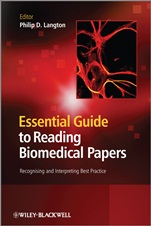
Essential Guide to Reading Biomedical Papers: Recognising and Interpreting Best Practice
ISBN 9781119959977
Autor: Philip D. Langton
Wydawca: Wiley
Dostępność: 3-6 tygodni
Cena: 218,40 zł
Przed złożeniem zamówienia prosimy o kontakt mailowy celem potwierdzenia ceny.
ISBN13: |
9781119959977 |
ISBN10: |
1119959977 |
Autor: |
Philip D. Langton |
Oprawa: |
Paperback |
Rok Wydania: |
2012-11-23 |
Ilość stron: |
350 |
Wymiary: |
243x170 |
Tematy: |
JB |
Essential Guide to Reading Biomedical Papers: Recognising and Interpreting Best Practiceis an indispensable companion to the biomedical literature. This concise, easy–to–follow text gives an insight into core techniques and practices in biomedical research and how, when and why a technique should be used and presented in the literature. Readers are alerted to common failures and misinterpretations that may evade peer review and are equipped with the judgment necessary to be properly critical of the findings claimed by research articles. This unique book will be an invaluable resource for students, technicians and researchers in all areas of biomedicine.
Allows the reader to develop the necessary skills to properly evaluate research articles Coverage of over 30 commonly–used techniques in the biomedical sciences Global approach and application, with contributions from leading experts in diverse fields
Appraisal of research papers in undergraduate courses tends to address the results, but rarely includes a critical evaluation of the researchers methodology. In reality, few bioscientists can claim a working knowledge of more than a handful of the techniques covered in this collection. These shortcomings can be greatly overcome thanks to this book. The contributors are active research scientists of high quality. Each addresses the methods in a critical sense and provide an expert′s view of the advantages and pitfalls. There is no equivalent book currently available. Dr David J. Miller, on behalf of The Physiological Society.
List of contributors ix
Foreword xi
Preface xiii
Acknowledgements xvii
Introduction xix
Section A – Basic principles 1
1 Philosophy of science 3
James Ladyman
2 Ingredients of experimental design 9
Nick Colegrave
3 Statistics: a journey that needs a guide 17
Gordon Drummond
Section B – Cell and molecular 27
4 Organ bath pharmacology 29
Emma Robinson
5 Small vessel myography 39
Tomoko Kamishima and John M Quayle
6 Mammalian cell cultures: the example of airway epithelial cell cultures for cystic fibrosis research 49
Scott H Randell
7 Electron microscopy (TEM and SEM) 59
Paul Verkade
8 Fluorescence microscopy 67
Mark Jepson
9 Intracellular ′sharp′ microelectrode recording 77
Helena C Parkington and Harold A Coleman
10 Single electrode voltage–clamp (SEVC) 85
Harold A Coleman and Helena C Parkington
11 Patch clamp recording 95
Neil Bannister and Phil Langton
12 Production of antibodies 105
Elek Molnar
13 Immunocytochemistry and immunohistochemistry 117
Elek Molnar
14 Immunoprecipitation (IP) 129
David Bates
15 Immunoblotting (western) 137
Samantha F. Moore, Joshua S. Savage and Ingeborg Hers
16 Applications of green fluorescent protein (GFP) 147
Mark Jepson
17 Fluorescent measurement of ion activity in cells 153
Helen Kennedy
18 Detection of exocytosis real time 163
Anja Teschemacher
19 Viral vector transgenesis 173
Anja Teschemacher
20 Polymerase chain reaction (PCR) and reverse transcription (RT)–PCR 179
Lucy F. Donaldson
21 In situ hybridisation (ISH) 187
Lucy F. Donaldson
22 Methods of interference (antisense, siRNAs and dominant negative mutations) 193
Allison Fulford
23 Transcriptome analysis: microarrays 203
Charles Hindmarch
24 Experimental proteomics 215
Thierry Le Bihan
Section C – In vivo / integrative 229
25 Behavioural methodology 231
Emma Robinson
26 Genetically modified mouse models 241
Nina Balthasar
27 Wireless recording of cardiovascular signals 247
Julian FR Paton and Fiona D McBryde
28 Electrical stimulation methods 253
Jon Wakerley
29 Extracellular recording 261
Jon Wakerley
30 Antidromic identification 271
Jon Wakerley
31 Event–triggered averaging, including spike–triggered averaging 279
Richard Apps
32 Axonal transport tracing of CNS pathways 285
John Crabtree
33 Cardiovascular methods: general considerations for human studies 291
Erica A Wehrwein and Michael J Joyner
34 Measuring cardiac output in humans 299
Erica A Wehrwein and Michael J Joyner
35 Measuring peripheral blood flow in humans 311
Erica A Wehrwein and Michael J Joyner
Index 319
The book would be of most benefit to new researchers or early career scientists though with some benefits to the more experienced scientist moving into a new discipline. (Microbiology Today, 1 September 2013)
As a guide to how to properly ask questions of life and how to interpret its often–enigmatic answers, this book is a must read. Summing Up: Highly recommended. Upper–division undergraduates, graduate students, researchers/faculty, and professionals. (Choice, 1 August 2013)
Too many recent bioscience graduates lack significant research lab experience. Even research projects can expose them to just a few techniques. Appraisal of research papers in undergraduate courses tends to address the results, but rarely includes a critical evaluation of the researchers methodology. In reality, few bioscientists can claim a working knowledge of more than a handful of the techniques covered in this collection.
These shortcomings can be greatly overcome thanks to this book. The contributors are active research scientists of high quality. Each addresses the methods in a critical sense and provide an expert′s view of the advantages and pitfalls. There is no equivalent book currently available. Dr David J. Miller on behalf of The Physiological Society
Research questions require the scientist to employ molecular, cell, organism and population approaches, and the reader of scientific literature to carefully consume data from each of those environments. This book provides a clear and concise summary of the research techniques and approaches that generate data. Importantly, the authors identify appropriate uses and cautionary caveats, essential for readers who do not use the technique. This book is essential for accurate and careful interpretation of scientific literature. Professor Robert G. Carroll, Editor Advances in Physiology Education
Koszyk
Książek w koszyku: 0 szt.
Wartość zakupów: 0,00 zł
Informacje


Kontakt
Gambit
Centrum Oprogramowania
i Szkoleń Sp. z o.o.
Al. Pokoju 29b/22-24
31-564 Kraków
Siedziba Księgarni
ul. Kordylewskiego 1
31-542 Kraków
+48 12 410 5991
+48 12 410 5987
+48 12 410 5989
Subskrypcje
Administratorem danych osobowych jest firma Gambit COiS Sp. z o.o. Na podany adres będzie wysyłany wyłącznie biuletyn informacyjny.
Autoryzacja płatności

Informacje na temat autoryzacji płatności poprzez PayU.

© Copyright 2012: GAMBIT COiS Sp. z o.o. Wszelkie prawa zastrzeżone.
Projekt i wykonanie: Alchemia Studio Reklamy