


Wydawcy
Katalog tematyczny
- Archeologia (109)
- Ekonomia, finanse, business (13704)
- Filozofia (1445)
- Historia (3040)
- Języki i językoznawstwo (2356)
- Lifestyle, hobby i rozrywka (475)
- Medycyna (9704)
- Nauki humanistyczne (4)
- Nauki o Ziemi i środowisku (2638)
- Nauki ścisłe (20412)
- Nauki społeczne (8486)
- Nauki techniczne (13450)
- Budownictwo lądowe (1045)
- Chemia przemysłowa (2258)
- Elektronika i telekomunikacja (3287)
- Energetyka (1122)
- Inne nauki stosowane (363)
- Inżynieria biochemiczna (507)
- Inżynieria transportu (232)
- Mechanika i materiały (3316)
- Nauka o środowisku (321)
- Rolnictwo (507)
- Technika, ogólnie (475)
- Prawo (1696)
- Publikacje informacyjne i interdyscyplinarne (1288)
- Religia i wierzenia (917)
- Technika komputerowa (4067)
- Zdrowie, relacje międzyludzkie i rozwój osobisty (657)





Informacje szczegółowe o książce
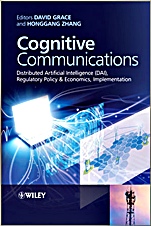
Cognitive Communications: Distributed Artificial Intelligence (DAI), Regulatory Policy and Economics, Implementation
ISBN 9781119951506
Autor: David Grace, Honggang Zhang
Wydawca: Wiley
Dostępność: 3-6 tygodni
Cena: 662,55 zł
Przed złożeniem zamówienia prosimy o kontakt mailowy celem potwierdzenia ceny.
ISBN13: |
9781119951506 |
ISBN10: |
111995150X |
Autor: |
David Grace, Honggang Zhang |
Oprawa: |
Hardback |
Rok Wydania: |
2012-08-31 |
Ilość stron: |
500 |
Wymiary: |
254x176 |
Tematy: |
TJ |
This book discusses in–depth the concept of distributed artificial intelligence (DAI) and its application to cognitive communications In this book, the authors present an overview of cognitive communications, encompassing both cognitive radio and cognitive networks, and also other application areas such as cognitive acoustics. The book also explains the specific rationale for the integration of different forms of distributed artificial intelligence into cognitive communications, something which is often neglected in many forms of technical contributions available today. Furthermore, the chapters are divided into four disciplines: wireless communications, distributed artificial intelligence, regulatory policy and economics and implementation. The book contains contributions from leading experts (academia and industry) in the field. Key Features: Covers the broader field of cognitive communications as a whole, addressing application to communication systems in general (e.g. cognitive acoustics and Distributed Artificial Intelligence (DAI) Illustrates how different DAI based techniques can be used to self–organise the radio spectrum Explores the regulatory, policy and economic issues of cognitive communications in the context of secondary spectrum access Discusses application and implementation of cognitive communications techniques in different application areas (e.g. Cognitive Femtocell Networks (CFN) Written by experts in the field from both academia and industry Cognitive Communications will be an invaluable guide for research community (PhD students, researchers) in the areas of wireless communications, and development engineers involved in the design and development of mobile, portable and fixed wireless systems., wireless network design engineer. Undergraduate and postgraduate students on elective courses in electronic engineering or computer science, and the research and engineering community will also find this book of interest.
List of Figures xiii List of Tables xxv About the Editors xxvii Preface xxix PART I INTRODUCTION 1 Introduction to Cognitive Communications 3 David Grace 1.1 Introduction 3 1.2 A NewWay of Thinking 4 1.3 History of Cognitive Communications 6 1.4 Key Components of Cognitive Communications 8 1.5 Overview of the Rest of the Book 9 1.5.1 Part 2: Wireless Communications 10 1.5.2 Part 3: Application of Distributed Artificial Intelligence 11 1.5.3 Part 4: Regulatory Policy and Economics 12 1.5.4 Part 5: Implementation 13 1.6 Summary and Conclusion 14 References 14 PART II WIRELESS COMMUNICATIONS 2 Cognitive Radio and Networks for Heterogeneous Networking 19 Haesik Kim and Aarne M€ammel€a 2.1 Introduction 19 2.1.1 Historical Sketch 19 2.1.2 Cognitive Radio and Networks 21 2.1.3 Heterogeneous Networks 22 2.2 Cognitive Radio for Heterogeneous Networks 26 2.2.1 Channel Sensing and Network Sensing 26 2.2.2 Interference Mitigation 27 2.2.3 Power Control 31 2.3 Applying Cognitive Networks to Heterogeneous Networks 37 2.3.1 Network Policy for Coexistence of Different Networks 37 2.3.2 Cooperation Mechanisms 39 2.3.3 Network Resource Allocation 41 2.3.4 Self–Organization Mechanisms 44 2.3.5 Handover Mechanisms 45 2.4 Performance Evaluation 47 2.5 Conclusion 50 References 50 3 Channel Assignment and Power Allocation Algorithms in Multi–Carrier–Based Cognitive Radio Environments 53 Musbah Shaat and Faouzi Bader 3.1 Introduction 53 3.2 The Orthogonal Frequency–Division Multiplexing (OFDM) Transmission Scheme 54 3.2.1 Why OFDM is Appropriate for CR 55 3.3 Resource Management in Non–Cognitive OFDM Environments 56 3.3.1 Single User OFDM Systems 56 3.3.2 Multiple User OFDM Systems (OFDMA) 57 3.3.3 Resource Allocation Algorithms in Non–Cognitive OFDM Systems 58 3.4 Resource Management in OFDM–Based Cognitive Radio Systems 58 3.4.1 Algorithms Dealing with In–Band Interference 59 3.4.2 Algorithms Dealing with Mutual Interference 60 3.4.3 System Model 61 3.4.4 Problem Formulation 63 3.4.5 Resource Management in Downlink OFDM–Based CR Systems 64 3.4.6 Resource Management in Uplink OFDM–Based CR Systems 76 3.5 Conclusions 88 References 89 4 Filter Bank Techniques for Multi–Carrier Cognitive Radio Systems 93 Yun Cui, Zhifeng Zhao, Rongpeng Li, Guangchao Zhang and Honggang Zhang 4.1 Introduction 93 4.2 Basic Features of Filter Banks–Based Multi–Carrier Techniques 94 4.2.1 Introduction to the Filter Bank System 95 4.2.2 The Polyphase Structure of Filter Banks 96 4.2.3 Basic Structure of Filter Banks–Based Multi–Carrier Systems 97 4.3 Adaptive Threshold Enhanced Filter Bank for Spectrum Detection in IEEE 802.22 98 4.3.1 Multi–Stage Analysis Filter Banks for Spectrum Detection 99 4.3.2 Complexity and Detection Precision Analysis 101 4.3.3 Spectrum Detection in IEEE 802.22 103 4.3.4 Power Estimation with Adaptive Threshold 106 4.4 Transform Decomposition for Spectrum Interleaving in Multi–Carrier Cognitive Radio Systems 108 4.4.1 FFT Pruning in Cognitive Radio Systems 108 4.4.2 Transform Decomposition for General DFT 110 4.4.3 Improved Transform Decomposition Method for DFT with Sparse Input Points 111 4.4.4 Numerical Results and Computational Complexity Analysis 114 4.5 Remaining Problems in Filter Banks–Based Multi–Carrier Systems 115 4.6 Summary and Conclusion 117 References 117 5 Distributed Clustering of Cognitive Radio Networks: A Message–Passing Approach 119 Kareem E. Baddour, Oktay Ureten and Tricia J. Willink 5.1 Introduction 119 5.1.1 Inter–Node Collaboration in Decentralized Cognitive Networks 119 5.1.2 Scalability Issues and Overhead Costs 120 5.1.3 Self–Organization Based on Distributed Clustering 120 5.2 Clustering Techniques for Cognitive Radio Networks 122 5.3 A Message–Passing Clustering Approach Based on Affinity Propagation 124 5.4 Case Studies 126 5.4.1 Clustering Based on Local Spectrum Availability 127 5.4.2 Sensor Selection for Cooperative Spectrum Sensing 132 5.5 Implementation Challenges 138 5.6 Conclusions 140 References 140 PART III APPLICATION OF DISTRIBUTED ARTIFICIAL INTELLIGENCE 6 Machine Learning Applied to Cognitive Communications 145 Aimilia Bantouna, Kostas Tsagkaris, Vera Stavroulaki, Panagiotis Demestichas and Giorgos Poulios 6.1 Introduction 145 6.2 State of the Art 146 6.3 Learning Techniques 148 6.3.1 Bayesian Statistics 148 6.3.2 Supervised Neural Networks (NNs) 150 6.3.3 Self–Organizing Maps (SOMs): An Unsupervised Neural Network 153 6.3.4 Reinforcement Learning 157 6.4 Advantages and Disadvantages of Applying Machine Learning to Cognitive Radio Networks 158 6.5 Conclusions 159 Acknowledgement 160 References 160 7 Reinforcement Learning for Distributed Power Control and Channel Access in Cognitive Wireless Mesh Networks 163 Xianfu Chen, Zhifeng Zhao and Honggang Zhang 7.1 Introduction 163 7.2 Applying Reinforcement Learning to Distributed Power Control and Channel Access 165 7.2.1 Conjecture–Based Multi–Agent Q–Learning for Distributed Power Control in CogMesh 165 7.2.2 Learning with Dynamic Conjectures for Opportunistic Spectrum Access in CogMesh 176 7.3 Future Challenges 191 7.4 Conclusions 192 References 192 8 Reinforcement Learning–Based Cognitive Radio for Open Spectrum Access 195 Tao Jiang and David Grace 8.1 Open Spectrum Access 195 8.2 Reinforcement Learning–Based Spectrum Sharing in Open Spectrum Bands 196 8.2.1 Learning Model 196 8.2.2 Basic Algorithms 200 8.2.3 Performance 200 8.3 Exploration Control and Efficient Exploration for Reinforcement Learning–Based Cognitive Radio 208 8.3.1 Exploration Control Techniques for Cognitive Radios 208 8.3.2 Efficient Exploration Techniques and Learning Efficiency for Cognitive Radios 218 8.4 Conclusion 229 References 230 9 Learning Techniques for Context Diagnosis and Prediction in Cognitive Communications 231 Aimilia Bantouna, Kostas Tsagkaris, Vera Stavroulaki, Giorgos Poulios and Panagiotis Demestichas 9.1 Introduction 231 9.2 Prediction 232 9.2.1 Building Knowledge: Learning Network Capabilities and User Preferences/ Behaviours 232 9.2.2 Application to Context Diagnosis and Prediction: The Case of Congestion 248 9.3 Future Problems 253 9.4 Conclusions 254 References 255 10 Social Behaviour in Cognitive Radio 257 Husheng Li 10.1 Introduction 257 10.2 Social Behaviour in Cognitive Radio 258 10.2.1 Cooperation Formation 258 10.2.2 Channel Recommendations 261 10.3 Social Network Analysis 267 10.3.1 Model of Recommendation Mechanism 267 10.3.2 Interacting Particles 268 10.3.3 Epidemic Propagation 273 10.4 Conclusions 281 References 281 PART IV REGULATORY POLICY AND ECONOMICS 11 Regulatory Policy and Economics of Cognitive Radio for Secondary Spectrum Access 285 Maziar Nekovee and Peter Anker 11.1 Introduction 285 11.2 Spectrum Regulations: Why and How? 286 11.3 Overview of Regulatory Bodies and Their Inter–Relation 287 11.3.1 ITU 287 11.3.2 CEPT/ECC 288 11.3.3 European Union 289 11.3.4 ETSI 290 11.3.5 National Spectrum Management Authority 291 11.4 Why Secondary Spectrum Access? 291 11.5 Candidate Bands for Secondary Access 293 11.5.1 Terrestrial Broadcasting Bands 294 11.5.2 Radar Bands 294 11.5.3 IMT Bands 295 11.5.4 Military Bands 296 11.6 Regulatory and Policy Issues 296 11.6.1 UK Regulatory Environment 300 11.6.2 US Regulatory Environment 301 11.6.3 European Regulatory Environment 302 11.6.4 Regulatory Environments Elsewhere 303 11.7 Technology Enablers and Options for Secondary Sharing 304 11.7.1 Cognitive Radio 304 11.7.2 Technology Options for Secondary Access 306 11.8 Economic Impact and Business Opportunities of SSA 308 11.8.1 Stakeholders and Economic of SSA 309 11.8.2 Use Cases and Business Models 310 11.9 Outlook 313 11.10 Conclusions 314 Acknowledgements 315 References 315 PART V IMPLEMENTATION 12 Cognitive Radio Networks in TV White Spaces 321 Maziar Nekovee and Dave Wisely 12.1 Introduction 321 12.2 Research and Development Challenges 324 12.2.1 Geolocation Databases 324 12.2.2 Sensing 327 12.2.3 Beacons 330 12.2.4 Physical Layer 330 12.2.5 System Issues 331 12.2.6 Devices 335 12.3 Regulation and Standardization 335 12.3.1 Regulation 335 12.3.2 Standardization 338 12.4 Quantifying Spectrum Opportunities 343 12.5 Commercial Use Cases 346 12.6 Conclusions 354 Acknowledgement 355 References 355 13 Cognitive Femtocell Networks 359 Faisal Tariq and Laurence S. Dooley 13.1 Introduction 359 13.2 Femtocell Network Architecture 361 13.2.1 Underlay and Overlay Architectures for Femtocell Networks 362 13.2.2 Home Femtocell and Enterprise Femtocell 366 13.2.3 Access Mechanism: Closed, Open and Hybrid Access 369 13.2.4 Possible Operating Spectrum 371 13.3 Interference Management Strategies 372 13.3.1 Cross–Tier Interference Management 373 13.3.2 Intra–Tier Interference Management 376 13.4 Self Organized Femtocell Networks (SOFN) 381 13.4.1 Self–Configuration 383 13.4.2 Self–Optimization 383 13.4.3 Self–Healing and Self–Protection 388 13.5 Future Research Directions 388 13.5.1 Green Femtocell Networks 388 13.5.2 Communication Hub for Smart Homes 389 13.5.3 MIMO–Based Interference Alignment for Femtocell Networks 389 13.5.4 Enhanced FFR 390 13.5.5 CoMP–Based Femtocell Network 391 13.5.6 Holistic Approach to SOFN 391 13.6 Conclusion 391 References 391 14 Cognitive Acoustics: A Way to Extend the Lifetime of Underwater Acoustic Sensor Networks 395 Lu Jin, Defeng (David) Huang, Lin Zou and Angela Ying Jun Zhang 14.1 The Concept of Cognitive Acoustics 395 14.2 Underwater Acoustic Communication Channel 397 14.2.1 Propagation Delay 397 14.2.2 Severe Attenuation 397 14.2.3 Ambient Noise 398 14.3 Some Distinct Features of Cognitive Acoustics 401 14.3.1 Purposes of Deployment 401 14.3.2 Grey Space 402 14.3.3 Cost of Field Measurement and System Deployment 402 14.4 Fundamentals of Reinforcement Learning 402 14.4.1 Markov Decision Process 402 14.4.2 Reinforcement Learning 403 14.4.3 Q–Learning 403 14.5 An Application Scenario: Und...
Koszyk
Książek w koszyku: 0 szt.
Wartość zakupów: 0,00 zł
Informacje


Kontakt
Gambit
Centrum Oprogramowania
i Szkoleń Sp. z o.o.
Al. Pokoju 29b/22-24
31-564 Kraków
Siedziba Księgarni
ul. Kordylewskiego 1
31-542 Kraków
+48 12 410 5991
+48 12 410 5987
+48 12 410 5989
Subskrypcje
Administratorem danych osobowych jest firma Gambit COiS Sp. z o.o. Na podany adres będzie wysyłany wyłącznie biuletyn informacyjny.
Autoryzacja płatności

Informacje na temat autoryzacji płatności poprzez PayU.

© Copyright 2012: GAMBIT COiS Sp. z o.o. Wszelkie prawa zastrzeżone.
Projekt i wykonanie: Alchemia Studio Reklamy