


Wydawcy
Katalog tematyczny
- Archeologia (109)
- Ekonomia, finanse, business (13704)
- Filozofia (1445)
- Historia (3040)
- Języki i językoznawstwo (2356)
- Lifestyle, hobby i rozrywka (475)
- Medycyna (9704)
- Nauki humanistyczne (4)
- Nauki o Ziemi i środowisku (2638)
- Nauki ścisłe (20412)
- Nauki społeczne (8486)
- Nauki techniczne (13450)
- Prawo (1696)
- Publikacje informacyjne i interdyscyplinarne (1288)
- Religia i wierzenia (917)
- Technika komputerowa (4067)
- Zdrowie, relacje międzyludzkie i rozwój osobisty (657)





Informacje szczegółowe o książce
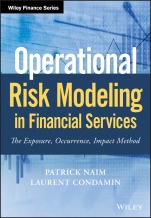
Operational Risk Modeling in Financial Services: The Exposure, Occurrence, Impact Method
ISBN 9781119508502
Autor: Patrick Naim, Laurent Condamin
Wydawca: Wiley
Dostępność: 3-6 tygodni
Cena: 286,65 zł
Przed złożeniem zamówienia prosimy o kontakt mailowy celem potwierdzenia ceny.
ISBN13: |
9781119508502 |
ISBN10: |
1119508509 |
Autor: |
Patrick Naim, Laurent Condamin |
Oprawa: |
Hardback |
Rok Wydania: |
2019-04-05 |
Ilość stron: |
320 |
Wymiary: |
249x177 |
Tematy: |
KF |
Transform your approach to oprisk modelling with a proven, non-statistical methodology Operational Risk Modeling in Financial Services provides risk professionals with a forward-looking approach to risk modelling, based on structured management judgement over obsolete statistical methods. Proven over a decade's use in significant banks and financial services firms in Europe and the US, the Exposure, Occurrence, Impact (XOI) method of operational risk modelling played an instrumental role in reshaping their oprisk modelling approaches; in this book, the expert team that developed this methodology offers practical, in-depth guidance on XOI use and applications for a variety of major risks. The Basel Committee has dismissed statistical approaches to risk modelling, leaving regulators and practitioners searching for the next generation of oprisk quantification. The XOI method is ideally suited to fulfil this need, as a calculated, coordinated, consistent approach designed to bridge the gap between risk quantification and risk management. This book details the XOI framework and provides essential guidance for practitioners looking to change the oprisk modelling paradigm. Survey the range of current practices in operational risk analysis and modelling Track recent regulatory trends including capital modelling, stress testing and more Understand the XOI oprisk modelling method, and transition away from statistical approaches Apply XOI to major operational risks, such as disasters, fraud, conduct, legal and cyber risk The financial services industry is in dire need of a new standard -- a proven, transformational approach to operational risk that eliminates or mitigates the common issues with traditional approaches. Operational Risk Modeling in Financial Services provides practical, real-world guidance toward a more reliable methodology, shifting the conversation toward the future with a new kind of oprisk modelling.
Author Biography: PATRICK NAIM (left) is the CEO of Elseware and widely recognized as an expert for operational risk modeling and quantification. Patrick has extensive experience in advising banks, insurance and energy companies for over 20 years in Continental Europe, the United Kingdom, and North America. He is also the author of Risk Quantification: Management, Diagnosis and Hedging and Bayesian Networks: a Practical Guide to Applications, both from Wiley. LAURENT CONDAMIN (right), PHD, is Managing Partner and Researcher at Elseware. For the past 10 years, he has been advising the largest financial institutions. His areas of expertise are operational risk modeling, stress testing, credit rating modeling, project risk analysis, insurance coverage optimization and cost-benefit analysis.
List of Figures xi List of Tables xv Foreword xix Preface xxi Part One Lessons Learned in 10 Years of Practice Chapter 1 Creation of the Method 3 1.1 From Artificial Intelligence to Risk Modelling 3 1.2 Model Losses or Risks? 5 Chapter 2 Introduction to the XOI Method 7 2.1 A Risk Modelling Doctrine 7 2.2 A Knowledge Management Process 8 2.3 The eXposure, Occurrence, Impact (XOI) Approach 9 2.4 The Return of AI: Bayesian Networks for Risk Assessment 10 Chapter 3 Lessons Learned in 10 Years of Practice 13 3.1 Risk and Control Self-Assessment 13 3.2 Loss Data 24 3.3 Quantitative Models 30 3.4 Scenarios Workshops 36 3.5 Correlations 41 3.6 Model Validation 47 Part Two Challenges of Operational Risk Measurement Chapter 4 Definition and Scope of Operational Risk 57 4.1 On Risk Taxonomies 57 4.2 Definition of Operational Risk 68 Chapter 5 The Importance of Operational Risk 71 5.1 The Importance of Losses 71 5.2 The Importance of Operational Risk Capital 74 5.3 Adequacy of Capital to Losses 76 Chapter 6 The Need for Measurement 77 6.1 Regulatory Requirements 77 6.2 Nonregulatory Requirements 82 Chapter 7 The Challenges of Measurement 93 7.1 Introduction 93 7.2 Measuring Risk or Measuring Risks? 93 7.3 Requirements of a Risk Measurement Method 95 7.4 Risk Measurement Practices 98 Part Three The Practice of Operational Risk Management Chapter 8 Risk and Control Self-Assessment 105 8.1 Introduction 105 8.2 Risk and Control Identification 107 8.3 Risk and Control Assessment 113 Chapter 9 Losses Modelling 121 9.1 Loss Distribution Approach 122 9.2 Loss Regression 134 Chapter 10 Scenario Analysis 137 10.1 Scope of Scenario Analysis 137 10.2 Scenario Identification 150 10.3 Scenario Assessment 163 Part Four The Exposure, Occurrence, Impact Method Chapter 11 An Exposure-Based Model 179 11.1 A Tsunami Is Not an Unexpectedly Big Wave 179 11.2 Using Available Knowledge to Inform Risk Analysis 180 11.3 Structured Scenarios Assessment 181 11.4 The XOI Approach: Exposure, Occurrence, and Impact 182 Chapter 12 Introduction to Bayesian Networks 185 12.1 A Bit of History 185 12.2 A Bit of Theory 186 12.3 Influence Diagrams and Decision Theory 187 12.4 Introduction to Inference in Bayesian Networks 187 12.5 Introduction to Learning in Bayesian Networks 189 Chapter 13 Bayesian Networks for Risk Measurement 191 13.1 An Example in Car Fleet Management 191 Chapter 14 The XOI Methodology 203 14.1 Structure Design 203 14.2 Quantification 209 14.3 Simulation 214 Chapter 15 A Scenario in Internal Fraud 219 15.1 Introduction 219 15.2 XOI Modelling 219 Chapter 16 A Scenario in Cyber Risk 227 16.1 Definition 227 16.2 XOI Modelling 234 Chapter 17 A Scenario in Conduct Risk 239 17.1 Definition 239 17.2 Types of Misconduct 241 17.3 XOI Modelling 246 Chapter 18 Aggregation of Scenarios 255 18.1 Introduction 255 18.2 Influence of a Scenario on an Environment Factor 257 18.3 Influence of an Environment Factor on a Scenario 258 18.4 Combining the Influences 261 18.5 Turning the Dependencies into Correlations 262 Chapter 19 Applications 265 19.1 Introduction 265 19.2 Regulatory Applications 267 19.3 Risk Management 278 Chapter 20 A Step towards "Oprisk Metrics" 287 20.1 Introduction 287 20.2 Building Exposure Units Tables 288 20.3 Sources for Driver Quantification 289 20.4 Conclusion 290 Index 291
Koszyk
Książek w koszyku: 0 szt.
Wartość zakupów: 0,00 zł
Informacje


Kontakt
Gambit
Centrum Oprogramowania
i Szkoleń Sp. z o.o.
Al. Pokoju 29b/22-24
31-564 Kraków
Siedziba Księgarni
ul. Kordylewskiego 1
31-542 Kraków
+48 12 410 5991
+48 12 410 5987
+48 12 410 5989
Subskrypcje
Administratorem danych osobowych jest firma Gambit COiS Sp. z o.o. Na podany adres będzie wysyłany wyłącznie biuletyn informacyjny.
Autoryzacja płatności

Informacje na temat autoryzacji płatności poprzez PayU.

© Copyright 2012: GAMBIT COiS Sp. z o.o. Wszelkie prawa zastrzeżone.
Projekt i wykonanie: Alchemia Studio Reklamy