


Wydawcy
Katalog tematyczny
- Archeologia (109)
- Ekonomia, finanse, business (13704)
- Filozofia (1445)
- Historia (3040)
- Języki i językoznawstwo (2356)
- Lifestyle, hobby i rozrywka (475)
- Medycyna (9704)
- Nauki humanistyczne (4)
- Nauki o Ziemi i środowisku (2638)
- Nauki ścisłe (20412)
- Nauki społeczne (8486)
- Nauki techniczne (13450)
- Prawo (1696)
- Publikacje informacyjne i interdyscyplinarne (1288)
- Religia i wierzenia (917)
- Technika komputerowa (4067)
- Zdrowie, relacje międzyludzkie i rozwój osobisty (657)





Informacje szczegółowe o książce
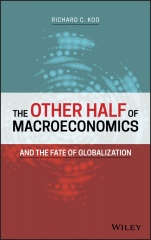
The Other Half of Macroeconomics and the Fate of Globalization
ISBN 9781119482154
Autor: Richard C. Koo
Wydawca: Wiley
Dostępność: 3-6 tygodni
Cena: 205,80 zł
Przed złożeniem zamówienia prosimy o kontakt mailowy celem potwierdzenia ceny.
ISBN13: |
9781119482154 |
ISBN10: |
1119482151 |
Autor: |
Richard C. Koo |
Oprawa: |
Hardback |
Rok Wydania: |
2018-02-23 |
Ilość stron: |
320 |
Wymiary: |
242x153 |
Tematy: |
KC |
PRAISE FOR THE OTHER HALF OF MACROECONOMICS
"Richard Koo has had some of the most important economic ideas of the last two decades. This book extends his important perspective to a wider range of long–run issues. Koo′s arguments deserve the attention of everyone who cares about achieving strong sustained economic growth in the industrial world."
Lawrence H. Summers, Charles W. Eliot University Professor, Harvard University
"Richard Koo is the most important economist of our time because he alone has devised a revolutionary framework that accurately explains the global economic crisis. His work is revolutionary not because it overthrows all the economic theory that preceded it, but rather because it completes it. Koo′s policy prescriptions offer the world the best chance of restoring prosperity before this economic crisis becomes a political crisis and then a geopolitical crisis. The sooner our policymakers understand the implications of this extraordinary book and act upon them the safer we all will be."
Richard Duncan, Author, The Dollar Crisis; Publisher, Macro Watch
"Richard Koo is one of the most astute analysts of macroeconomic policies, showing that only fiscal policy is effective in balance sheet recessions. He now expands his view to the world economy and the history of advanced countries′ economic development, arguing that fiscal expansion is the only effective macroeconomic policy for the foreseeable future. But instead of John Maynard Keynes′ suggestion that burying money and digging it up helps, he argues forcibly that socially productive investments are needed for advanced economies to keep up with emerging ones."
Peter Temin, M.I.T.; Author, The Vanishing Middle Class: Prejudice and Power in a Dual Economy (2017)
"In the wake of the Great Recession, Richard Koo challenges us in his latest book to look at ′the other half of macroeconomics,′ one in which the primary concern of the private sector is to ′minimize debt′ rather than ′maximize profit.′ Koo brings a wealth of knowledge and real–world experience working in both the U.S. and East Asia to his discussion of the stages of economic development. I find his examples from Japan and China especially compelling. I warmly recommend this book."
Axel Leijonhufvud, Professor Emeritus, UCLA and University of Trento, Italy
"Richard Koo′s The Other Half of Macroeconomics and the Fate of Globalization will soon rival Piketty′s Capital as the economics book to–date of our century. Koo′s book, as its title suggests, divides in half. The first, like John Maynard Keynes′ The General Theory, deeply subverts traditional economic theory. The second, like Karl Polanyi′s The Great Transformation, sets out a new analysis of recent economic history and maps a new fork in the road to humankind′s future. Except for dogmatists and anti–humanitarians, it is required reading."
Edward Fullbrook, Founder, World Economics Association; Editor, Real–World Economics Review
"Anyone who has a deep interest in globalization should read this book. It is at one time thoughtful, analytical, original, policy–relevant and highly engaging."
Jeffrey E. Garten, Dean and Professor Emeritus, Yale University School of Management
"The Great Depression produced Keynes, and the Great Recession produced Koo. With this book, he not only ushers economic analysis into the 21st century but also goes back centuries to show what has been missing in economics all along. This highly accessible book contains new insights worthy of a Nobel Prize."
Shousaku Murayama, CEO, iPS Academia Japan, Kyoto University; former Research Director, Bank of Japan
Preface ix
About the Author xiii
CHAPTER 1 Introduction to the Other Half of Macroeconomics 1
CHAPTER 2 Balance Sheet Problems Create Shortage of Borrowers 17
CHAPTER 3 Dearth of Investment Opportunities Can Deter Borrowers 53
CHAPTER 4 Macroeconomic Policy During the Three Stages of Economic Development 83
CHAPTER 5 Challenges of Remaining an Advanced Country 107
CHAPTER 6 Helicopter Money and the QE Trap 127
CHAPTER 7 Europe Repeating Mistakes of 1930s 169
CHAPTER 8 Banking Problems in the Other Half of Macroeconomics 195
CHAPTER 9 The Trump Phenomenon and the Conflict Between Free Capital Flows and Free Trade 225
CHAPTER 10 Rethinking Economics 257
References & Bibliography 281
Afterword 287
Index 289
RICHARD C. KOO is the Chief Economist of Nomura Research Institute, where he is responsible for providing independent economic and market analysis to Nomura Securities, the leading securities house in Japan, and its clients. Best known for his theory of balance sheet recessions, Koo has advised several Japanese prime ministers over the last thirty years, and for the past ten years, he has advised numerous Western governments and central banks on how best to address post–bubble economic and banking problems. Before joining Nomura in 1984, Richard, a US citizen, was an economist with the Federal Reserve Bank of New York. Prior to that, he was a Doctoral Fellow of the Board of Governors of the Federal Reserve System. In addition to being one of the first non–Japanese to participate in the development of Japan′s five–year economic plan, he taught at Waseda University in Tokyo as a visiting professor and is now a Senior Advisor to the Center for Strategic and International Studies in Washington, D.C.
Koszyk
Książek w koszyku: 0 szt.
Wartość zakupów: 0,00 zł
Informacje


Kontakt
Gambit
Centrum Oprogramowania
i Szkoleń Sp. z o.o.
Al. Pokoju 29b/22-24
31-564 Kraków
Siedziba Księgarni
ul. Kordylewskiego 1
31-542 Kraków
+48 12 410 5991
+48 12 410 5987
+48 12 410 5989
Subskrypcje
Administratorem danych osobowych jest firma Gambit COiS Sp. z o.o. Na podany adres będzie wysyłany wyłącznie biuletyn informacyjny.
Autoryzacja płatności

Informacje na temat autoryzacji płatności poprzez PayU.

© Copyright 2012: GAMBIT COiS Sp. z o.o. Wszelkie prawa zastrzeżone.
Projekt i wykonanie: Alchemia Studio Reklamy