


Wydawcy
Katalog tematyczny
- Archeologia (109)
- Ekonomia, finanse, business (13704)
- Filozofia (1445)
- Historia (3040)
- Języki i językoznawstwo (2356)
- Lifestyle, hobby i rozrywka (475)
- Medycyna (9704)
- Nauki humanistyczne (4)
- Nauki o Ziemi i środowisku (2638)
- Nauki ścisłe (20412)
- Nauki społeczne (8486)
- Nauki techniczne (13450)
- Budownictwo lądowe (1045)
- Chemia przemysłowa (2258)
- Elektronika i telekomunikacja (3287)
- Energetyka (1122)
- Inne nauki stosowane (363)
- Inżynieria biochemiczna (507)
- Inżynieria transportu (232)
- Mechanika i materiały (3316)
- Nauka o środowisku (321)
- Rolnictwo (507)
- Technika, ogólnie (475)
- Prawo (1696)
- Publikacje informacyjne i interdyscyplinarne (1288)
- Religia i wierzenia (917)
- Technika komputerowa (4067)
- Zdrowie, relacje międzyludzkie i rozwój osobisty (657)





Informacje szczegółowe o książce
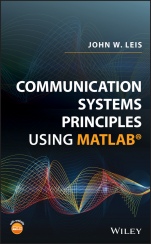
Communication Systems Principles Using MATLAB
ISBN 9781119470670
Autor: John W. Leis
Wydawca: Wiley
Dostępność: 3-6 tygodni
Cena: 603,75 zł
Przed złożeniem zamówienia prosimy o kontakt mailowy celem potwierdzenia ceny.
ISBN13: |
9781119470670 |
ISBN10: |
1119470676 |
Autor: |
John W. Leis |
Oprawa: |
Hardback |
Rok Wydania: |
2018-11-30 |
Ilość stron: |
576 |
Wymiary: |
232x166 |
Tematy: |
TJ |
Discover the basic telecommunications systems principles in an accessible learn–by–doing format
Communication Systems Principles Using MATLAB covers a variety of systems principles in telecommunications in an accessible format without the need to master a large body of theory. The text puts the focus on topics such as radio and wireless modulation, reception and transmission, wired networks and fiber optic communications. The book also explores packet networks and TCP/IP as well as digital source and channel coding, and the fundamentals of data encryption.
Since MATLAB® is widely used by telecommunications engineers, it was chosen as the vehicle to demonstrate many of the basic ideas, with code examples presented in every chapter. The text addresses digital communications with coverage of packet–switched networks. Many fundamental concepts such as routing via shortest–path are introduced with simple and concrete examples. The treatment of advanced telecommunications topics extends to OFDM for wireless modulation, and public–key exchange algorithms for data encryption. Throughout the book, the author puts the emphasis on understanding rather than memorization. The text also:
Includes many useful take–home skills that can be honed while studying each aspect of telecommunications Offers a coding and experimentation approach with many real–world examples provided Gives information on the underlying theory in order to better understand conceptual developments Suggests a valuable learn–by–doing approach to the topicWritten for students of telecommunications engineering, Communication Systems Principles Using MATLAB® is the hands–on resource for mastering the basic concepts of telecommunications in a learn–by–doing format.
Preface
Acknowledgments
Introduction
About the companion website
Chapter 1 Signals & Systems
1.1 Chapter Objectives
1.2 Introduction
1.3 Signals and Phase Shift
1.4 System Building Blocks
1.5 Integration & Differentiation of a Waveform
1.6 Generating Signals .
1.7 Measuring and Transferring Power
1.8 System Noise
1.9 Chapter Summary
1.10 Problems
Chapter 2 Wired,Wireless & Optical Systems
2.1 Chapter Objectives
2.2 Introduction .
2.3 Useful Preliminaries .
2.3.1 Frequency Components when a Signal Waveform is Known .
2.3.2 Frequency Spectrum when a Signal is Measured .
2.3.3 Measuring the Frequency Spectrum in Practice .
2.4 Wired Communications .
2.5 Radio and Wireless
2.6 Optical Transmission
2.7 Chapter Summary .
2.8 Problems .
Chapter 3 Modulation & Demodulation
3.1 Chapter Objectives
3.2 Introduction .
3.3 Useful Preliminaries .
3.4 The Need for Modulation .
3.5 Amplitude Modulation .
3.6 Frequency and Phase Modulation .
3.7 Phase Tracking and Synchronization .
3.8 Demodulation using IQ Methods
3.9 Modulation for Digital Transmission
3.10 Chapter Summary
3.11 Problems
Chapter 4 Internet Protocols & Packet Delivery Algorithms
4.1 Chapter Objectives
4.2 Introduction
4.3 Useful Preliminaries
4.4 Packets, Protocol Layers and the Protocol Stack
4.5 Local Area Networks
4.6 Device Packet Delivery: Internet Protocol
4.7 Network Access Configuration .
4.8 Application Packet Delivery: TCP and UDP
4.9 TCP: Reliable Delivery and Network Fairness
4.10 Packet Routing
4.11 Chapter Summary
4.12 Problems
Chapter 5 Quantization & Coding
5.1 Chapter Objectives
5.2 Introduction
5.3 Useful Preliminaries .
5.4 Digital Channel Capacity
5.5 Quantization
5.6 Source Coding
5.7 Image Coding .
5.8 Speech & Audio Coding .
5.9 Chapter Summary
5.10 Problems
Chapter 6 Data Transmission & Integrity
6.1 Chapter Objectives
6.2 Introduction
6.3 Useful Preliminaries .
6.4 Bit Errors in Digital Systems
6.5 Approaches to Block Error Detection
6.6 Encryption & Security
6.7 Chapter Summary
6.8 Problems
Index
John Leis, PhD, is an Associate Professor of Electrical and Computer Engineering at the University of Southern Queensland. He has authored many technical papers in areas involving signal processing and networking. Dr. Leis′s interests include signal processing for data compression and coding, medical signal processing, and advanced instrumentation using signal processing algorithms. He has collaborated internationally on various research projects. Dr. Leis has taught the subject material extensively in Australia and also Singapore. He is a Senior Member of the Institution of Electrical & Electronic Engineers and a Member of the Association for Computing Machinery.
Koszyk
Książek w koszyku: 0 szt.
Wartość zakupów: 0,00 zł
Informacje


Kontakt
Gambit
Centrum Oprogramowania
i Szkoleń Sp. z o.o.
Al. Pokoju 29b/22-24
31-564 Kraków
Siedziba Księgarni
ul. Kordylewskiego 1
31-542 Kraków
+48 12 410 5991
+48 12 410 5987
+48 12 410 5989
Subskrypcje
Administratorem danych osobowych jest firma Gambit COiS Sp. z o.o. Na podany adres będzie wysyłany wyłącznie biuletyn informacyjny.
Autoryzacja płatności

Informacje na temat autoryzacji płatności poprzez PayU.

© Copyright 2012: GAMBIT COiS Sp. z o.o. Wszelkie prawa zastrzeżone.
Projekt i wykonanie: Alchemia Studio Reklamy