


Wydawcy
Katalog tematyczny
- Archeologia (109)
- Ekonomia, finanse, business (13704)
- Filozofia (1445)
- Historia (3040)
- Języki i językoznawstwo (2356)
- Lifestyle, hobby i rozrywka (475)
- Medycyna (9704)
- Nauki humanistyczne (4)
- Nauki o Ziemi i środowisku (2638)
- Nauki ścisłe (20412)
- Nauki społeczne (8486)
- Nauki techniczne (13450)
- Budownictwo lądowe (1045)
- Chemia przemysłowa (2258)
- Elektronika i telekomunikacja (3287)
- Energetyka (1122)
- Inne nauki stosowane (363)
- Inżynieria biochemiczna (507)
- Inżynieria transportu (232)
- Mechanika i materiały (3316)
- Nauka o środowisku (321)
- Rolnictwo (507)
- Technika, ogólnie (475)
- Prawo (1696)
- Publikacje informacyjne i interdyscyplinarne (1288)
- Religia i wierzenia (917)
- Technika komputerowa (4067)
- Zdrowie, relacje międzyludzkie i rozwój osobisty (657)





Informacje szczegółowe o książce
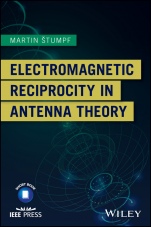
Electromagnetic Reciprocity in Antenna Theory
ISBN 9781119466376
Autor: Martin Stumpf
Wydawca: Wiley
Dostępność: 3-6 tygodni
Cena: 300,30 zł
Przed złożeniem zamówienia prosimy o kontakt mailowy celem potwierdzenia ceny.
ISBN13: |
9781119466376 |
ISBN10: |
1119466377 |
Autor: |
Martin Stumpf |
Oprawa: |
Paperback |
Rok Wydania: |
2018-02-13 |
Ilość stron: |
130 |
Wymiary: |
234x156 |
Tematy: |
TJ |
Provides a self–contained account on applications of electromagnetic reciprocity theorems to multiport antenna systems
The reciprocity theorem is among the most intriguing concepts in wave field theory and has become an integral part of almost all standard textbooks on electromagnetic (EM) theory. This book makes use of the theorem to quantitatively describe EM interactions concerning general multiport antenna systems. It covers a general reciprocity–based description of antenna systems, their EM scattering properties, and further related aspects.
Beginning with an introduction to the subject, Electromagnetic Reciprocity in Antenna Theory provides readers first with the basic prerequisites before offering coverage of the equivalent multiport circuit antenna representations, EM coupling between multiport antenna systems and their EM interactions with scatterers, accompanied with the corresponding EM compensation theorems.
In addition, the text:
Presents basic prerequisites including the definition of the notation, integral transformations, and EM reciprocity theorems in their general form Explores multiport antenna forward–scattering theorem, multiport antenna matching theorem and uniqueness theorem Supplements each chapter with a solved illustrative exampleElectromagnetic Reciprocity in Antenna Theory is an excellent text for EMC and antenna researchers and students of the subject as well.
Introduction xi
1 Basic Prerequisites 1
1.1 Laplace Transformation 3
1.2 Time Convolution 4
1.3 Time Correlation 5
1.4 EMReciprocity Theorems 6
1.4.1 Reciprocity Theorem of the Time–Convolution Type 8
1.4.2 Reciprocity Theorem of the Time–Correlation Type 9
1.4.3 Application of the Reciprocity Theorems to an Unbounded Domain 11
1.5 Description of the Antenna Configuration 13
1.5.1 Antenna Power Conservation 14
1.5.2 Antenna Interface Relations 16
2 Antenna Uniqueness Theorem 19
2.1 Problem Description 19
2.2 Problem Solution 19
3 Forward–Scattering Theorem in Antenna Theory 23
3.1 Problem Description 23
3.2 Problem Solution 23
4 Antenna Matching Theorems 31
4.1 Reciprocity Analysis of the Time–Correlation Type 31
4.1.1 Transmitting State 31
4.1.2 Receiving State 34
4.1.3 EquivalentMatching Condition 35
5 Equivalent Kirchhoff Network Representations of a Receiving Antenna System 41
5.1 Reciprocity Analysis of the Time–Convolution Type 41
5.1.1 Equivalent Circuits for Plane–Wave Incidence 41
5.1.2 Equivalent Circuits for a Known Volume–Current Distribution 45
6 The Antenna Systemin the Presence of a Scatterer 51
6.1 Receiving Antenna in the Presence of a Scatterer 51
6.2 Transmitting Antenna in the Presence of a Scatterer 56
6.2.1 Analysis Based on the Reciprocity Theorem of the Time–Convolution Type 57
6.2.2 Analysis Based on the Reciprocity Theorem of the Time–Correlation Type 59
7 EMCoupling Between Two Multiport Antenna Systems 65
7.1 Description of the Problem Configuration 65
7.2 Analysis Based on the Reciprocity Theorem of the Time–Convolution Type 68
7.3 Analysis Based on the Reciprocity Theorem of the Time–Correlation Type 71
8 Compensation Theorems for the EMCoupling Between Two Multiport Antennas 77
8.1 Description of the Problem Configuration 77
8.2 Analysis Based on the Reciprocity Theorem of the Time–Convolution Type 79
8.2.1 The Change in Scenario (BA) 79
8.2.2 The Change in Scenario (AB) 82
8.3 Analysis Based on the Reciprocity Theorem of the Time–Correlation Type 85
8.3.1 The Change in Scenario (BA) 85
8.3.2 The Change in Scenario (AB) 88
9 Compensation Theorems for the EMScattering of an Antenna System 95
9.1 Description of the Problem Configuration 95
9.2 Reciprocity Analysis 96
9.2.1 Compensation Theorems in Terms of Electric Current–excited Sensing EM Fields 99
9.2.2 Compensation Theorems in Terms of Voltage–Excited Sensing EM Fields 100
9.2.3 Power Reciprocity Expressions 101
AppendixA Lerch s Uniqueness Theorem 107
A.1 Problem ofMoments 107
A.2 Proof of Lerch s Theorem 108
References 111
Index 115
Martin tumpf, PhD, is an Associate Professor at SIX Research Centre, Brno University of Technology, Brno, The Czech Republic. His research interests include analytical and numerical modeling of wave field phenomena with an emphasis on electromagnetic compatibility and antenna engineering. He is a member of the IEEE and the IEEE Electromagnetic Compatibility Society.
Koszyk
Książek w koszyku: 0 szt.
Wartość zakupów: 0,00 zł
Informacje


Kontakt
Gambit
Centrum Oprogramowania
i Szkoleń Sp. z o.o.
Al. Pokoju 29b/22-24
31-564 Kraków
Siedziba Księgarni
ul. Kordylewskiego 1
31-542 Kraków
+48 12 410 5991
+48 12 410 5987
+48 12 410 5989
Subskrypcje
Administratorem danych osobowych jest firma Gambit COiS Sp. z o.o. Na podany adres będzie wysyłany wyłącznie biuletyn informacyjny.
Autoryzacja płatności

Informacje na temat autoryzacji płatności poprzez PayU.

© Copyright 2012: GAMBIT COiS Sp. z o.o. Wszelkie prawa zastrzeżone.
Projekt i wykonanie: Alchemia Studio Reklamy