


Wydawcy
Katalog tematyczny
- Archeologia (109)
- Ekonomia, finanse, business (13704)
- Filozofia (1445)
- Historia (3040)
- Języki i językoznawstwo (2356)
- Lifestyle, hobby i rozrywka (475)
- Medycyna (9704)
- Nauki humanistyczne (4)
- Nauki o Ziemi i środowisku (2638)
- Nauki ścisłe (20412)
- Nauki społeczne (8486)
- Nauki techniczne (13450)
- Budownictwo lądowe (1045)
- Chemia przemysłowa (2258)
- Elektronika i telekomunikacja (3287)
- Energetyka (1122)
- Inne nauki stosowane (363)
- Inżynieria biochemiczna (507)
- Inżynieria transportu (232)
- Mechanika i materiały (3316)
- Nauka o środowisku (321)
- Rolnictwo (507)
- Technika, ogólnie (475)
- Prawo (1696)
- Publikacje informacyjne i interdyscyplinarne (1288)
- Religia i wierzenia (917)
- Technika komputerowa (4067)
- Zdrowie, relacje międzyludzkie i rozwój osobisty (657)





Informacje szczegółowe o książce
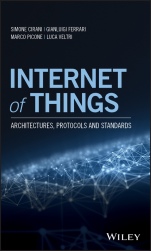
Internet of Things: Architectures, Protocols and Standards
ISBN 9781119359678
Autor: Simone Cirani, Gianluigi Ferrari, Marco Picone, Luca Veltri
Wydawca: Wiley
Dostępność: 3-6 tygodni
Cena: 565,95 zł
Przed złożeniem zamówienia prosimy o kontakt mailowy celem potwierdzenia ceny.
ISBN13: |
9781119359678 |
ISBN10: |
1119359678 |
Autor: |
Simone Cirani, Gianluigi Ferrari, Marco Picone, Luca Veltri |
Oprawa: |
Hardback |
Rok Wydania: |
2018-11-16 |
Ilość stron: |
408 |
Wymiary: |
219x158 |
Tematy: |
TJ |
Explores the main IoT topics of Connectivity, Interoperability, Discoverability, and Security/Privacy, and examines the existing technologies, protocols, and architectures
This book addresses researchers and graduate students at the forefront of study/research on the Internet of Things (IoT) by presenting state–of–the–art research together with the current and future challenges in building new smart applications (e.g., Smart Cities, Smart Buildings, and Industrial IoT) in an efficient, scalable, and sustainable way. It covers the main pillars of the IoT world (Connectivity, Interoperability, Discoverability, and Security/Privacy), providing a comprehensive look at the current technologies, procedures, and architectures.
Internet of Things: Architectures, Protocols and Standards starts with an overview and a discussion about the integration of IoT technologies with Cloud and Fog Computing paradigms and how this vision will play a fundamental role in the design and deployment of large scale IoT applications. The last part is dedicated to the application of all the concepts and standards into real world use cases, in order to provide beneficial insights that can be used as design examples and guidelines. It also presents the definition of classes of IoT Constrained Devices in terms of Hardware and Software and an experimental analysis related to the creation and deployment of an IoT testbed with heterogeneous devices.
Delves into the key topics of the Internet of Things Explores a hot topic that will be relevant for years to come due to its integration with Industrial Internet and Industry 4.0 Examines current research along with the challenges in creating efficient, scalable, and sustainable smart applications for the future Looks at practical aspects of integrating IoT on different classes of devices Includes an accompanying website: www.wiley.com/go/archi17Internet of Things: Architectures, Protocols and Standards will appeal to researchers, engineers, and graduate students working directly in IoT areas as well as those in computer engineering and software development.
1 Preliminaries, Motivation, and Related Work 1
1.1 What is the Internet of Things? 1
1.2 Wireless Ad–hoc and Sensor Networks: the Ancestors without IP 1
1.3 IoT–enabled applications 2
1.3.1 Home and Building Automation 3
1.3.2 Smart Cities 3
1.3.3 Smart Grid 3
1.3.4 Industrial IoT 4
1.3.5 Smart Farming 5
2 Standards 7
2.1 Traditional Internet review 7
2.1.1 Physical/Link Layer 8
2.1.2 Network Layer 11
2.1.3 Transport Layer 13
2.1.4 Application Layer 16
2.2 Internet of Things 19
2.2.1 Architecting an IP–based Internet of Things 20
2.2.2 Physical/Link Layer 21
2.2.3 Network Layer 25
2.2.4 Transport Layer 26
2.2.5 Application Layer 26
2.3 Industrial Internet of Things 59
3 Interoperability 61
3.1 Applications in the Internet of Things 61
3.2 The verticals: Cloud–based solutions 61
3.3 REST architectures: the Web of Things 63
3.3.1 REST: the Web as a platform 64
3.3.2 Richardson maturity model 68
3.4 The Web of Things 76
3.5 Messaging Queues and Publish/Subscribe Communications 77
3.5.1 Advantages of Pub/Sub 77
3.5.2 Disadvantages of Pub/Sub 78
3.5.3 MQTT 78
3.6 Session Initiation for the Internet of Things 80
3.6.1 Motivations 80
3.6.2 Lightweight Sessions in IoT 81
3.7 Performance Evaluation 86
3.7.1 Implementation 86
3.7.2 Experimental results 87
3.7.3 Conclusions 90
3.8 Optimized communications: a Data–driven IoT–oriented Dual–network Management Protocol 90
3.8.1 DNMP Motivations 91
3.8.2 Related Work 92
3.8.3 The DNMP Protocol 93
3.8.4 Implementation with IEEE 802.15.4 and IEEE 802.11s 97
3.8.5 Performance evaluation 99
3.8.6 IEEE 802.15.4–controlled Selective Activation of the IEEE 802.11s Network 103
3.8.7 Conclusions 104
3.9 Discoverability in Constrained Environments 105
3.9.1 CoRE Link Format 105
3.9.2 CoRE interfaces 108
3.10 Data formats – Media Types for Sensor Markup Language (SenML) 110
4 Discoverability 115
4.1 Service and Resource Discovery 115
4.2 Local and Large–scale Service Discovery 116
4.2.1 ZeroConf 119
4.2.2 UPnP 120
4.2.3 URI Beacons and the Physical Web 120
4.3 A scalable and self–configuring architecture for service discovery in the Internet of Things 122
4.3.1 IoT Gateway 123
4.3.2 A P2P–based Large Scale Service Discovery Architecture 126
4.3.3 Zeroconf–based Local Service Discovery for Constrained Environments 132
4.3.4 Implementation results 135
4.4 Lightweight Service Discovery in Low–power IoT Networks 142
4.4.1 E cient Forwarding Protocol for Service Discovery 144
4.4.2 E cient Multiple Unicast Forwarding 146
4.5 Implementation Results 148
5 Security and Privacy in the IoT 153
5.1 Security issues in the IoT 153
5.2 Security mechanisms overview 156
5.2.1 Traditional vs. Lightweight security 157
5.2.2 Lightweight cryptography 162
5.2.3 Key Agreement, Distribution, and Security Bootstrapping 173
5.2.4 Processing Data in the Encrypted Domain: Secure Data Aggregation 174
5.2.5 Authorization Mechanisms for Secure IoT Services 176
5.3 Privacy issues in the IoT (confidentiality, aggregation, pseudonymity and anonymity) 179
5.4 The role of authorization 179
5.4.1 IoT–OAS: A delegation–based authorization framework for the Internet of Things 182
5.4.2 Application Scenarios 187
6 Cloud and Fog Computing for the Internet of Things 191
6.1 Cloud Computing 191
6.2 Big Data Processing Pattern 192
6.3 Big Stream 193
6.3.1 Big Stream–Oriented Architecture 195
6.3.2 Graph–based Processing 198
6.3.3 Implementation 200
6.3.4 Performance Evaluation 207
6.3.5 Solutions and Security Considerations 209
6.4 Big Stream and Security 212
6.4.1 Graph–based Cloud System Security 213
6.4.2 Normalization after a Secure Stream Acquisition with OFS Module 215
6.4.3 Enhancing Application Register with IGS Module 216
6.4.4 Securing Stream inside Graph Nodes 218
6.4.5 Evaluation of a Secured Big Stream Architecture 221
6.5 Fog Computing and IoT 225
6.6 The Role of the IoT Hub 227
6.6.1 Virtualization and Replication 228
7 IoT in Practice 243
7.1 Hardware for the IoT 243
7.1.1 Classes of Constrained Devices 245
7.1.2 Hardware Platforms 246
7.2 Software for the IoT 256
7.2.1 Contiki OS 259
7.3 Vision and Architecture of a Testbed for the Web of Things 261
7.3.1 An All IP–based Infrastructure for Smart Objects 264
7.3.2 Enabling interactions with Smart Objects through the IoT Hub 265
7.3.3 Testbed Access and Security 267
7.3.4 Exploiting the Testbed: Building WoT Applications for Mobile and Wearable Devices 268
7.3.5 Open Challenges and Future Vision 270
7.4 Wearable Computing for the Internet of Things: Interaction Patterns with Smart Objects in RESTful Environments 271
7.4.1 Shaping the Internet of Things in a Mobile–Centric World 271
7.4.2 Interaction Patterns with Smart Objects through Wearable Devices 272
7.4.3 Implementation in a real–world IoT testbed 275
7.5 E ective Authorization for the Web of Things 278
7.5.1 Authorization Framework Architecture 281
7.5.2 Implementation and Validation 283
Simone Cirani, PhD, is a Co–Founder and Head of IoT at Caligoo Inc., Chicago, IL, USA.
Gianluigi Ferrari, PhD, is a Faculty Member at the Department of Engineering of Architecture, at the University of Parma, Italy. He is also Co–founder and President of things2i s.r.l., Parma, Italy.
Marco Picone, PhD, is a Co–Founder and Head of Mobile Computing at Caligoo Inc., Chicago, IL, USA.
Luca Veltri, PhD, is a Faculty Member at the Department of Engineering and Architecture, at the University of Parma, Italy.
Koszyk
Książek w koszyku: 0 szt.
Wartość zakupów: 0,00 zł
Informacje


Kontakt
Gambit
Centrum Oprogramowania
i Szkoleń Sp. z o.o.
Al. Pokoju 29b/22-24
31-564 Kraków
Siedziba Księgarni
ul. Kordylewskiego 1
31-542 Kraków
+48 12 410 5991
+48 12 410 5987
+48 12 410 5989
Subskrypcje
Administratorem danych osobowych jest firma Gambit COiS Sp. z o.o. Na podany adres będzie wysyłany wyłącznie biuletyn informacyjny.
Autoryzacja płatności

Informacje na temat autoryzacji płatności poprzez PayU.

© Copyright 2012: GAMBIT COiS Sp. z o.o. Wszelkie prawa zastrzeżone.
Projekt i wykonanie: Alchemia Studio Reklamy