


Wydawcy
Katalog tematyczny
- Archeologia (109)
- Ekonomia, finanse, business (13704)
- Filozofia (1445)
- Historia (3040)
- Języki i językoznawstwo (2356)
- Lifestyle, hobby i rozrywka (475)
- Medycyna (9704)
- Nauki humanistyczne (4)
- Nauki o Ziemi i środowisku (2638)
- Nauki ścisłe (20412)
- Nauki społeczne (8486)
- Nauki techniczne (13450)
- Prawo (1696)
- Publikacje informacyjne i interdyscyplinarne (1288)
- Religia i wierzenia (917)
- Technika komputerowa (4067)
- Zdrowie, relacje międzyludzkie i rozwój osobisty (657)





Informacje szczegółowe o książce
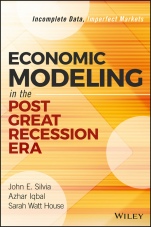
Economic Modeling in the Post Great Recession Era: Incomplete Data, Imperfect Markets
ISBN 9781119349839
Autor: John E. Silvia, Azhar Iqbal, Sarah Watt House
Wydawca: Wiley
Dostępność: 3-6 tygodni
Cena: 359,10 zł
Przed złożeniem zamówienia prosimy o kontakt mailowy celem potwierdzenia ceny.
ISBN13: |
9781119349839 |
ISBN10: |
1119349834 |
Autor: |
John E. Silvia, Azhar Iqbal, Sarah Watt House |
Oprawa: |
Hardback |
Rok Wydania: |
2017-03-03 |
Ilość stron: |
400 |
Wymiary: |
232x163 |
Tematy: |
KC |
PRAISE FOR ECONOMIC MODELING in the POST GREAT RECESSION ERA
"The years since the end of the Great Recession have been an era of disappointing economic performance in which the long–awaited (and long–expected) return to pre–recession trends has been slow to materialize. The authors of this fine new book develop the theme that the Great Recession marks a structural break that has had long–lasting effects on the trend paths of the economy and then explain and demonstrate how to construct useful econometric models that account for this new reality. Highly recommended!"
Rob Roy McGregor, Professor of Economics, Belk College of Business, UNC Charlotte
"John, Azhar, and Sarah′s book combines a practical examination of an imperfect economy with a focus on current issues of jobs, inflation, and credit markets. The book recognizes structural change in the 21st century economy and does not engage in wishful thinking hoping for a return to a simpler, idealized economic landscape. This is the type of thinking we need in the post Great Recession era."
Larry Kudlow, The Larry Kudlow Show, Kudlow & Co., LLC
"It has been well–documented that nobody has been more right about the economy since the Great Recession began than John Silvia. Anyone who wants to understand what has been going on, model it, or think about how to improve it, needs to read this book."
Kevin Hassett, Director of Economic Policy Studies, AEI
Preface/Justification
Acknowledgments
Chapter 1: Setting the Context
The Problem with Uncritical Assumptions in a Less Than Perfect Economy
The Problem with Models in an Imperfect Economy
Four Characteristics of a Less than Perfect Economy
Economic Policy Inconsistencies The Parable of Strange Bedfellows
Chapter 2: Dynamic Adjustment in an Economy: Frictions Matter
Introduction
Quantifying Frictions: Is the Long–run Average a Useful Guide for Future?
Modeling Dynamic Adjustment Due to Economic Frictions: Decision Making in an Evolving World
Dynamic Economic Adjustment: An Evolution Unto Itself
Appendix
Chapter 3: Information: Past Imperfect, Present Incomplete, Future Uncertain
Story Behind the Numbers
Conclusion
Chapter 4: Price Adjustment & Search for Equilibrium
What barriers are there to perfectly flexible prices?
Implications
Finding Dynamic Adjustment in the Data
Chapter 5: Business Investment
Drivers of Business Spending
Putting All Together: Explaining Slow Recovery in Capital Investment?
Chapter 6: Corporate Profits: Reward, Incentive and That Standard of Living
Introduction
The Role of Profits in the Economic Cycle: Five Drivers
The Role of Profits in the Economy
Concluding Remarks
Chapter 7: Labor Market Evolution: Implications for Private Sector and Public Policy Decision Makers
Labor Market Imperfections
Part II: Heterogeneity in the Labor Market
Part III: How Do Secular Labor Market Trends Impact Economic Policy?
Chapter 8: Inflation
Introduction
What Is Inflation?
Why Does Inflation Matter?
What Determines Inflation?
Inflation After the Great Recession
Application: Predicting If Central Banks Can Achieve Price Stability
Chapter 9: Interest Rates and Credit
Imperfect Guidance in an Uncertain World
A Look at Actual History over the Long–Run
Credit Section
Imperfect Information and Credit
The Policymaker s Catch–22 the Dynamic Inconsistency of Current Policy and Implications for Private Decision Makers
Predicting Yields Multivariate Analysis
Do Global Yields Correlate with U.S. Yields?
Credit Spreads: A Break with History
Patterns since the Great Recession: Corporate Debt Yields and Equity Earnings Case Against the Central Wisdom of Low Volatility
Identifying a Structural Break
Conclusion
Chapter 10: Three Dimensional Checkers: Open Economy, Capital Flows and Exchange Rates
Newton s Third law
Three Dimensional Checkers on an International Playing Field
A Perfect Model in an Imperfect World
A Model for Policy Not the Real World
Violation of Three Conditions for Perfect Competition
Imperfect Information and Price/Policy Maker Discovery
Persistent Disequilibrium in Prices and Exchange Rates Dynamic Adjustment Problem
Price Adjustments: Limits by Policymakers
Capital Flows and Treasury Yields in the Post–Great Recession Era
Is the Post–2007 Economy Structurally Different?
Tracking U.S. Capital Flows: What Has Changed?
Are Global Treasury Yields Mean–Reverting?
Concluding Remarks: Future Looks Different
Chapter 11: Assessing Economic Policy in an Imperfect Economy
Generalized Policy Model
Rules and Reputation: Beyond Economic Benchmarks
Confronting Our Three Market Imperfections
Economic Policy in the Context of an Imperfect Economy
About the Authors
Index
JOHN E. SILVIA is a managing director and the chief economist for Wells Fargo. Previously he worked on Capitol Hill as senior economist for the U.S. Senate Joint Economic Committee and chief economist for the U.S. Senate Banking, Housing, and Urban Affairs Committee.
AZHAR IQBAL is director and econometrician at Wells Fargo Securities.
SARAH WATT HOUSE is vice president of Wells Fargo Securities.
Koszyk
Książek w koszyku: 0 szt.
Wartość zakupów: 0,00 zł
Informacje


Kontakt
Gambit
Centrum Oprogramowania
i Szkoleń Sp. z o.o.
Al. Pokoju 29b/22-24
31-564 Kraków
Siedziba Księgarni
ul. Kordylewskiego 1
31-542 Kraków
+48 12 410 5991
+48 12 410 5987
+48 12 410 5989
Subskrypcje
Administratorem danych osobowych jest firma Gambit COiS Sp. z o.o. Na podany adres będzie wysyłany wyłącznie biuletyn informacyjny.
Autoryzacja płatności

Informacje na temat autoryzacji płatności poprzez PayU.

© Copyright 2012: GAMBIT COiS Sp. z o.o. Wszelkie prawa zastrzeżone.
Projekt i wykonanie: Alchemia Studio Reklamy